Becán is one of the most rewarding archaeological stops in southern Campeche. The ancient Maya city sits beside Federal Highway 186 in the Río Bec region, close to Xpujil and within easy reach of Chicanná, Balamkú, Xpuhil, and Calakmul. Its unusual defensive moat, monumental plazas, steep temple platforms, vaulted passage, and forest setting give the site a character that is different from both the large, remote city of Calakmul and the smaller architectural groups nearby.
The practical attraction is its manageable scale. You can reach the entrance without committing to the long reserve road required for Calakmul, yet Becán still offers enough architecture and history for a serious visit. It works well as a first southern-Campeche ruin, a half-day stop on a road trip, or one part of a two- or three-day itinerary based in Xpujil. It is also a useful choice when you want to understand Río Bec architecture without spending an entire day in transit.
This guide explains what makes Becán important, what you see on the route, how to get there, how long to allow, and how to combine it with nearby sites without turning the jungle corridor into a rushed checklist. Conditions, entry arrangements, monument access, and transport availability can change, so confirm current details with the official site before travelling.
What is Becán?
Becán was a major Maya settlement in the southeast of modern Campeche. It became a regional centre with large plazas, elevated platforms, palace-like buildings, temples, residential areas, and controlled entrances. The site is especially known for the ditch or moat that surrounds its central monumental area. INAH describes the fosse as an unusual feature in the Maya area, with seven entrances and a raised crossing that visitors use to enter the cleared archaeological zone.
The name is commonly associated with a path, hollow, or ravine formed by running water. It is also interpreted as a reference to the surrounding ditch, sometimes rendered as “path of the serpent.” The exact translation is less important than the physical relationship between name and landscape: at Becán, the boundary is visible. You do not simply walk from a modern parking area into an open field of ruins. You cross into an enclosed ancient core whose earthworks helped define movement and separation.
The city belongs to the Río Bec cultural and architectural area. Río Bec is not one single city but a regional tradition and network of settlements across southern Campeche. The architecture is associated with tall, steep-sided towers, elaborate façades, false stairways, and buildings that communicate royal or sacred power without functioning like ordinary climbable pyramids. Becán contains several of these visual ideas, but it is not identical to Xpuhil or Chicanná. Each site presents the regional style differently.
Becán’s main occupation extended across many centuries. The cleared monuments visible today represent a small part of a much larger settlement, and vegetation still shapes the experience. The forest hides the limits of the old city, softens the stone, and creates a cooler but humid setting beneath the canopy. Archaeology here is easier to read when you pay attention to spaces between buildings, not only to the tallest structure.
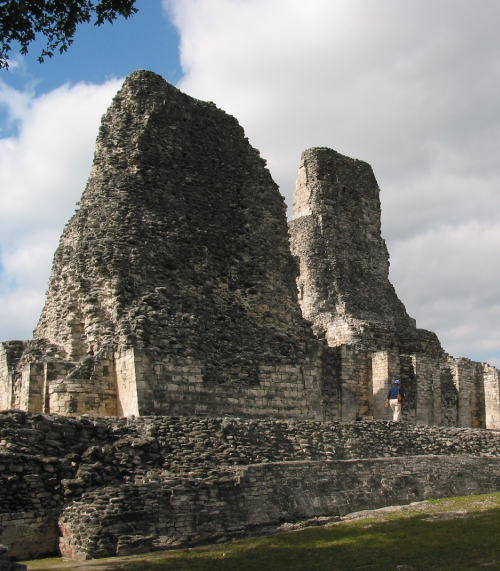
 A monumental Maya building in the central area of Becán, Campeche
Why the moat matters
The moat is the feature that makes Becán immediately different. It encircles the central part of the settlement and creates a broad perimeter around the most important buildings. Do not imagine a water-filled medieval castle moat. The feature is an excavated ditch and earthwork system in a limestone landscape, and its appearance varies along the route. In places it reads as a depression; elsewhere the raised edges and crossing make the boundary easier to understand.
Its purpose remains a subject of interpretation. A defensive function is possible, but the ditch may also have helped organise the city, mark a restricted ceremonial core, or communicate the power of the people who controlled entry. Archaeological features often served several purposes at once. A boundary can be practical and symbolic: it can slow movement while also telling visitors that the space inside is different from the surrounding settlement.
Crossing the ancient entrance gives the visit a useful opening sequence. First, you encounter the landscape and the ditch. Then you pass into a group of plazas and structures that feel more concentrated. This movement makes it easier to think about urban planning. Becán is not just a collection of pyramids placed among trees; it is a designed centre with thresholds, routes, courtyards, and buildings arranged around public space.
Look back toward the crossing after entering. The change in level and the line of the earthworks are often more legible from inside than from the road. If you arrive with a guide, ask how the site’s excavators distinguish the moat, natural drainage, platforms, and later modifications. That question leads to a more useful interpretation than simply asking whether the ditch was “for war.”
The main plazas and structures
The visitor route moves through several architectural groups rather than one single central pyramid. The exact route open to visitors may change, but the principal areas usually give you a strong sense of the site’s layout. The East Plaza is an important point of orientation. It is framed by major structures and contains the kind of open civic space that allowed movement, gatherings, ceremonies, and the display of authority.
Structure I, Structure II, Structure III, and Structure IV are associated with the East Plaza group. Their current appearance is the result of excavation, stabilisation, reconstruction, and the survival of original masonry. Some surfaces are clean and regular; others retain rough stone, collapsed sections, or weathered details. Those differences are not a flaw in the visit. They show how archaeological conservation balances readability with the need to avoid rebuilding what cannot be securely understood.
You will see broad platforms, stairways, rooms, roof remains, and high masses of stone. The scale is impressive without the overwhelming distances of Calakmul. Becán’s plazas make it possible to pause and compare buildings from one position. Stand in the open area and look at how the structures frame the space. Notice which façades face the plaza, where stairways direct attention, and how the forest interrupts the modern view.
The site includes a ballcourt. Its presence places Becán within a wider Mesoamerican pattern of ritual and political life, but avoid treating every ballcourt as a complete explanation of Maya culture. The court is one element in an urban centre that also required housing, food production, water management, administration, trade, and movement between communities. The strength of Becán is that these functions appear as parts of one planned landscape.
Some buildings have rooms and passageways that reward close looking. A corbel-vaulted passage shows how Maya builders used stone courses to narrow a roof over an interior corridor. The space is narrow, dark, and tactile. It is easy to walk past it while concentrating on the exterior monuments, so slow down when the route enters a covered or constricted area. The passage demonstrates that the city’s architecture was not only about huge public silhouettes; it also involved practical circulation through enclosed spaces.
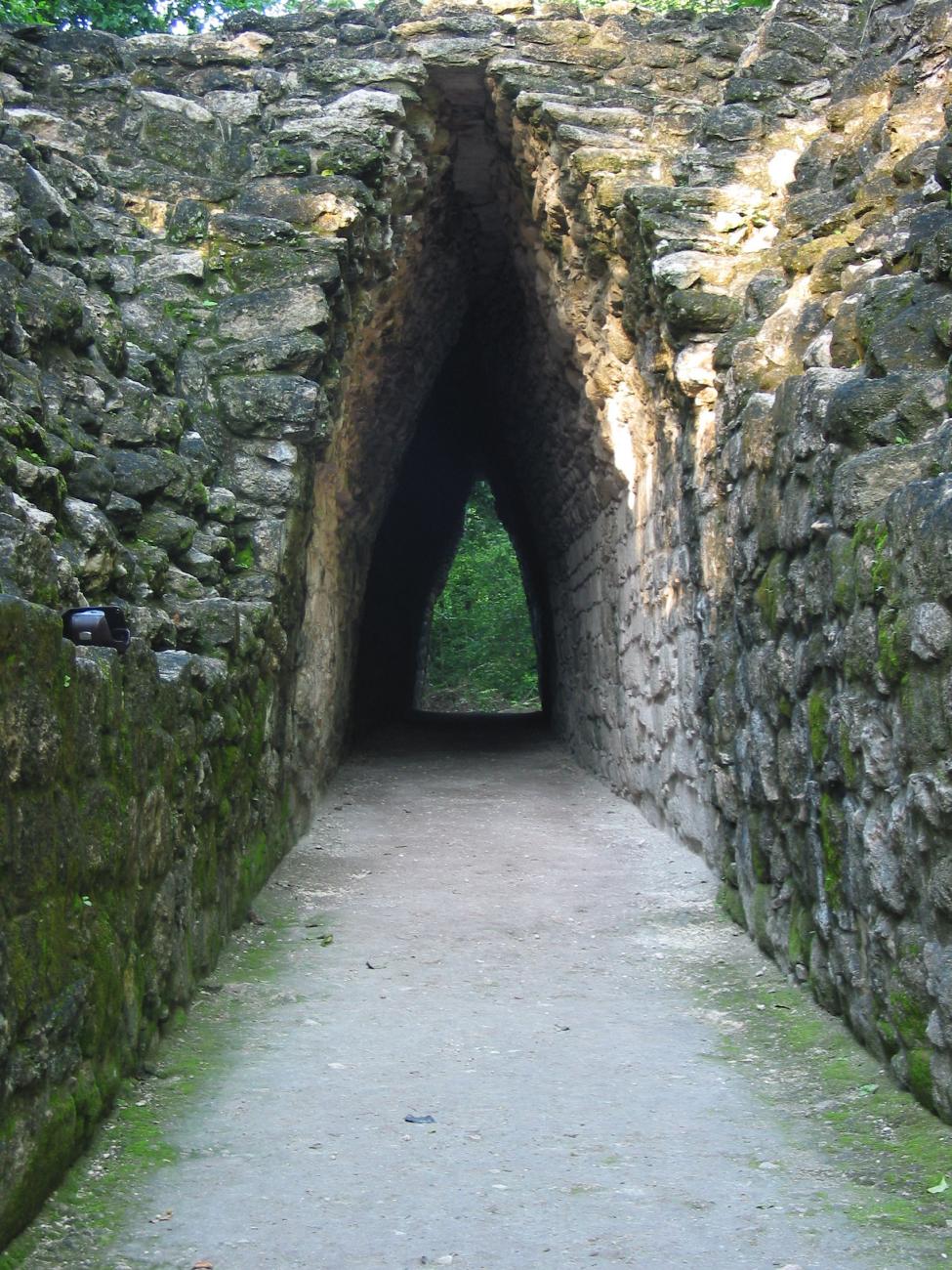 A vaulted passage inside the Maya archaeological zone of Becán, Campeche
Reading the upper architecture
The higher buildings deserve a second kind of attention. From below, their mass and height dominate the clearing; from closer range, the masonry reveals doorways, blocked openings, projecting stones, and layers of repair. The upper portions were designed to be seen across a plaza, but they also contain evidence of how the building changed over time.
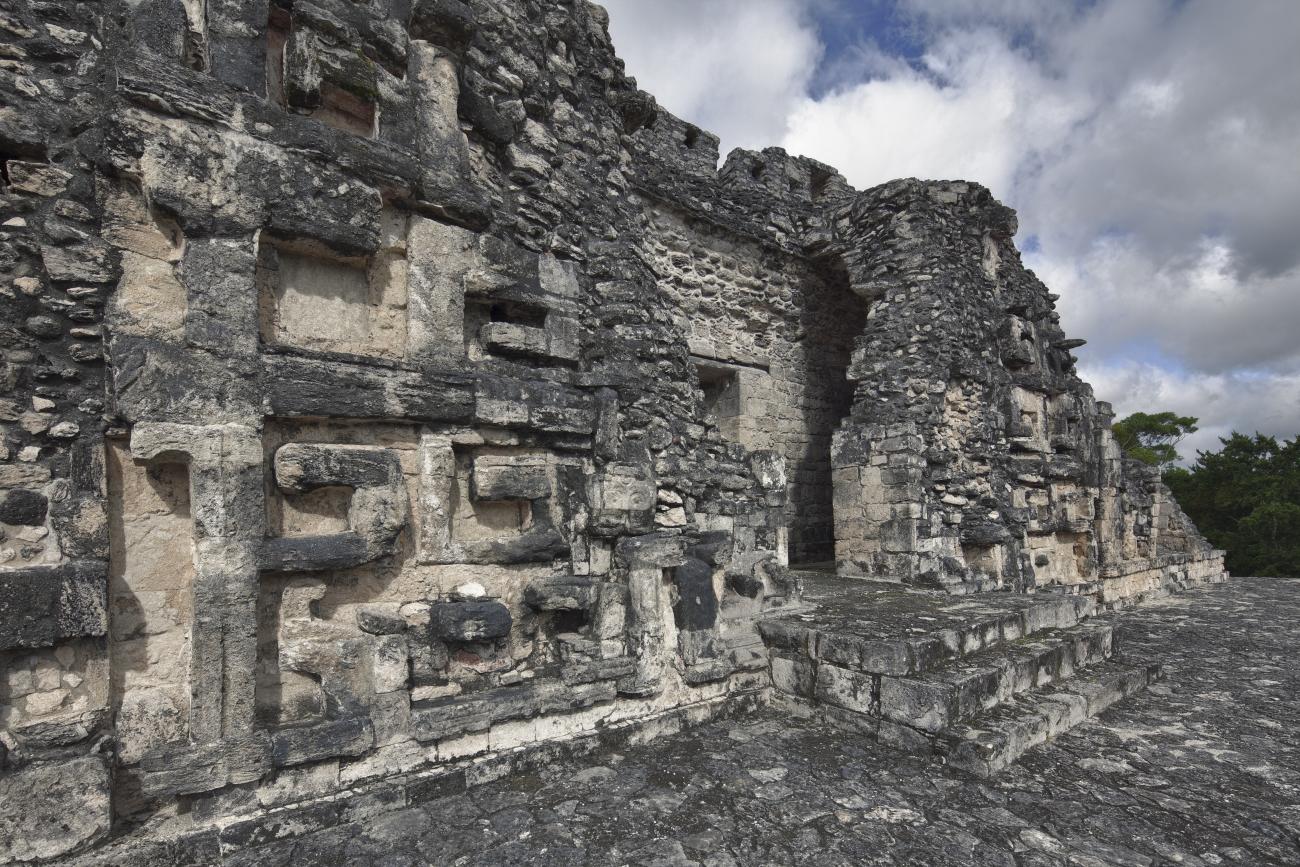 Upper masonry and façade details of Structure X at Becán, Campeche
Río Bec architecture without the confusion
Travel writing often groups Becán, Chicanná, and Xpuhil together as “jungle ruins,” but that label hides the architectural question that connects them. Río Bec buildings use scale, height, symmetry, and façade imagery to create authority. Their tall towers often resemble temples, yet many have steep or false stairways that were not practical routes to a functioning summit. The effect was visual and ideological as much as architectural.
Becán is a good place to study that distinction because its buildings include a mixture of monumental platforms, rooms, passages, and Río Bec-style forms. Look for the relationship between a building’s apparent height and its actual access. A structure may be designed to be seen from a plaza rather than climbed. A façade may suggest a sacred mountain or divine presence without inviting visitors to walk to its top.
This is also why a visit should not be reduced to the question, “Can I climb it?” Rules for monument access can change for conservation, safety, or management reasons. When a stairway is closed, the building does not become less meaningful. You can study its proportions, position, façade, and relation to nearby structures from ground level. Follow barriers and staff instructions even if an older photograph shows visitors in a place that is now restricted.
The three southern sites closest to Xpujil make a useful comparison. Xpuhil is known for its distinctive three-towered principal building. Chicanná is associated with a façade whose zoomorphic imagery gives the entrance a strong visual presence. Becán combines the Río Bec tradition with a larger civic plan and the unusual moat. Visit all three if you have time, but do not expect them to repeat one another.
History and political setting
Becán grew during a period when Maya cities in the southern lowlands were connected by trade, marriage, warfare, alliances, and competition. Monumental construction required organised labour, food supplies, skilled masons, authority, and access to materials. The plazas and platforms therefore tell you about administration as well as religion.
The city’s position in the Río Bec region placed it within a network of settlements rather than at the edge of civilisation. Modern roads make the area feel remote because the forest is extensive and towns are small. In the ancient period, paths, raised routes, waterways, and political ties connected communities across the landscape. The absence of a modern city beside the ruins should not be mistaken for ancient isolation.
The moat is especially important in discussions of political power. Whether primarily defensive, symbolic, or multifunctional, it shows that the central area was deliberately bounded. The city’s leaders controlled access to spaces where ceremonies, administration, and elite display took place. The crossing and plazas turn arrival into a staged process.
The archaeological record is incomplete. Stone buildings survive better than roofs, wooden structures, textiles, food, and everyday conversations. Inscriptions and architectural patterns help researchers reconstruct parts of the political story, but visitors should be cautious with tidy legends that claim to explain every feature. A good guide will distinguish what is documented from what is inferred.
The broader region experienced changes in population and political organisation over the centuries. The abandonment or transformation of monumental centres was not a single event across the Maya world. Buildings were modified, reused, covered, and sometimes left to the forest. At Becán, the visible remains are a layered record rather than a frozen scene from one exact year.
How to get to Becán
From Xpujil
Xpujil is the most practical base. Becán is close to town by southern-Campeche standards and lies along the same Federal Highway 186 corridor as the other Río Bec sites. You can arrange a rental car, a local driver, or a guided excursion. If relying on a driver, confirm the return arrangement before leaving Xpujil, including the meeting point and waiting time. Do not assume that a vehicle will automatically be available outside the gate when you finish.
The short road distance does not eliminate planning. Buy water and food in Xpujil, carry cash for site-related expenses, and make sure your phone, navigation, and transport plan are ready before departure. A basic vehicle inspection is sensible if you are driving yourself. The corridor is rural, and a small problem is harder to solve when you are between towns.
From Escárcega
Escárcega is the western transport hub for the route. Drivers coming from Campeche City, the Gulf coast, or central Campeche normally use Escárcega before continuing east on Highway 186. Becán can be visited on the way toward Xpujil, but calculate the entire day rather than looking only at the final highway segment. A late arrival can leave too little time for the site and the onward drive.
If you are using intercity buses, the bus can get you along the main corridor, but it does not replace the last-mile plan. Ask locally where to get off and how to arrange the onward ride. Schedules and stop practices can change, and a rural highway stop is not the same as arriving at a staffed urban terminal.
From Chetumal or Bacalar
Travellers arriving from Quintana Roo can use Xpujil as a Campeche base before visiting Becán. The state border is not the destination boundary: Becán itself is in Campeche, and the visitor plan still needs to account for the highway, local transfers, site hours, and the return route. Be aware that Campeche and Quintana Roo use different time zones. Check the current local time before making a timed connection.
A same-day visit from the east may be possible for independent drivers, but an overnight in Xpujil gives you more flexibility. It lets you visit Becán early, continue to another nearby site, or reserve the following day for Calakmul without making every stop depend on one long drive.
From Campeche City
San Francisco de Campeche is a poor daily base for Becán if the goal is a relaxed archaeological visit. The route south is long, and adding the return journey can turn a few hours at the ruins into a tiring cross-state day. If Becán is important, move inland and stay in Xpujil or plan it as part of a longer southbound itinerary.
The capital remains useful before or after the Río Bec corridor. Its walled centre, museums, malecón, food, and evening atmosphere are entirely different from the forest. Splitting the itinerary gives both environments enough time rather than using one as an exhausting day-trip base for the other.
Guided tours and independent visits
Becán is straightforward for a confident driver, but a guide can add value when you want help reading architecture, chronology, and the relationships among the Río Bec sites. Compare what a listed excursion actually includes. Check its departure point, transport, language, time at Becán, other stops, entry arrangements, meals, and return plan. Do not assume that a Calakmul tour automatically includes Becán; the routes and available products vary.
Browse Becán activities on GetYourGuide · Compare Calakmul-area options on Viator
A guided visit is most useful when it explains the moat and the architecture rather than repeating a list of dates. Ask about the differences between functional stairways and false stairways, how the plazas were used, and what is known about the region’s political network. If wildlife is part of the itinerary, remember that sightings are never guaranteed and should not take precedence over safe driving or site rules.
An independent visit gives you control over pace. You can spend twenty minutes with the vaulted passage, return to a plaza, sketch the layout, or sit in shade without keeping a group schedule. The trade-off is that interpretation becomes your responsibility. Read the official site information beforehand and avoid relying on a single old blog post for current access rules.
Where to stay for Becán
Xpujil is the logical overnight base because it has the area’s largest concentration of basic accommodation and services. Expect practical rather than resort-style lodging. Prioritise air conditioning or reliable ventilation, water, a workable check-in arrangement, and advice about early departures. If you are travelling in a hot or wet period, a room that allows you to recover after a day outdoors matters more than decorative extras.
Staying close to the ruins can be appealing, but confirm exactly where a property is located and what services are available before booking. Remote lodging may be quiet while offering fewer food, fuel, cash, or transport options. Do not name or recommend a particular property unless you have verified its current listing and can provide both booking channels.
Check current Xpujil-area rates on Booking.com · Compare Xpujil stays on Trip.com
If Becán is one stop on a route from the Gulf coast to the east, an overnight in Xpujil is usually more comfortable than driving onward after a full day outside. It also gives you the option of visiting the smaller sites on separate mornings. For Calakmul, an Xpujil base is particularly useful because the reserve road requires an early start and a dedicated transport plan.
How long to spend at Becán
Allow at least two to three hours for a purposeful visit, with more time if you read the architecture closely, take photographs, or walk slowly in the heat. The site is compact enough for a half-day, but the time needed depends on the route open, your mobility, the weather, and whether you have a guide.
A useful sequence is to begin with the entrance and moat, continue through the main plaza groups, pause at the larger structures, look for the ballcourt and passageway, and finish with any route sections still open. Do not rush immediately to the largest visible building. The site’s meaning emerges from the sequence of boundary, plaza, structure, corridor, and forest.
If combining Becán with Chicanná and Xpuhil, plan a full day and keep the order flexible. Each visit includes walking in heat, parking or transfer time, and the possibility that a site is temporarily operating differently. Three sites may fit comfortably for a motivated traveller, but only if you avoid treating every stop as a race to the next gate.
When to visit
The dry season can make roads and paths easier, but heat remains a serious factor. Early morning is generally more comfortable for walking and photography. It also gives you a better chance of having quiet time in the plazas before the day becomes hotter. Bring water, a hat, sun protection, insect repellent, and footwear with a stable sole.
Rain changes the experience rather than automatically making it impossible. Stone and soil can become slippery, humidity rises, and a storm may affect your planned route. Keep an extra layer or rain protection in your day bag and leave flexibility in the schedule. Do not enter closed areas or climb wet structures.
Wildlife may appear in the surrounding forest, but Becán is primarily an archaeological visit. Monkeys, birds, and other animals are possible in the wider corridor, not guaranteed on a particular walk. Keep distance, do not feed animals, and avoid loud playback or attempts to lure wildlife into photographs.
Accessibility and physical demands
Becán involves uneven ground, exposed stone, roots, steps, and changes in level. The walk is less logistically demanding than Calakmul’s long approach but is not a flat urban attraction. Some structures have steep stairs or surfaces that can be difficult for anyone with limited mobility, balance issues, or heat sensitivity.
Check the current route with site staff if you need step-free access or a shorter circuit. The exact accessible portion can depend on conservation work and conditions. Travel with a companion if you may need help on uneven ground, and take breaks before you feel overheated. There is no benefit in pushing through a climb simply to reproduce someone else’s photograph.
Families can find Becán easier to manage than Calakmul because the journey from Xpujil is shorter and the site can fit into a half-day. Children still need shade, water, firm shoes, and supervision around steps and drop-offs. Turn the moat, plazas, and hidden passage into observation questions rather than expecting young visitors to absorb a long chronology lecture.
Becán compared with nearby ruins
Becán and Calakmul
Calakmul is the much larger and more remote experience, with a long reserve approach and extensive monumental groups in a protected forest. Becán is closer to the highway and easier to combine with other short visits. Choose Calakmul when the scale of a major Maya capital and the deep-forest journey are central to your trip. Choose Becán when you want strong architecture with a more manageable day.
The two sites complement one another. Becán helps you see regional planning, the moat, and Río Bec architecture without using all your energy. Calakmul shows how far a major political centre could extend and how deeply the forest can conceal an ancient city.
Becán and Xpuhil
Xpuhil is closer to the town named after it and is known for the three-towered building that gives the site its visual identity. Becán offers a broader civic layout and the moat. If you have limited time, either can be worthwhile; if architecture is a main interest, visiting both makes the contrast more informative.
Becán and Chicanná
Chicanná is often remembered for its powerful entrance façade and zoomorphic imagery. Becán is better for understanding an enclosed urban core, plazas, and monumental circulation. The sites are close enough to pair, but their strongest features are different. Avoid writing off one as a smaller version of the other.
Becán and Balamkú
Balamkú is particularly important for its preserved stucco frieze, subject to current access and conservation arrangements. Becán’s interest lies more in its urban architecture and moat. The pair can work well in a route that balances a close look at a specific sculptural feature with a larger walk through plazas and platforms.
A practical Becán itinerary from Xpujil
For a relaxed first day, arrive in Xpujil, buy supplies, confirm transport, and visit Becán the following morning. Leave early enough to enjoy the site before peak heat. After the ruins, return to town for lunch and a rest rather than immediately attempting the longest possible circuit.
With a full day, visit Becán first and continue to one nearby Río Bec site if the route and opening conditions allow. Keep the afternoon flexible. If you are driving, check fuel before leaving Xpujil and avoid assuming that every stop will have food or a functioning cash point.
On a three-day plan, reserve one day for Becán, Xpuhil, and Chicanná, one day for Calakmul, and the remaining time for arrival, departure, Balamkú, or a local nature activity. The exact order depends on your transport and current site arrangements. The important principle is to separate the remote Calakmul day from a crowded list of smaller stops.
If you are travelling east or west along Highway 186, Becán can be a useful stopover. Do not let a highway itinerary force you to arrive at the end of the day. The best visit is one with enough daylight for the moat, plazas, and forest paths, followed by a realistic onward journey.
What to bring
Carry more water than you think you will need, especially if you are visiting in warm weather or combining sites. Add a hat, sunscreen, insect repellent, stable walking shoes, a light rain layer, and a small amount of cash. A phone battery pack is useful in a rural corridor, but do not assume it will solve poor reception or replace an agreed transport plan.
A modest snack helps if the route takes longer than expected. Keep food packed away and do not leave wrappers in the forest. Binoculars can be useful for distant birds, but they are optional; the architectural details deserve attention too.
Photographers should use the official rules for tripods, professional equipment, drones, and flash. A camera does not justify crossing a barrier or entering a restricted structure. Morning light can show masonry relief and vegetation well, while later cloud cover may reduce harsh contrast.
Frequently asked questions
Is Becán worth visiting?
Yes, especially if you are already travelling through southern Campeche. Becán combines a rare moat, substantial plazas, Río Bec architecture, and a manageable approach from Xpujil. It is a strong choice for travellers who want more than one famous pyramid but do not want every archaeological visit to require a full day of remote driving.
How far is Becán from Xpujil?
Becán is close to Xpujil on the Federal Highway 186 corridor, but the exact journey depends on your starting point, road conditions, vehicle, and stops. Use current local directions rather than relying on an old travel-time claim.
Can you visit Becán without a car?
Yes, but arrange the last part of the journey before leaving Xpujil or the highway transport. A bus along the main corridor does not necessarily deliver you to the entrance or guarantee a return ride. A local driver or guided visit can remove that uncertainty.
Is Becán suitable for children?
It can be. The shorter approach and moderate scale are easier for many families than Calakmul, but the site still has heat, uneven paths, stairs, and exposed edges. Bring water and supervise children closely.
Can visitors climb Becán’s structures?
Monument access changes. Follow current signs and staff instructions, and do not assume that an older photograph reflects today’s rules. Some Río Bec towers were designed as symbolic forms rather than practical stairways, even when they resemble pyramids.
Can Becán and Calakmul be visited on the same day?
It may be possible with a carefully arranged private itinerary, but it is usually a demanding plan. Calakmul requires the long reserve approach, while Becán deserves time of its own. If both are priorities, staying near Xpujil and using separate days is more comfortable.
Is there food at the archaeological zone?
Do not plan on a full restaurant service at the gate. Buy water and food in Xpujil or another confirmed town stop before setting out, and check current facilities locally. Carry supplies responsibly and take rubbish with you.
The right way to visit Becán
Becán is best understood as a city, not a single ruin in the jungle. Cross the moat, read the plazas, look closely at the passageways, and compare the scale of the buildings with the forest that now surrounds them. Give the site enough time to reveal its layout before moving on to the next archaeological zone.
Base yourself in Xpujil if you are exploring the corridor, confirm the transport details, arrive early, and keep the day flexible for heat and road conditions. Pair Becán with nearby sites when you have enough time, but do not sacrifice the main visit to collect names. Its moat and architecture already provide a clear reason to stop: this is one of southern Campeche’s most legible places for seeing how Maya power was organised in stone, earth, movement, and landscape.