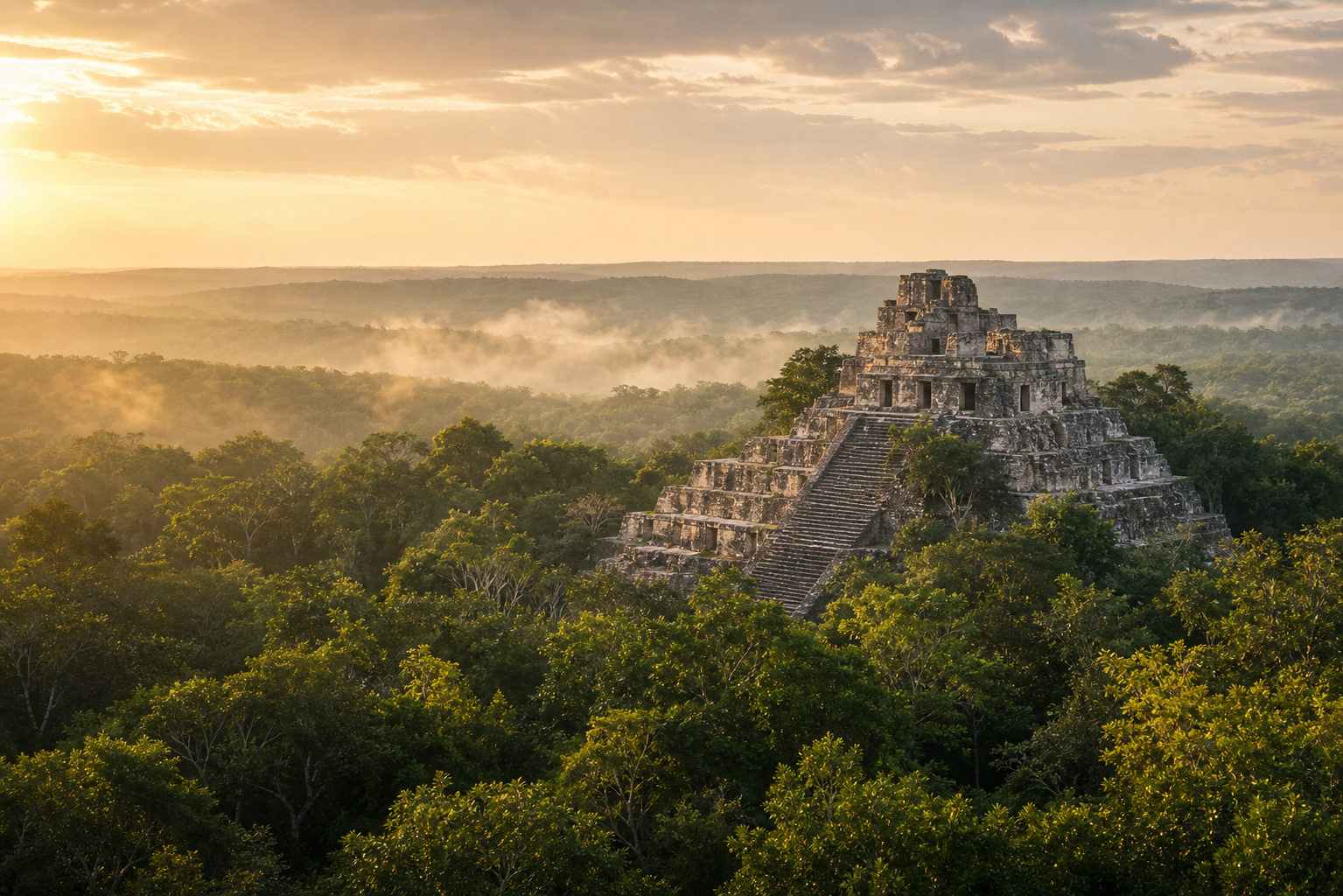

Bacalar to Calakmul is a journey from the lagoon country of southern Quintana Roo into the jungle of southern Campeche. The road distance is roughly 236 kilometres, but distance alone understates the planning involved. You first need to reach Xpujil, the practical gateway town, and then cover the much slower road into the Calakmul Biosphere Reserve and archaeological zone. There is no ordinary public bus that drops you at the ruins.
The most comfortable option is a rental car, provided you are happy driving in Mexico and can give the visit enough time. A bus can take you from Bacalar to Xpujil, but you must arrange the final leg separately. An organised day trip is possible for travellers with very limited time, although it is a long day with many hours on the road. For most people, the better plan is to sleep in Xpujil, visit Calakmul early, and continue only after you have seen the site without rushing.
This guide explains the route, the border between Quintana Roo and Campeche, car logistics, buses, the Tren Maya, taxis, organised tours, overnight planning, and the practical details that matter once you leave Bacalar behind.
 Bacalar Lagoon in Quintana Roo, the starting point for the journey to southern Campeche
The route in one view
The journey has two very different parts.
The first part is Bacalar to Xpujil, normally via Federal Highway 186. This is the useful intercity connection. Xpujil has fuel, cash access, food, accommodation, basic shops, and transport providers. It is in Campeche State and is the sensible place to stop before Calakmul.
The second part is Xpujil to the Calakmul ruins. The turnoff from Highway 186 leads south into the reserve. The road continues through forest and becomes progressively slower. The archaeological zone is not just a short detour from town. Allow several hours for the return journey, the reserve road, entrance procedures, walking, and the site itself.
A typical self-drive plan looks like this:
- Leave Bacalar early and reach Xpujil with fuel and food plans sorted.
- Sleep in Xpujil rather than trying to enter the reserve late in the day.
- Start for Calakmul early the following morning.
- Visit the archaeological zone and return to Xpujil in daylight.
- Continue toward Escárcega, Campeche City, or back toward Chetumal only when the timing works.
The journey also crosses a time-zone boundary. Bacalar and the southern part of Quintana Roo use Eastern Time, while Campeche uses Central Time. When you cross into Campeche, your clock is one hour earlier. This matters if you are travelling by bus, meeting a driver, or trying to arrive for a morning admission window. Check the current local time on the day of travel rather than relying on an old itinerary.
Need transport? Book a transfer on WhatsApp.
How far is Bacalar from Calakmul?
The road distance is approximately 236 kilometres, or about 147 miles, depending on the exact starting point in Bacalar and the destination pin used for Calakmul. The first leg to Xpujil is approximately 126 kilometres. The second leg from Xpujil toward the archaeological site is approximately 110 kilometres when the reserve road and final approach are included.
A direct drive can take around four hours in favourable conditions, but that is not a useful promise for trip planning. The route involves fuel, a stop in Xpujil, possible entrance checkpoints, slower driving in the reserve, and time to find the correct access road. A realistic door-to-door estimate is closer to four to five hours for a direct self-drive, without a substantial stop. A day trip with a return to Bacalar can occupy roughly twelve hours or more.
The last section is the reason Calakmul should not be treated like a normal roadside ruin. Once you turn south, services become limited. There are no reliable fuel stations, restaurants, supermarkets, or normal taxi options inside the reserve. Download maps before leaving town, keep water in the vehicle, and do not assume that a mobile signal or a last-minute ride will appear.
By rental car: the most flexible option
Driving is usually the best choice if you want to see Calakmul properly and continue through Campeche. It lets you choose an early departure, carry enough water and food, stop in Xpujil, and avoid trying to coordinate a bus with a taxi on the same day. It also makes it easier to add a nearby archaeological site such as Xpujil, Bécan, or Chicanná on a separate day.
Rent the car in Bacalar, Chetumal, or another convenient arrival point, and check the one-way rules if you plan to return it in a different city. A rental booked for a spontaneous pickup in Xpujil is not a dependable plan; vehicle choice there is limited and availability may be poor. If you are arriving by bus or train, arrange any local vehicle well in advance rather than expecting a car to be waiting.
A normal car can handle the main highway, but the reserve approach rewards a vehicle with reasonable ground clearance. The issue is not that every metre is an off-road trail. It is that potholes, branches, uneven surfaces, and slow wildlife-sensitive sections make a low, small car less comfortable. Inspect the tyres, spare wheel, jack, lights, and insurance paperwork before leaving Bacalar.
Do not treat the drive as a race. Federal Highway 186 is a two-lane road with long, quiet sections, but quiet does not mean risk-free. Overtaking, animals, fatigue, and poor visibility after dark all matter. Leave a margin for slower traffic and never plan to drive the reserve road at night. Wildlife is part of the protected landscape, and the final road is not lit or designed for fast travel.
Fuel and supplies before leaving Bacalar
Fill the tank in Bacalar or Chetumal. Xpujil is the important refuelling point for the Calakmul visit, and a station at or near the corridor may be useful as a backup, but do not build the plan around a single unconfirmed fuel stop. The safest habit is to arrive in Xpujil with enough fuel for the complete reserve excursion and the onward journey to the next major town.
Buy water and food before entering the reserve. The archaeological site has basic visitor services, but choices are not comparable to a town supermarket and conditions can change. Pack more water than you think you need, especially during the hot season. Keep food simple and secure it from animals. Fruit, sandwiches, nuts, and other sturdy snacks travel better than anything that melts or spoils quickly.
Cash is useful for the route. Independent access points and smaller services may not have reliable card terminals, and the reserve has multiple admission points or fees that can be updated. The official INAH Calakmul page currently lists archaeological-site and conservation charges separately; check the latest official information before departure and carry enough Mexican pesos for the day. Do not rely on an old blog post for the current total.
Driving from Bacalar to Xpujil
From Bacalar, follow the signed highway toward Chetumal and the western corridor, then continue on Federal Highway 186 toward Xpujil. Exact navigation instructions can change as road layouts and map pins are updated, so confirm the route in a current map application before departing. The important destination is Xpujil town, not the isolated Tren Maya station labelled Calakmul and not an incorrect map pin somewhere in the reserve.
The landscape gradually changes from the settled lagoon corridor to a more forested route. The drive can feel easy because traffic is often light, but the long straight stretches encourage fatigue. Take a proper break in Chetumal or Xpujil rather than trying to complete the whole journey without stopping. If you arrive in Xpujil late, stay there and begin the reserve trip the next morning.
 Federal Highway 186 between Escárcega and Xpujil in the Calakmul reserve region

Bus from Bacalar to Xpujil
The bus is the realistic public-transport first leg. ADO and AU services operate along the Highway 186 corridor, but departure times, operating days, and fares change. Check the current schedule on the operator’s website or at the terminal for your exact date. Search for Xpujil as the destination and allow for the one-hour time-zone difference when comparing times.
Some schedules may be direct, while others make a connection in Chetumal. A connection can be more useful than a very late direct departure because arriving in Xpujil at a practical hour gives you a chance to check in, buy supplies, and arrange transport to Calakmul. A late arrival is not automatically wrong, but it usually means sleeping first and visiting the ruins the following day.
Bus travel is cheaper and removes the stress of driving, but it does not solve the final 110 kilometres. There is no ordinary scheduled bus that takes visitors from Xpujil through the reserve to the archaeological zone. You need a pre-arranged taxi, shared transport, local excursion, or another private vehicle for that section.
Buy the ticket early if your itinerary depends on one departure. Online payment can occasionally fail with international cards, so keep the terminal as a backup. Take a screenshot or print the booking details, particularly if you are travelling across a weak-signal corridor. At the terminal, confirm the destination verbally as Xpujil and not Calakmul station.
Bus plus taxi from Xpujil
The bus-and-taxi combination works best when you arrange the return before leaving town. Ask the driver or local transport provider to quote the complete round trip, including waiting time, rather than accepting a vague one-way promise. There are no taxis waiting inside the archaeological zone, and you should not assume that a driver can be summoned from the site.
Agree on the following details in advance:
- The exact pickup point in Xpujil.
- The departure time and whether it is early enough for the reserve entry rules.
- Whether the driver waits during your visit or returns at a fixed time.
- Whether the quote includes the reserve road, parking, fuel, and any waiting time.
- The meeting point for the return journey.
- What happens if the road or site closes temporarily.
A shared transfer may reduce the cost if several travellers are going to the same place, but do not squeeze the visit into a schedule that leaves no margin. Calakmul is spread through forest, and the best experience comes from walking at a steady pace and allowing time for the major plazas, structures, viewpoints, and wildlife pauses.
If you are using a taxi only for the final leg, the total cost per person depends heavily on the number of passengers. A larger group can make a private vehicle more reasonable, while a solo traveller may find a confirmed tour easier to budget. The driver is not automatically a guide. If interpretation and history matter to you, book a service that explicitly includes a guide rather than assuming transport includes a guided visit.
The Tren Maya option
The Tren Maya can form part of a Bacalar-to-Xpujil journey, but it does not remove the final road transfer. The critical booking decision is the station. The booking system can show both Xpujil and Calakmul. For an independent visitor, Xpujil is generally the useful arrival point because it is the town with accommodation, food, fuel, and onward options. The Calakmul station is isolated and should not be treated as a convenient replacement for the ruins’ entrance.
Check the current official train schedule before buying anything. Service patterns and departure times can change, and a connection may be required. A train that looks convenient on a map may still leave you arriving too late to arrange the reserve transfer. Ask your accommodation or transport provider to confirm the current station arrangements, but use the official rail operator for the final timetable.
From Xpujil station, arrange a taxi or excursion to the ruins. The station is not the archaeological site. It is also not a place where you should expect a ready-made fleet of taxis at every arrival. Pre-arrange the pickup with your accommodation or a verified provider, and keep the driver’s contact details available offline.
The train is most useful for travellers who want to combine this route with other stations in Campeche or the wider peninsula and who can spend an extra night in the gateway area. It is less useful for a same-day Bacalar-Calakmul visit because every transfer has to align with the reserve’s entry windows and the long return road.
Organised tours from Bacalar
A guided day trip is the simplest way to visit Calakmul from Bacalar without driving. Verified marketplace inventory exists for full-day Calakmul excursions from Bacalar or Chetumal, often combining road transport with a guided archaeological visit and a jungle component. Read the current product page carefully: pickup zones, languages, meals, entrance fees, group size, and cancellation rules vary.
Compare current Calakmul and jungle tours from Bacalar on GetYourGuide · See Calakmul tours from Bacalar on Viator
Expect a long day. The tour has to cover the outward drive, stops, the reserve approach, the archaeological zone, and the return to Bacalar. That can be worthwhile when your itinerary cannot accommodate an overnight, but it is not the relaxed way to experience Calakmul. Travellers who dislike early starts, long vehicle days, heat, or uneven walking should stay near Xpujil instead.
Before booking, check whether the listing says “Calakmul” but actually visits the archaeological site, rather than only a nearby reserve attraction. Confirm the pickup address in Bacalar and the expected return area. Read the current inclusions rather than assuming breakfast, lunch, drinks, entry fees, or a professional archaeological guide are included. Product pages are date-dependent, so availability and details should be checked again immediately before payment.
A tour is a good fit for solo travellers who do not want to negotiate a private taxi, families that value door-to-door logistics, and visitors who want historical explanation during a large site visit. It is a weaker fit for photographers, birders, and slow walkers who need to control the schedule. For those travellers, an overnight and private transport arrangement usually gives better value in time, even if the headline cost is higher.
The final road from Xpujil to Calakmul
The reserve road is the part that catches first-time visitors off guard. From Xpujil, you drive toward the signed Calakmul access and then continue through protected forest. The distance is not huge on a map, but speed drops. Allow roughly two to three hours for the complete Xpujil-to-site run in real conditions, including the approach, checkpoints, and slow sections. The exact timing depends on road conditions, your vehicle, stops, and how early you arrive.
The road is also part of the experience. You may see birds, monkeys, reptiles, or other wildlife, but sightings are never guaranteed. Do not stop in unsafe places or leave food outside the vehicle. Keep the speed low in wildlife areas, follow local instructions, and never use the reserve as a night-driving shortcut.
The official INAH listing gives Calakmul’s normal visiting window as 08:00 to 17:00, with last access at 16:00, but other reserve and community checkpoints can have their own operating limits. These conditions make an early departure from Xpujil important. Check the official INAH and conservation information immediately before the trip because hours, fees, or access rules can change.
 A Calakmul sign in Xpujil, Campeche, the gateway town for the Calakmul road
Where to sleep: Bacalar, Xpujil, or both?
Bacalar works well as a starting point if you want to enjoy the lagoon first. It is not the best base for a comfortable Calakmul visit when you also want time at the ruins. Driving out and back in one day turns a major archaeological and nature experience into a transport exercise.
Xpujil is the practical overnight base. Staying there puts you closer to the reserve entrance and gives you a chance to refuel, withdraw cash, buy provisions, and speak with a driver before the morning departure. Accommodation is generally simpler than in Bacalar, but simplicity is useful here. Prioritise a secure room, early access to your vehicle, air conditioning or effective ventilation, and a location that makes the morning departure easy.
Check current Xpujil-area accommodation on Booking.com · Compare Xpujil stays on Trip.com
Conhuas and other reserve-side options may shorten the road distance, but availability and services are more limited. Choose them only after confirming the exact location, check-in arrangements, food situation, and transfer plan. A property that appears close on a map may not offer the same practical support as a town base.
A two-night Xpujil plan is especially useful. Arrive from Bacalar on the first day, visit Xpujil or another nearby site if you have energy, go to Calakmul early on the second day, and sleep again before continuing. This protects the archaeological visit from a delayed bus, bad weather, car trouble, or a late arrival.
How to plan a self-drive itinerary
One night, fast version
Leave Bacalar early, drive to Xpujil, and continue to Calakmul only if you are certain you can meet the access conditions and still return safely. This is possible in theory but leaves little margin. It is not recommended for a first visit unless you have already confirmed the road, admission windows, and vehicle arrangements.
Two nights, sensible version
Arrive in Xpujil on day one and stay locally. Use the afternoon for supplies and a nearby attraction if time permits. On day two, leave early for Calakmul, spend several hours at the archaeological zone, and return to Xpujil in daylight. Continue toward your next destination on day three.
Three nights, slower version
This is the best structure for travellers interested in both archaeology and wildlife. Use one day for Calakmul, another for nearby Río Bec sites or reserve activities, and leave the final day for the onward journey. It also makes the route more resilient when tropical rain slows the reserve road.
Do not combine Bacalar lagoon activities, the complete drive to Calakmul, a full archaeological visit, and a long onward transfer into one improvised day. The geography is too spread out. The journey works when you treat Xpujil as a real stop rather than a pin on the way to somewhere else.
What to pack for the route
Wear light clothing that covers the shoulders and legs when practical. Closed shoes are more useful than sandals on uneven archaeological paths. Bring a hat, sunglasses, insect repellent, sunscreen, and a light rain layer. Humidity can make a short walk feel strenuous, while rain can arrive quickly during the wet season.
Carry a daypack with water, food, a phone battery, a small first-aid kit, and any medication you may need. Download maps, booking confirmations, and translation tools before the signal fades. Keep cash separated between wallets or bags, and do not leave valuables visible in a parked car.
A camera with spare batteries is useful, but drones and professional photography may be restricted. Check the current INAH rules before bringing specialist equipment. Do not climb or touch fragile masonry, and follow any temporary closures inside the archaeological zone.
For children, the main difficulty is not the history but the length of the travel day, heat, and uneven ground. A family should plan more water, more snacks, and a slower route. A same-day Bacalar excursion can be exhausting for young children; an Xpujil overnight makes breaks and bedtime much easier.
Weather and seasonal judgement
Heat is a factor throughout the year, but the forest can feel especially close during humid periods. Early morning gives you cooler walking conditions and a better chance of seeing active wildlife. Midday can be bright and hot on exposed structures even when the surrounding jungle provides shade.
Rain does not automatically cancel the trip, but it can slow the road and make surfaces slippery. Ask locally about current conditions before committing to the reserve road. If heavy weather is forecast, leave an extra day rather than forcing a narrow same-day itinerary. A delayed return is more serious here than on a city excursion because there are long stretches without services.
The dry season can make walking more comfortable but does not guarantee clear roads or animal sightings. The wet season can make the forest vivid and active but requires patience with rain. Choose the season that matches your tolerance for heat, mud, and flexible timing rather than chasing a promise of perfect conditions.
Common mistakes on this route
The first mistake is booking the Calakmul Tren Maya station instead of Xpujil. The station names are easy to confuse, but the onward logistics are not interchangeable.
The second is treating Xpujil as the ruins. Xpujil is the gateway town and also the name of an archaeological site nearby. Calakmul is much farther into the reserve. Allow time for the correct destination.
The third is arriving in Xpujil without a final transfer. Bus tickets solve only the first leg. Arrange the round trip before entering the reserve.
The fourth is leaving Bacalar too late. A comfortable start by the lagoon can become a stressful race toward a checkpoint or admission window. If you want a relaxed visit, sleep in Xpujil first.
The fifth is carrying too little water and cash. The reserve is not a normal urban attraction, and card payments or shops cannot be assumed at every stage.
The sixth is relying on a single old timetable or blog. Bus, train, entrance, and tour information changes. Use current operator and official site information, then build in a margin.
The seventh is driving back through the reserve after dark. Avoid it. Wildlife, darkness, fatigue, and road conditions make the risk disproportionate to the extra hour saved.
Which option is best?
Choose a rental car if you value independence, want to stay in Xpujil, plan to visit more than one southern Campeche site, or will continue toward Escárcega and Campeche City. It is the strongest all-round option, but only when you are comfortable with long drives and careful reserve-road driving.
Choose bus plus a pre-arranged taxi if you want to keep costs down and are willing to plan the transfer precisely. It works better with at least one night in Xpujil and a confirmed return vehicle. It is not a spontaneous same-day solution.
Choose the Tren Maya if its current schedule fits a multi-stop itinerary and you understand that Xpujil is the useful station. It is a transport component, not a complete Calakmul transfer.
Choose an organised tour from Bacalar if you have only one available day, do not want to drive, and accept a long door-to-door schedule. Compare the live itinerary and inclusions carefully, particularly the pickup area, entry fees, guide, meals, and return time.
For most independent travellers, the best answer is simple: travel from Bacalar to Xpujil on one day, sleep there, and visit Calakmul early the next morning. That plan respects the distance, protects your time at the ruins, and leaves room for the jungle road to be slow. Calakmul is worth the effort, but the route rewards travellers who plan it as a two-stage journey rather than trying to compress Campeche’s remote interior into a single transfer.
If your schedule allows only one day, compare the current guided departures before choosing a self-drive dash. If you have two or more nights, make Xpujil the anchor, verify every access detail locally, and keep the return trip in daylight.
Practical FAQ
Can you visit Calakmul as a day trip from Bacalar?
Yes, organised day trips operate from Bacalar or nearby Chetumal, but it is a long day with many hours of driving. A self-drive day trip is possible only with an early start, a suitable vehicle, and careful attention to access times. Staying in Xpujil is more comfortable.
Is there a direct bus from Bacalar to Calakmul?
No ordinary intercity bus takes you directly to the archaeological ruins. Public transport can take you toward Xpujil, but the final reserve road requires a pre-arranged taxi, local transport, private car, or organised tour.
Should you stay in Bacalar or Xpujil?
Stay in Bacalar for the lagoon and in Xpujil for the Calakmul visit. If the ruins are the priority, Xpujil is the practical base because it shortens the morning approach and provides the last useful services before the reserve.
Can you use the Tren Maya to reach Calakmul?
You can use the train as far as the regional corridor, but you still need road transport to the ruins. Book and verify Xpujil logistics carefully. Do not assume the station labelled Calakmul is a convenient archaeological-site entrance.
What is the most important thing to verify before leaving?
Verify the current INAH visiting hours, reserve access conditions, transport schedule, and your return transfer. These details can change and are more important than an old fare or distance estimate.
The route from Bacalar to Calakmul is not difficult because it is confusing; it is difficult because it is remote. Give it daylight, water, cash, a reliable final transfer, and enough time to stop being in transit. That is the difference between merely reaching the ruins and having a good day there.
A simple decision
If you can spare the night, sleep in Xpujil and drive or ride to Calakmul at first light. If you cannot, use a verified full-day tour rather than improvising a bus connection and taxi in the same morning. Either way, check the official access information and current transport details immediately before departure.
Need transport? Book a transfer on WhatsApp.