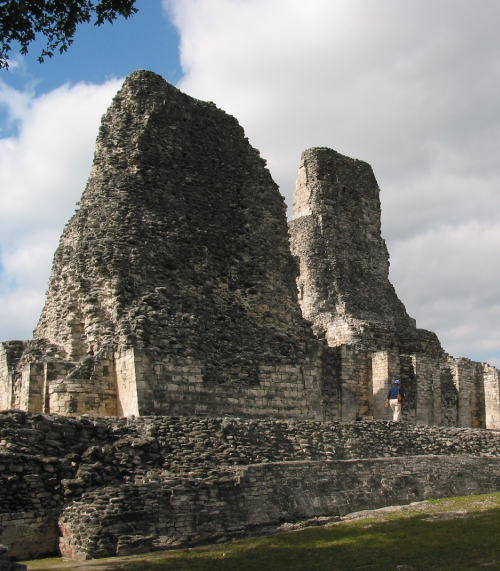
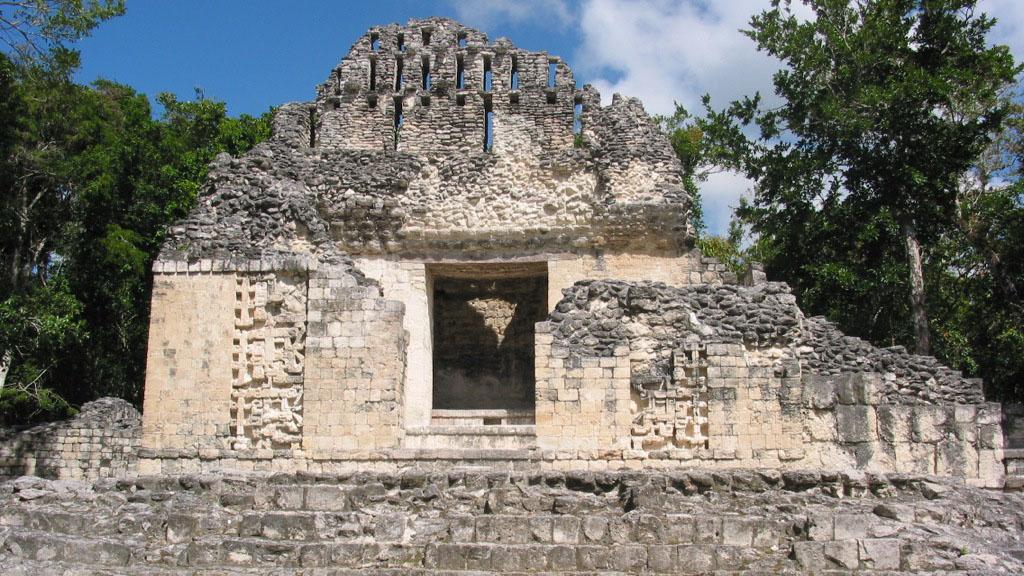
Chicanná is a compact Maya archaeological site in southern Campeche, close to Becán, Xpujil, and the road toward Calakmul. It is not the biggest ruin in the region, and that is part of its appeal. You can understand the buildings without spending an entire day crossing a huge ceremonial center, yet the architecture is unusually expressive: the best-known entrance is framed as the open mouth of a supernatural creature.
The site works best as part of a Río Bec circuit rather than as an isolated day trip from Campeche city. From the state capital, the drive is long enough that combining Chicanná with the nearby ruins or with an overnight in Xpujil makes more sense than rushing there and back. Once you arrive, the route through the forest is manageable, shaded in places, and rich in details that are easy to miss if you only stop for a photograph.
This guide explains what Chicanná is, what to look for, how to reach it, how much time to allow, what conditions to expect, and how to combine it responsibly with the other archaeological sites of Calakmul Municipality.
What is Chicanná?
Chicanná is a pre-Hispanic settlement associated with the Río Bec architectural region. INAH describes occupation beginning in the Middle and Late Preclassic periods, with major stone construction developing during the Early Classic. The site continued to be used across later centuries, and the visible remains represent a long process of building, adaptation, and conservation rather than one single moment.
The modern name is generally interpreted from Maya words associated with a serpent’s mouth or serpent house. That name comes from the dramatic façade of the building commonly called Structure II. It is useful as a visual clue, but it should not be treated as a complete translation of the ancient city’s own name. The original ancient name is not securely known.
Chicanná is often described as an elite settlement connected to the larger regional center of Becán. That interpretation helps explain the scale of the site. It has formal plazas and carefully finished architecture, but its visitor circuit is far smaller than Calakmul’s. The buildings sit among mature vegetation, and the forest is not merely a backdrop: it is part of the setting that shaped settlement, water management, agriculture, movement, and visibility.
 The restored entrance architecture of Chicanná in southern Campeche
Where is Chicanná?
Chicanná is in the municipality of Calakmul in southeastern Campeche. The entrance is reached from Federal Highway 186, the road connecting Escárcega with Xpujil and continuing toward the eastern side of the peninsula. The archaeological-zone access road branches near the highway, so the site is geographically close to the other Río Bec ruins but not inside the Calakmul archaeological core.
That distinction matters. Chicanná is not Calakmul, and a visit here does not take you into the deepest part of the Calakmul Biosphere Reserve. Calakmul is a much larger ancient city reached by a long internal road from the highway. Chicanná is a separate, more accessible site near the Xpujil area. Travelers sometimes use “Calakmul” as shorthand for all the ruins in southern Campeche, but planning becomes much easier when every site is treated as its own stop.
The closest practical base is Xpujil, a small town on Highway 186. Xpujil has the most useful concentration of accommodation, fuel, food, cash access, and local transport for a Río Bec itinerary. Becán and Xpujil archaeological sites are nearby enough to combine with Chicanná in one day if you start early and accept a warm, fairly active schedule. Calakmul itself deserves a separate day for most visitors.
Why visit Chicanná?
The main reason is architectural character. Chicanná offers a concentrated introduction to the Río Bec tradition, including tall, symbolic forms, elaborate façades, and carefully constructed masonry. The famous serpent-mouth entrance gives the visit a strong visual focus, but the site is more than one doorway. Look at the way plazas are framed, how buildings control the approach, and how the structures seem to emerge from the vegetation.
A second reason is pace. At a large site, visitors can spend hours walking between groups and still feel they have seen only part of the map. Chicanná is easier to absorb. You can pause at a façade, read the interpretive material, examine the stonework, and walk back through the trees without treating the visit as a march from one landmark to the next.
A third reason is comparison. Chicanná becomes more interesting when you have seen, or are about to see, Becán and Xpujil. The three sites belong to the same broad regional conversation but express it differently. Becán emphasizes a fortified civic center and a large urban layout. Xpujil is remembered for its distinctive towered structure. Chicanná is especially effective at showing how an entrance and façade could communicate power, ritual, and a relationship with the supernatural world.
Visit if you enjoy archaeology, architecture, history, quiet forest walks, and places that reward close looking. It may be less satisfying if you have only a few hours in Campeche City and do not want a long transfer. In that case, Edzná is the more practical archaeological excursion from the capital.
The serpent-mouth entrance and Structure II
Structure II is the building most people associate with Chicanná. Its doorway is designed with a large, mask-like face surrounding the entrance. The imagery has been interpreted as a supernatural or serpent-like mouth, with prominent eyes, teeth, and other sculptural elements creating the impression that a person is entering the body of a powerful being.
The effect is strongest when you approach slowly. From a distance, the façade reads as a dark opening in a large wall. As you get closer, the separate elements become clearer: the framing bands, the projecting forms, and the relationship between the doorway and the plaza. The design turns movement into part of the experience. You are not simply looking at a wall; you are being directed toward a threshold.
Be careful with definitive claims about ritual use. The imagery supports interpretations about sacred space and supernatural symbolism, but the exact ceremonies performed there are not known. Tourist descriptions sometimes turn thoughtful archaeological hypotheses into certainty. A better approach is to observe what is visible and understand that researchers use architecture, iconography, context, and comparison to build interpretations.
If the entrance is busy, wait rather than standing in the middle of the approach for a quick picture. The façade is easier to understand when you can see its full outline. Do not climb or touch architectural elements unless the site staff specifically permits it. Even a small amount of repeated contact can damage stucco, paint traces, and fragile edges.
Other buildings and details to notice
Chicanná’s appeal is not limited to Structure II. The site includes a group of excavated and conserved buildings arranged around plazas and paths. The exact route and access to individual structures can change as conservation work continues, so follow the current visitor circuit rather than assuming an older map or travel blog is still accurate.
Look for changes in masonry. Some surfaces are regular and carefully dressed, while others reveal later additions, repairs, or less finished construction. These differences help you imagine the site as a lived place that was modified over time. A Maya settlement was not built once and abandoned immediately; buildings could be expanded, re-faced, reused, or given new meaning.
Notice elevation. Chicanná occupies a naturally elevated setting in a region where even modest rises can affect drainage, visibility, and the relationship between buildings and the surrounding forest. A raised structure is not automatically a mountain-like monument, but it can still create a strong visual hierarchy. Stand back from the plazas and consider which buildings dominate the view and which ones are encountered only after turning a corner.
Watch for traces of color and surface treatment. Maya architecture was not imagined as bare gray limestone. Stucco and paint were used, and INAH’s Chicanná material notes remains of stucco with evidence of red paint. What survives is fragmentary, so do not expect every building to be brightly colored. Instead, use those remnants to picture how different the site may have looked when façades were finished and maintained.
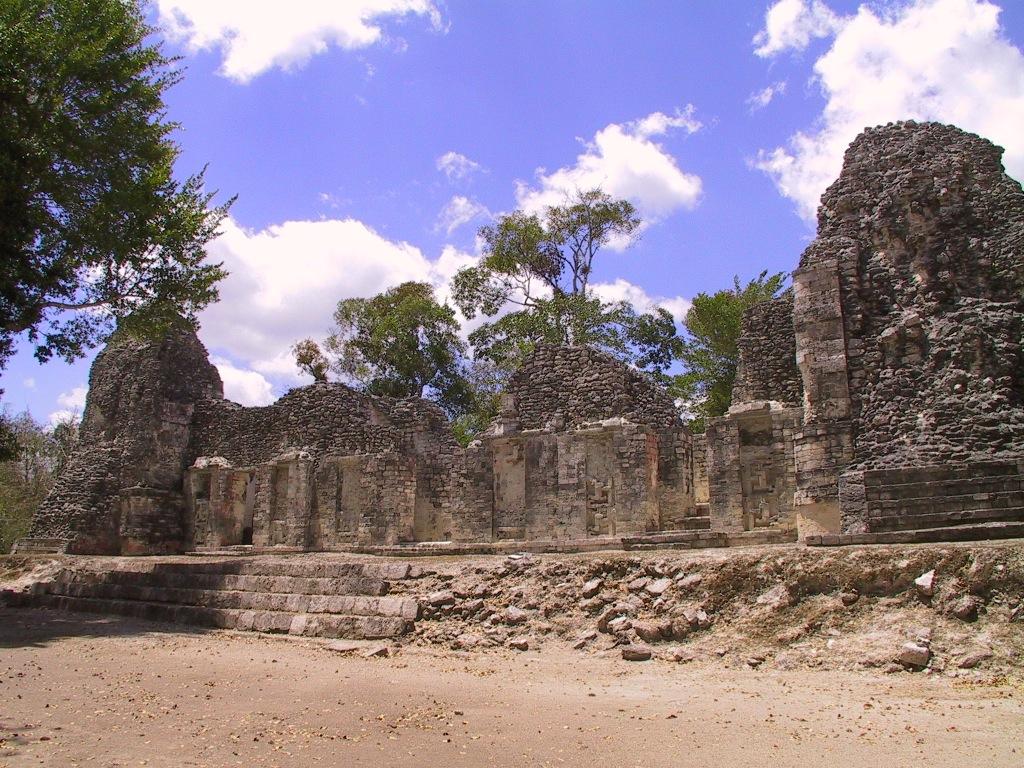
 Structure VII at the Chicanná archaeological zone, Campeche
Chicanná in the Río Bec region
The Río Bec label refers both to a geographic area and to an architectural tradition. Research on the region has identified monumental groups, residential areas, agricultural features, and settlements that do not fit the simple model of one centralized city surrounded by empty forest. The landscape held many communities and different forms of authority.
Architectural styles should not be treated like modern national borders. Similar forms can reflect contact, shared ideas, political relationships, local innovation, or several of these at once. Chicanná, Becán, and Xpujil are close enough to compare, but each site still has its own history and visitor experience.
This is why a Río Bec circuit is more informative than collecting isolated photographs. At Chicanná, study the threshold and the surface. At Becán, focus on the moat, plazas, causeways, and the relationship between defense and civic space. At Xpujil, look at the towered composition and how a building can create a memorable skyline. The comparison reveals a region with shared design language but varied social and architectural priorities.
How to get to Chicanná
By rental car
A rental car is the most flexible option for visiting Chicanná, Becán, Xpujil, and Calakmul. From Campeche City, follow the main route toward Champotón and Escárcega, then continue east on Federal Highway 186 toward Xpujil. From Xpujil, Chicanná is a short drive along the highway and its signed access road.
Use a reliable map downloaded for offline use, but also pay attention to road signs and kilometer markers. Mobile coverage can be inconsistent in southern Campeche. Fill the tank before a long archaeological day, keep drinking water in the vehicle, and avoid assuming that every small turnoff has fuel, food, or an ATM.
Driving after dark is less comfortable than driving in daylight. Highway conditions, animals, poorly lit vehicles, speed changes, and unexpected roadwork all deserve attention. Plan to arrive at your accommodation before night if possible, especially on a first visit.
By bus and local transport
Public transport can get you to the Xpujil area, but Chicanná is not planned like an urban attraction with frequent door-to-door service. Long-distance buses run along the regional corridor, while the final connection to an archaeological entrance may require a taxi, local ride, or pre-arranged transport. Ask locally about the return option before you enter the site; do not rely on finding an immediate vehicle at closing time.
This arrangement is workable for travelers who stay in Xpujil and visit the nearby ruins over several days. It is much less convenient for a same-day trip from Campeche City, because the long intercity journey leaves little room for missed connections or delays. Keep small cash available for local transport and entrance-related purchases, and confirm the current schedule shortly before travel.
With a guided excursion
Marketplace inventory for southern Campeche changes, and Chicanná may appear as part of a multi-site Río Bec or Calakmul itinerary rather than as a stand-alone excursion. If you choose a bookable tour, read the itinerary carefully. Confirm whether the plan actually includes Chicanná, how much time is allocated there, whether entrance fees are included, and where pickup occurs.
Compare Calakmul-region tours on GetYourGuide · See Campeche and Calakmul options on Viator
A guided trip can be useful when you do not want to drive the long highway corridor or arrange several local connections. It is less suitable if you want to linger at one façade, photograph without rushing, or change the order of the sites. Do not assume that a listing mentioning Calakmul automatically visits Chicanná; verify the exact route before booking.
How long do you need?
Allow roughly two to three hours for a comfortable Chicanná visit, including time to walk the circuit, pause at the principal structures, read signs, and take breaks in the heat. A fast visitor may see the central highlights sooner, but rushing reduces the value of a site whose details are architectural and visual.
Add driving time separately. From Xpujil, Chicanná can fit easily into a morning or afternoon sequence with nearby sites. From Campeche City, the road journey is the main challenge, not the walking circuit. A same-day return can create a very long day, especially if you also want to visit Becán or Xpujil.
For a first visit to the region, two nights in or near Xpujil is a sensible minimum if Calakmul is included. One day can cover Chicanná, Becán, and Xpujil at a steady pace. Another day can be reserved for Calakmul, whose internal road, large site, and forest setting require more time. Travelers interested in birds, mammals, photography, or slower archaeology may want an extra night.
Opening hours, tickets, and current conditions
INAH’s Chicanná listing currently states daily opening from 08:00 to 17:00, with last access at 16:45. It also lists an entrance fee and identifies services including parking, an information module, toilets, and a shop. Fees, opening arrangements, and access rules can change, particularly during conservation work, weather events, or administrative updates.
Check the official INAH Chicanná visitor page before leaving. Use the current information there rather than relying on an old screenshot or a guide that gives a fixed price without a date. If you arrive close to closing, the last-entry rule matters: a site may stop admitting visitors before the posted closing time.
Sunday exemptions and other reduced or free-entry categories can depend on nationality, age, student or teacher status, and valid identification. Carry the documents you need if you expect to qualify. Keep cash available even when a site may accept electronic payment, because connectivity and payment arrangements are not guaranteed in a remote area.
What to bring
Bring more water than you think you will drink. The southern Campeche forest is hot and humid for much of the year, and walking on uneven paths increases fluid loss. A hat, light long-sleeved clothing, sunscreen, and insect repellent are practical rather than decorative choices.
Wear closed shoes with a firm sole. The route includes natural ground, roots, stones, and uneven surfaces. Sandals may be comfortable for a hotel or a beach, but they are not the best choice for moving around archaeological structures. A small daypack should hold water, identification, cash, a phone, a power bank, and any personal medication.
A lightweight rain layer is useful in the wet season. Rain can turn a shaded forest walk into a slippery one, and a sudden shower may make photography or map reading awkward. Bring a reusable bag for your own rubbish. Food restrictions at archaeological sites are common, so eat beforehand or follow the current rules rather than carrying an open meal into the circuit.
Heat, insects, and walking conditions
Plan to arrive early. Morning generally offers cooler temperatures, softer light, and better conditions for sustained attention. The forest provides shade but does not make the climate cool. Even a short circuit can feel demanding when the air is humid and there is little breeze.
Apply repellent before entering and check clothing and bags afterward if you have been near dense vegetation. Ticks and other insects are part of a tropical forest environment; sensible clothing and a quick check reduce problems without turning the visit into a source of anxiety.
Do not climb every structure just because another ruin allowed it. Access rules are set for conservation and safety, and they can differ from one site to another. Wet stone, steep steps, loose edges, and heat all increase risk. If a barrier is in place, treat it as part of the site’s current conditions.
Photography at Chicanná
The serpent-mouth façade needs space. Use a wider composition from the approach rather than standing close with a phone pointed upward. Early light can emphasize relief and shadow, while cloud cover often gives more even detail. If other visitors are present, wait for a clear moment or include them honestly as part of the scale.
Photograph details as well as the main entrance. A close view of stone joints, a surviving stucco trace, or the way vegetation meets a wall can communicate more than another image of the same doorway. Keep bags and tripods out of narrow paths, and never lean equipment against masonry.
The forest can make cameras overexpose bright openings and underexpose dark doorways. Check the screen, but do not spend the entire visit looking down. Take a few deliberate frames, then return attention to the architecture and its setting.
 Masonry and surviving surface detail at Chicanná in Campeche
Visiting Chicanná with children
Older children who enjoy ruins can find Chicanná approachable because the site is compact and the imagery is easy to discuss. Instead of giving a long lecture, ask them to look for thresholds, faces, animals, changes in stone, and places where a building controls the view. This turns the walk into observation rather than a search for a single famous photo.
The heat is the main planning issue. Start early, carry water, and set a realistic pace. Young children may tire on uneven paths even when the distance looks short on a map. Keep them away from edges, walls, and restricted areas. Do not promise a climb or an interior visit until you see what is open that day.
Pairing Chicanná with every nearby ruin can be too much for a family. One or two sites plus a long lunch or a hotel break may be more enjoyable than an ambitious checklist. If the group has mixed interests, divide the day so archaeology is balanced with time at the accommodation rather than treating the entire southern corridor as a single continuous excursion.
Where to stay near Chicanná
Chicanná itself is not a large town, so most visitors stay in Xpujil or in a lodge-style property along the regional corridor. Xpujil is the practical choice for travelers who want access to several ruins, groceries, fuel, and transport options. Remote accommodation can be appealing for forest atmosphere, but check exactly what services, meals, power arrangements, and transport support are available before booking.
Check current Xpujil-area rates on Booking.com · Compare Xpujil stays on Trip.com
Do not choose a base only by looking at the map. Ask how late you can arrive, whether there is secure parking, how breakfast timing fits an early ruin visit, and whether the property can help arrange a taxi or local transfer. Remote sites often involve longer gaps between services than visitors expect.
If your route continues toward Calakmul, staying near Xpujil reduces the temptation to drive the entire distance from Campeche City and back in one day. If you are continuing east, check the next transport connection in advance. A small town can be an efficient base, but it may not provide a backup for every missed bus or late arrival.
A practical one-day Río Bec circuit
A sensible circuit begins with an early breakfast and Chicanná before the strongest heat. Spend enough time at the principal façade to understand it, then continue to Becán, where the larger layout and defensive earthwork provide a useful contrast. Xpujil can follow if energy and opening conditions allow.
The order can change depending on your starting point and the current operating hours. The important principle is not to treat three ruins as interchangeable stops. Build in time for parking, walking from entrances, water breaks, and the possibility that a site takes longer to understand than expected.
A day combining Chicanná, Becán, and Xpujil is about regional comparison, not exhaustive study. You may leave with a stronger sense of Río Bec architecture even if you do not inspect every building. If you are also visiting Calakmul, protect the following day for that larger excursion instead of adding it to the same circuit.
Chicanná and Becán: which should you visit?
Choose Chicanná for an intimate architectural visit centered on façades, thresholds, and forest setting. Choose Becán if you want a larger civic-ceremonial layout, the encircling ditch, and a stronger sense of a fortified urban center. Many travelers should visit both because their differences make each site clearer.
If you have only one free stop near Xpujil, your choice depends on interest. Architecture and iconography may favor Chicanná. Urban planning, defensive features, and a more expansive walk may favor Becán. Neither is a substitute for Calakmul, which is more distant and monumental, or for Edzná, which has a different regional style and is far more convenient from Campeche City.
Do not rank them only by size. A small site can preserve an architectural idea more clearly than a large one. Chicanná is valuable precisely because the visitor can focus on how a building communicates through its entrance and surface.
Chicanná and Xpujil: a useful comparison
Xpujil is close enough to combine with Chicanná, and its best-known architecture makes the comparison immediate. Xpujil’s towered forms create a strong vertical silhouette. Chicanná’s experience is more about the encounter with a decorated threshold and the feeling of entering a charged space.
The modern town of Xpujil is also the logistical hub, while Chicanná is the archaeological stop. Plan fuel, cash, food, and accommodation in Xpujil rather than assuming that every need can be met beside the ruins. That simple distinction prevents a great deal of unnecessary stress.
If you are using public transport, Xpujil is usually the better place to base yourself and ask for the current local connection. If you are driving, use the town as a resupply point before heading farther into the forest toward Calakmul.
Chicanná and Calakmul
Calakmul is the major expedition in this part of Campeche. Its ruins are deep inside the biosphere reserve, and the combination of road time, forest, wildlife, and monumental architecture creates a very different day. Chicanná is not a smaller version of Calakmul; it is a separate site with a more concentrated architectural focus.
Visit Chicanná when you want to slow down and study a façade. Visit Calakmul when you are prepared for distance, a longer walking day, and a broad ancient urban landscape. Including both is worthwhile because one shows how a regional architectural idea can be expressed in a compact setting, while the other reveals the scale of a powerful Maya capital and its forest environment.
For tour availability, browse Calakmul experiences on GetYourGuide and compare Viator’s Campeche inventory. Read inclusions carefully: a Calakmul tour may not include Chicanná unless the itinerary says so.
GuideCalakmul Travel Guide: Maya City Above the JungleCalakmul is a vast Maya city inside a biosphere reserve near Campeche's southern border, best approached with an overnight near Xpujil rather than a rushed day from the capital. This guide explains driving times, reserve fees, what to expect at Structure II and the stelae groups, wildlife etiquette, and how Calakmul compares to easier day trips like Edzná. It covers dry-season road notes, guide options, and how to slot Calakmul into a longer Campeche itinerary when you have two or more days for the jungle south.Explore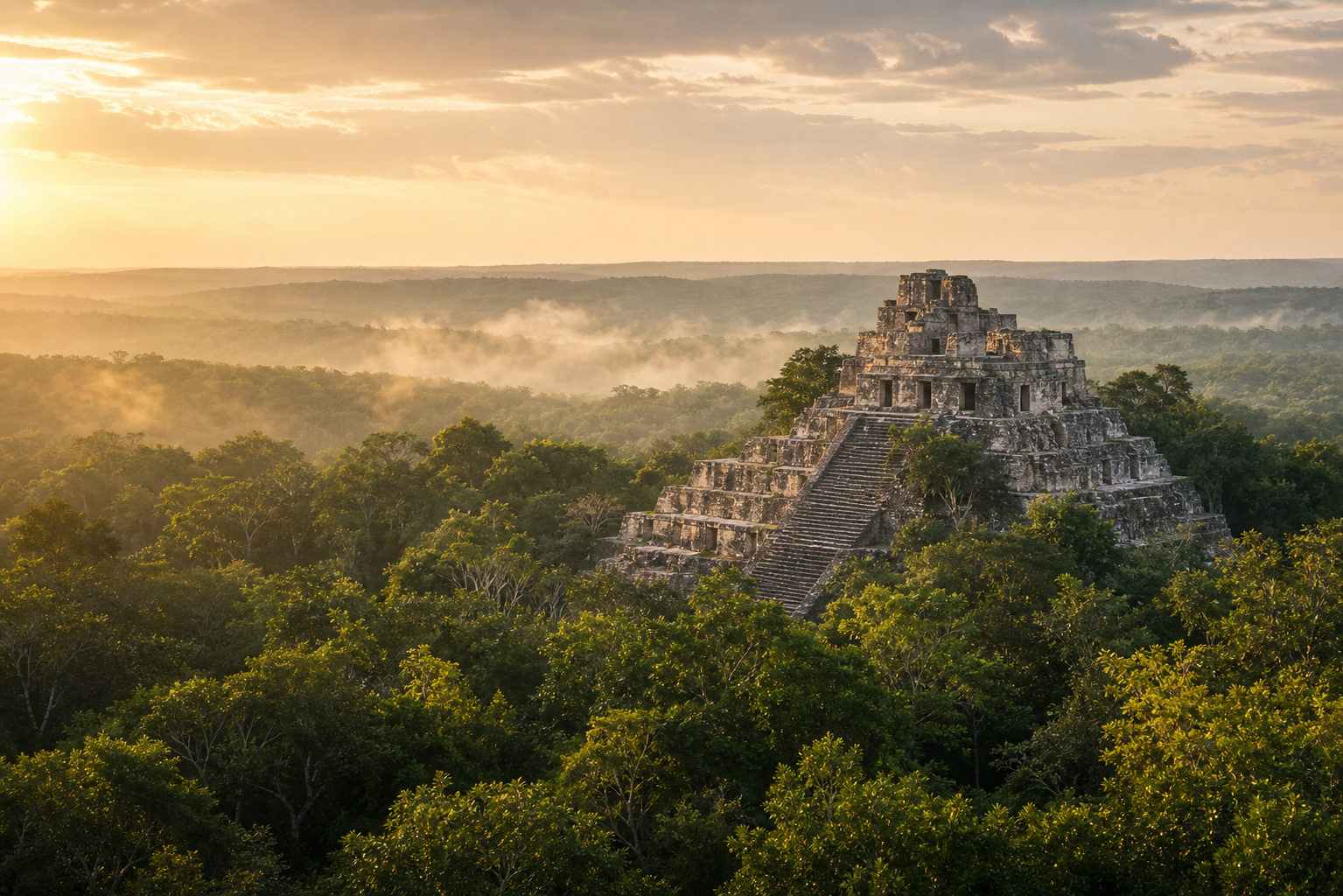
Responsible visiting
Archaeological sites are conservation areas, not open-air playgrounds. Stay on the marked path, respect barriers, avoid touching stucco or carved surfaces, and do not remove stones, plants, or anything else from the landscape. A small fragment is still part of the archaeological record.
Keep voices low around other visitors and staff. The forest carries sound, and the experience is better when people can hear birds, insects, and the explanations of a guide. Take rubbish with you if bins are unavailable, and avoid single-use packaging where practical.
Be thoughtful with wildlife. Do not feed animals, play recordings to attract birds, or approach anything that appears distressed. The reserve and forest around the sites are living habitats, not scenery arranged for a photo. Respect local communities and workers, follow current rules, and ask before photographing people.
 A forest road on the Highway 186 corridor near Xpujil and the Calakmul region
Common mistakes to avoid
The first mistake is treating Chicanná as a quick roadside photo. The famous doorway deserves time, and the surrounding buildings explain why it matters. The second is driving from Campeche City without checking the return plan. Long distances and remote roads are manageable when planned, but they are unforgiving when every delay is ignored.
The third mistake is relying on old opening hours or prices. Use the current INAH page and confirm conditions close to the visit. The fourth is attempting too many ruins in one hot day. A shorter list with attention is better than three hurried walks followed by an exhausted drive.
The fifth is confusing the names of the sites. Chicanná, Becán, Xpujil, and Calakmul are related geographically, but they are not one attraction. Put each entrance and route into your map separately. The sixth is arriving without water, cash, repellent, or a backup plan for weak mobile service.
Is Chicanná worth visiting?
Yes, if you are already exploring the southern Campeche corridor and have an interest in Maya architecture. The site is compact, distinctive, and easy to combine with Becán and Xpujil. Its serpent-mouth façade is memorable, but the broader value lies in seeing how architecture, elevation, forest, and movement work together.
It is not the right choice for every itinerary. From Campeche City, the journey is long, and a short visit can become an exhausting day. Travelers with limited time may prefer Edzná or the historic center of Campeche. Travelers heading toward Calakmul, however, should consider adding Chicanná because it gives the Río Bec region a clearer shape before or after the larger expedition.
The best plan is simple: base yourself near Xpujil, arrive early, carry water, verify current INAH conditions, and give the main façade enough time to reveal its details. Pair Chicanná with one or two nearby sites rather than forcing every ruin into one schedule. That approach leaves room to notice the architecture, respect the forest, and enjoy southern Campeche as a connected cultural landscape rather than a list of entrances. Before setting out, check the official INAH information for Chicanná, confirm your transport back to Xpujil, and leave enough daylight for the return drive. Chicanná rewards a patient visit much more than a hurried detour.
Frequently asked questions
Can you visit Chicanná and Calakmul on the same day?
It is possible only with a very early start, a private vehicle or carefully arranged transport, and a willingness to spend most of the day moving or walking. It is not the comfortable choice for most visitors. Chicanná, Becán, and Xpujil fit together more naturally, while Calakmul deserves its own day.
Is Chicanná suitable without a guide?
Yes. The site can be visited independently, and the compact layout makes self-guided observation straightforward. A guide can add context about Río Bec architecture and Maya history, but do not book a tour unless the listing clearly confirms Chicanná in the itinerary.
Where should you stay?
Xpujil is the most practical base because it is close to the Río Bec sites and provides the region’s main services. Remote lodging may suit travelers seeking a forest setting, but verify meals, electricity, parking, and transport arrangements before committing.
Can children visit?
Yes, provided the family plans around heat, uneven ground, and restricted structures. Early arrival, water, closed shoes, and short breaks make the visit easier. Keep children close to marked paths and explain that archaeological walls and stucco surfaces cannot be touched.
Is Chicanná the same as Xpujil ruins?
No. They are separate archaeological sites in the same southern Campeche region. Chicanná is known especially for its decorated serpent-mouth entrance, while Xpujil is associated with its distinctive towered Río Bec architecture. Both can be visited from Xpujil town.
Do you need a car?
A car is the easiest way to combine several sites and control your schedule, but it is not the only option. Bus travel to Xpujil followed by local transport can work if you stay overnight and confirm the final connection and return plan in advance.
Are there restaurants at the site?
Do not assume there is a full meal service at the archaeological entrance. Eat before visiting, carry water, and plan food around Xpujil or another confirmed stop. Follow current INAH rules about bringing food into the site.
What is the best time of day?
Morning is usually the most comfortable for heat and walking. It also gives you more flexibility if you want to continue to Becán or Xpujil. Check the current opening schedule and last-entry time before travel.
Can you climb the buildings?
Access varies by structure and can change for conservation or safety. Follow barriers and staff instructions. Never climb a closed structure or touch decorated surfaces simply because an old photograph shows someone doing so.
How does Chicanná compare with Edzná?
Edzná is a more convenient excursion from Campeche City and has a different architectural character. Chicanná is farther south, smaller, and more closely tied to the Río Bec cluster. Choose Edzná for efficient access from the capital; choose Chicanná when your route already includes Xpujil and Calakmul Municipality.
What should you verify before leaving?
Check the current INAH page for hours, fees, access notices, and rules. Confirm road and transport conditions, fill up before the remote stretches, download maps, and make sure your accommodation can receive you at the planned arrival time. These small checks matter more in southern Campeche than in a dense urban destination.
A visit to Chicanná is best understood as a close look at one part of a much larger landscape. Give the threshold, the forest, and the neighboring Río Bec sites enough time, and the stop becomes more than a famous doorway: it becomes a practical introduction to the architecture and history of southern Campeche.