Printable guide
Pomuch, Campeche: Complete Travel & Culture Guide
Published
A practical guide to Pomuch in northern Campeche: the town’s bread tradition, church and plaza, respectful cemetery visits, Hanal Pixán, transport, food, and useful nearby stops.

Pomuch is a small town in northern Campeche where food, family memory, Maya heritage, and ordinary town life are closely connected. It is best known outside the state for the annual cleaning of family bones at the local cemetery, a practice associated with Janal Pixán, the Maya season of remembering and feeding the dead. It is also known for pan de Pomuch, a local bread tradition made in wood-fired ovens and sold through bakeries in the town and surrounding Hecelchakán municipality.
That combination makes Pomuch a worthwhile stop, but it is not a themed attraction or a staged cemetery show. The cemetery is a working place of family devotion. The bakeries are working businesses, not a museum display. A good visit therefore depends less on ticking off sights and more on moving slowly, buying something locally made, asking before taking photographs, and understanding what you are seeing.
Pomuch belongs to Hecelchakán municipality in Campeche State, along the old Camino Real corridor between Campeche city and the northern part of the state. It can be visited as a short stop from Campeche city, combined with Hecelchakán and nearby northern Campeche towns, or included in a longer road trip toward Calkiní and the state border. The town is compact, hot, and practical. Bring water, cash, sun protection, and enough time to adjust your plans if a bakery has sold out or a family is using the cemetery privately.
Why visit Pomuch?
Pomuch is a good fit for travelers who want to see a living community rather than another large archaeological complex. The main experiences are modest in scale: walking around the central streets, looking at the local church and plaza, tasting the town’s bread, learning how the cemetery tradition works, and paying attention to the way Maya and Catholic customs coexist in public life.
The town does not offer a long list of formal attractions. That is part of the point. You will not need a packed schedule. A thoughtful half day can cover the centre, a bakery stop, and the cemetery, with time left for Hecelchakán or another northern Campeche stop. If you arrive expecting an entertainment venue, Pomuch may feel quiet. If you arrive prepared to observe respectfully, it can be one of the more memorable cultural visits in the state.
The strongest reason to come in late October or early November is the atmosphere around Janal Pixán. Families clean and arrange the remains of relatives, change embroidered cloths, refresh small ossuary boxes, decorate graves, and bring food and candles. The exact public activity varies from year to year, and the most meaningful moments remain family matters. Outside that season, you can still understand the town’s traditions, see the cemetery architecture, and learn about the practice without treating a private ritual as a spectacle.
Pomuch is also useful for travelers interested in regional food. Pan de Pomuch is associated with the town and neighboring Hecelchakán. Local bakeries have their own rhythms, recipes, and production schedules. Some breads are sweet, while others are made for filling or serving as a savory snack. The practical approach is to ask what has just come from the oven and buy a small assortment rather than arrive with a fixed list of products that may not be available that day.
A short history and cultural setting
Pomuch sits in a region shaped by Maya communities, colonial roads, parish life, agriculture, local commerce, and movement between the Gulf coast and the interior. The old Camino Real connected settlements in northern Campeche and the wider peninsula. Today, the highway makes travel faster, but the towns along the route still have distinct identities and local economies.
The cleaning of bones should be understood within a wider Maya relationship with ancestors and the dead. Janal Pixán is often translated as “food of the souls” or “food for the souls.” In the peninsula, remembrance is not limited to a single parade or a decorative altar. Families prepare food, visit cemeteries, maintain graves, and speak about relatives who have died. In Pomuch, the care given to cleaned bones makes that relationship especially visible.
The practice is sometimes described in travel writing as “bone washing,” although brushing and arranging are more accurate descriptions in many accounts. After burial and the passage of time, families may recover the bones, clean them carefully, wrap them in a freshly prepared cloth, and place them in a small box or ossuary. The details depend on the family, the condition of the remains, and local practice. It is not appropriate to assume that every tomb follows the same pattern or that every family welcomes visitors.
Catholic symbols and Maya remembrance are not separate worlds in Pomuch. Embroidered cloths may carry names, crosses, flowers, or other motifs. Candles, church calendars, family meals, and older ideas about the continuing presence of ancestors can appear together. Avoid explaining the tradition as a simple survival from a distant past. It is maintained by present-day families and changes as generations, materials, local rules, and visitor attention change.
The town’s bread is another expression of continuity. Traditional ovens, firewood, dough, and inherited methods connect household and commercial baking. Even when a bakery uses modern equipment for part of its work, the local identity of pan de Pomuch comes from the town and the way the bread is made, sold, and eaten. A traveler who buys bread directly, asks about the baking process, and does not demand a performance contributes more meaningfully than someone who only photographs an oven.
The centre: plaza, church, and everyday streets
Begin in the central area rather than heading straight to the cemetery. Pomuch’s plaza and church provide an easy orientation point, and the streets around them show the town as residents use it. Look for shade, sit for a few minutes, and notice the mix of houses, small shops, transport activity, and public buildings. This is not a colonial showpiece on the scale of Campeche city. Its value is local and everyday.
The church in Pomuch, Hecelchakán Municipality, Campeche
The church is a useful place to understand the town’s public religious landscape. Check whether the doors are open and whether a service is taking place before entering. Dress more conservatively than you might for a beach stop, keep voices low, and do not photograph people during prayer without permission. The exterior, plaza, and surrounding streets are usually more appropriate subjects than close photographs of worshippers.
A slow walk through the centre may take less than an hour, but do not measure it as a sightseeing circuit. Pomuch rewards small observations: painted facades, shade trees, front rooms opening toward the street, the smell of bread, and the movement of families preparing for an ordinary day. In the hotter part of the day, the pace becomes slower. Plan around that rather than trying to force a long walk in direct sun.
The plaza is also a practical place to reset your route. If you are driving, confirm where it is sensible to leave the vehicle without blocking local access. If you arrived by bus or colectivo, ask locally about the return direction before wandering far. Rural and small-town transport is not always displayed in a way that is easy for visitors to read, and schedules can change.
Pan de Pomuch and the bakery tradition
Pan de Pomuch is one of the clearest reasons to visit outside the cemetery season. The bread is associated with a local baking tradition that uses wood-fired ovens and recipes passed through generations. A bakery may produce different shapes and fillings depending on the day. Some loaves are soft and sweet; others are made as savory pieces or filled breads. The best purchase is often whatever is fresh when you arrive.
One well-documented local bakery tradition is connected with La Huachita, which has been described in regional cultural and food coverage as a long-running bakery in the Pomuch area. Because businesses can change hours, ownership, product availability, and visitor policies, verify locally before making a special trip for a particular item. If the bakery you hoped to visit is closed, that does not mean the town has nothing to offer: ask where residents are buying fresh bread that day.
When you enter a bakery, start with a simple question in Spanish: “¿Qué salió del horno?” or “¿Qué pan está fresco?” You do not need a long explanation. Pointing, asking the price, and buying a small amount is usually easier than trying to identify every product in advance. Prices and payment methods vary, so carry smaller Mexican notes and coins. Do not assume that card payment is available.
The bread travels well for the remainder of a day, but protect it from heat and crushing. If you are continuing toward Campeche city, keep it in a breathable bag rather than sealing warm bread in plastic immediately. If you are driving deeper into the state, buy enough for the journey but remember that fresh baked goods are part of the moment, not a substitute for a meal and water break.
Ask before photographing ovens, bakers, children, or people waiting to buy bread. A photograph of a loaf or the exterior may be fine, but a working bakery is a workplace. The fire, preparation area, and family recipes are not automatically public. If someone takes time to explain the process, buy something and thank them; do not turn a short purchase into an unpaid interview.
The Pomuch cemetery and the cleaning of bones
The cemetery is the reason many international visitors first hear about Pomuch. It is also the place where the town most needs respectful behavior. The cleaning of bones, known locally as Cho’o Ba’ak in reports about the tradition, is a family practice of care and remembrance. It is not a haunted attraction, a museum collection, or an opportunity to pose with human remains.
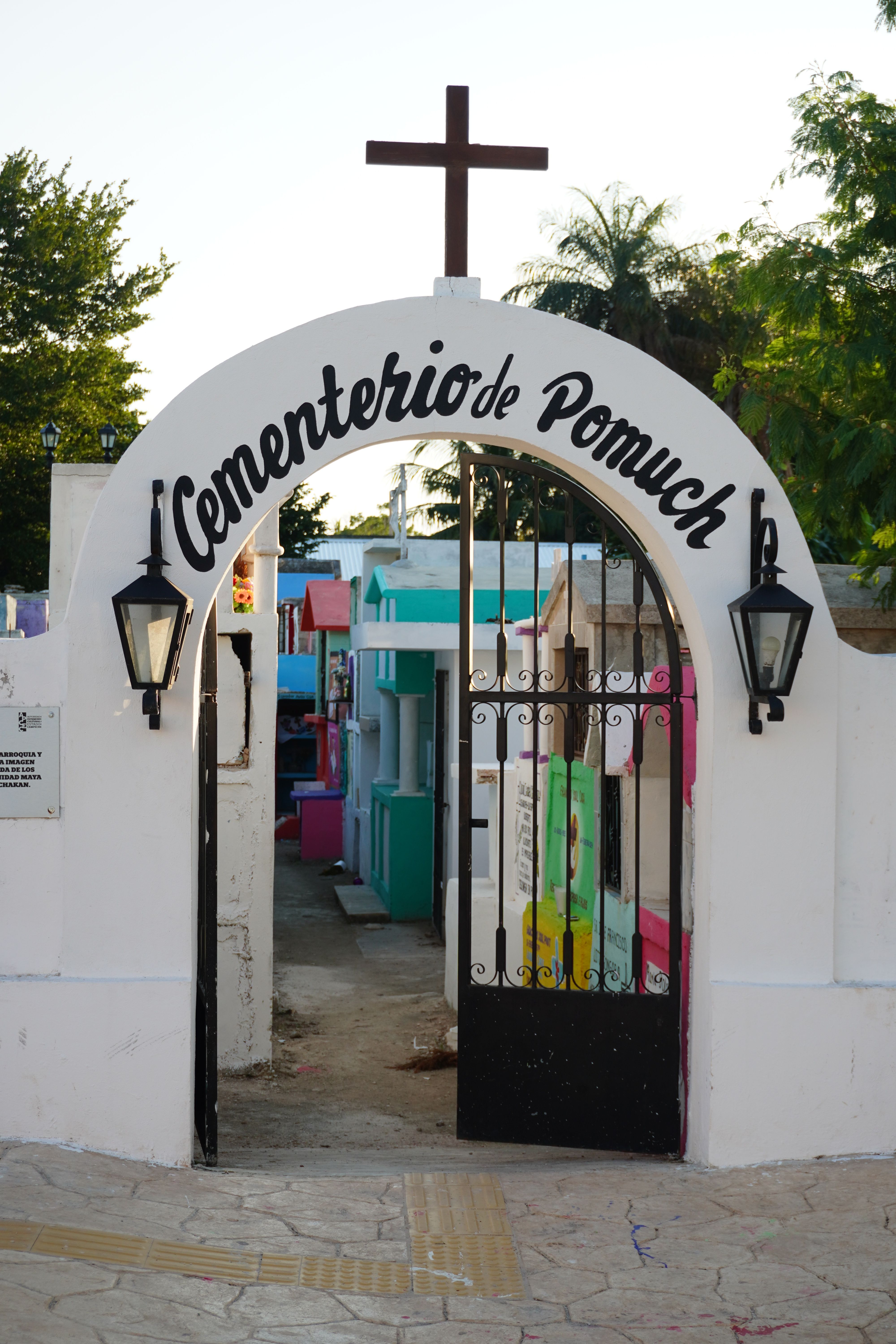 Pomuch cemetery entrance in Campeche
During the season, families may clean dust from bones with a small brush, change embroidered cloths, repaint or maintain an ossuary, add flowers, and light candles. The remains may be arranged in a small box with the head above the other bones. Practices differ between families, and not every ossuary is available for public viewing. Some relatives may welcome a brief greeting; others may want privacy.
The National Institute of Anthropology and History has described the practice as taking place annually in Pomuch and has noted the importance of the embroidered cloths, names, religious motifs, and small boxes kept in the cemetery. That official description is useful because it places the custom in a living cultural setting rather than reducing it to a shocking image.
If you visit the cemetery outside the main season, you may see decorated tombs and ossuaries but not the active cleaning. That is normal. Do not ask a family to open a box, remove a cloth, or recreate the ritual for a photograph. If the cemetery is quiet, treat that quiet as the correct visitor experience.
If you visit around October 25 through November 2, expect more activity but not a guaranteed public timetable. The dates commonly associated with Janal Pixán include October 31, November 1, and November 2, yet family preparation can begin earlier and community events may be announced separately. Verify current arrangements with the municipality, local cultural organizers, or a locally based guide. Do not rely on a social media post from a previous year as a current schedule.
Cemetery etiquette that matters
- Ask permission before photographing any grave, ossuary, family member, or ritual activity.
- Never touch bones, boxes, cloths, candles, flowers, or personal offerings.
- Do not use flash near people who are working or praying.
- Keep voices low and dress respectfully.
- Do not block a family’s path to a tomb or stand over someone cleaning remains.
- Do not photograph children without a parent or guardian’s permission.
- Never take a fragment, bone, cloth, flower, or object from the cemetery.
- If a family says no, accept the answer immediately.
- Avoid eating, drinking, laughing loudly, or staging portraits among the graves.
The most important rule is to ask whether photography is welcome at all. A cemetery can be open to visitors while particular family activities remain private. Being physically allowed through a gate is not the same as having consent to document everything you see.
Visiting during Janal Pixán
Janal Pixán changes the texture of Pomuch. Families may prepare food, clean graves, place candles, and spend time with relatives at the cemetery. The town can feel busier, but it may also be harder to find parking, a quiet place to eat, or a clear public programme. The most responsible plan is flexible: arrive early, spend time in the centre, ask about any public events, and leave the cemetery when it becomes crowded or when families need space.
The season is not Mexico’s Halloween. Costumes and commercial photography can flatten the meaning of the event, especially when visitors approach human remains as something exotic. Listen for the language local families use. Hanal Pixán is about feeding and remembering the souls, while the cleaning of bones is a practical and emotional act of continuing care.
Food is central. Families may prepare dishes associated with the season, including mucbipollo in parts of the peninsula, but availability in Pomuch varies by household, market, bakery, and event. Do not promise yourself a particular dish without checking current local information. If you see a community sale, ask what the dish contains and whether it is intended for public purchase or a family offering.
The season also has practical drawbacks. Weather can remain hot, rain can affect roads and outdoor events, and the cemetery ground may be uneven or muddy. Crowds are not necessarily large by major-city festival standards, but the narrow streets and small-town facilities can feel busy. Bring water and cash, avoid bringing a large backpack into crowded spaces, and make sure your return transport is arranged before evening.
Food beyond the bread
A Pomuch visit is not a restaurant crawl. The town is better approached through bakeries, markets, small food counters, and whatever local meal is being prepared that day. Names and businesses change, so the reliable advice is to ask residents where they would eat now rather than copy a static list.
Try the bread fresh, but also ask whether a savory filling is available. In northern Campeche, regional cooking reflects Maya ingredients, maize, achiote, chiles, poultry, pork, and local habits that vary from one town to the next. You may encounter tamales, stews, panuchos, salbutes, or other familiar peninsula foods, but recipes and names are not identical everywhere.
If you buy from a market or street stand, observe turnover. A busy stand with food being cooked and served continuously is generally a better choice than food sitting uncovered in the heat. Choose water from a sealed bottle unless you have confirmed the source of other drinks. Carry a small supply of drinking water because the walk between stops may not include a convenient shop.
Visitors should not treat local food as an anthropological sample. Ask what something is, whether it contains meat, and how spicy it is. If you have allergies, explain them clearly in Spanish and do not rely on a vague gesture. If you are vegetarian, say so before ordering; a dish with vegetables may still be cooked in animal fat or broth.
How to get to Pomuch from Campeche city
Pomuch is easiest to visit from Campeche city by road. The route follows the northern corridor through or toward Hecelchakán, with the exact journey time depending on traffic, road works, stops, and whether you use a local service or a private vehicle. A rental car gives you the most control, especially if you want to combine Pomuch with Hecelchakán, Calkiní, Bécal, or another northern Campeche stop.
Driving is straightforward in broad terms, but do not treat the route as an urban day trip. Leave fuel margin, keep navigation available offline, and avoid assuming every town has a convenient card-paying fuel station or reliable mobile signal. Use daylight for the return if you are unfamiliar with the region. Topes, motorcycles, pedestrians, buses, and animals can all change the pace.
Public transport is possible, but the last local connection requires more attention. Ask at the relevant Campeche or Hecelchakán transport point for the current service to Pomuch and confirm where you should wait for the return. There may be a colectivo, combi, or local bus rather than a clear tourist shuttle. Timetables can be informal, and a service that runs in the morning may be less frequent later in the day.
If you use public transport, make the trip smaller and more realistic: visit the centre, buy bread, see what is appropriate at the cemetery, and return before the last connection you have independently confirmed. Do not build a long chain of northern towns around a single unverified departure time.
A taxi can be useful for the final connection or for a short local transfer, but agree on the destination and fare before leaving. If you want a private driver for several stops, negotiate the full route in advance and clarify whether waiting time, fuel, and return travel are included. Do not assume that a driver who takes you to Pomuch will automatically be available for the return.
Compare Campeche-area tours and day trips on GetYourGuide · See current Viator options for Campeche experiences
Using Pomuch as a northern Campeche day trip
Pomuch works well as one stop in a route rather than as the only destination of a full day from far away. From Campeche city, you can combine it with Hecelchakán, then continue toward Calkiní or Bécal if your transport and opening times line up. The more stops you add, the more important it becomes to leave buffer time for food, local transport, and unplanned delays.
Hecelchakán is the logical companion because it is the municipality’s main town and provides additional services. It has its own church, central area, local food, and cultural history.
 Church in Hecelchakán, Campeche, near Pomuch
The Archaeological Museum of the Camino Real has been associated with the region’s Maya material and is a possible addition when it is open. Verify current opening arrangements locally before making it the reason for your trip.
Calkiní offers another northern Campeche perspective, with regional crafts and town life. Bécal is known for jipijapa hat-making traditions and caves used by artisans in the area. These places are in the same broad northern corridor, but they are not interchangeable. Pomuch is not Bécal, and a visit to one does not count as seeing the other. Allow time for each community rather than treating the route as a list of photo stops.
If your main goal is the cemetery tradition, do not dilute the visit with too many extra attractions. Arrive with enough time to learn, ask permission, and leave calmly. If your main goal is food and town culture outside Hanal Pixán, give the bakery and centre priority, then use the rest of the day for Hecelchakán or Calkiní.
Where to stay
Most travelers will sleep in Campeche city and visit Pomuch on a road day. This is convenient if you want the walled centre, the malecón, and a larger choice of lodging and evening food. It also means an early start and a return journey, so avoid adding a long nighttime drive after a hot day.
A second option is to stay closer to the northern corridor when you are already traveling that way. Availability in smaller towns is more limited and may not be listed consistently on international booking sites. Confirm check-in arrangements, payment method, parking, and whether breakfast is actually provided rather than assuming the listing is current.
If you want a simple base in Campeche city before or after the day trip, compare current availability rather than choosing a named property from an old article. Check current Campeche city rates on Booking.com · Compare Campeche stays on Trip.com
Pomuch itself is not a resort base. A short local stay may be possible, but it should be treated as a practical small-town arrangement, not as a guaranteed hotel destination. Ask locally and book ahead if an event around Janal Pixán is bringing visitors to the area.
Best time to visit
Choose the season according to your purpose. Late October and early November are the most culturally significant period because of Janal Pixán and the preparation around the cemetery. This is also the period when visitor sensitivity matters most. You may see more decoration and public activity, but you may also encounter crowds, rain, heat, and private family moments that should not be photographed.
The dry season can make a road trip more comfortable, although Campeche remains warm and strong sun is possible. Mornings are usually easier for walking and errands. If the bakery is important, arrive early enough to find fresh production, but confirm the business’s current routine rather than relying on a generic “open early” assumption.
The rainy season does not make Pomuch impossible. It does make flexible planning more valuable. Carry a light rain layer, protect your phone and camera, and allow extra time on the road. Cemetery paths can be less comfortable after rain, and outdoor community activities may move or change.
Avoid the hottest middle hours for a long outdoor walk. Pomuch is compact, but compact does not mean cool. Shade is uneven, and the combination of sun, humidity, and standing around can be tiring. A short visit with water is better than an ambitious itinerary that leaves you uncomfortable and inattentive.
What to bring
Bring water, cash in small denominations, sun protection, comfortable shoes, and a phone with an offline map. A small Spanish phrase sheet helps more than a large camera. If visiting the cemetery, bring patience and leave extra room in your bag for bread only after you have protected it from crushing.
Wear clothes suitable for a church and cemetery. You do not need formal clothing, but very beach-oriented attire can feel careless in a family ritual setting. Closed shoes are useful on uneven ground. A hat is practical outside, but remove it when local etiquette or a religious setting calls for it.
If you are traveling with children, explain before entering what a cemetery is and why families may be cleaning bones. Let children ask questions quietly, but do not allow touching, running, or close-up photography. If a child is not ready for the setting, stay in the plaza and bakery area instead.
Photography equipment should be discreet. A phone is often less intrusive than a large camera, but a phone can still be disrespectful if held close to a family. Ask first, lower the device when someone approaches a tomb, and never use a drone over the cemetery or homes.
Accessibility and pace
Pomuch is a working small town, not a fully interpreted visitor site. Sidewalks can be uneven, shade can be limited, and cemetery paths may be difficult for wheelchairs or anyone who has trouble walking on rough ground. Ask locally about the easiest entrance and route, but do not expect ramps, signage, or accessible toilets at every stop.
Travelers with mobility limitations may find the plaza and church exterior easier than the cemetery. A bakery purchase can be arranged with less walking if a companion enters, but ask the business what is practical. Heat management is important for everyone, especially older travelers and people with heart, respiratory, or blood-pressure conditions.
There is no need to rush. Pomuch is more rewarding when the schedule leaves space for a conversation, a change of weather, a closed door, or a family request for privacy. Build the day around two or three meaningful stops rather than a long checklist.
A respectful half-day plan
Start in the centre in the morning. Walk around the plaza and church exterior, then find a current local bakery or bread seller. Ask what is fresh and buy something to share later. Use the first part of the visit to understand the town before entering the cemetery.
Next, visit the cemetery only if it is appropriate and open to visitors. Outside the Janal Pixán season, look at the layout and decoration without expecting active cleaning. During the season, ask whether photography is allowed and follow any local guidance. Spend less time than you think you need; leaving before the space becomes crowded is often the considerate choice.
Have a simple meal or drink locally if available, then continue to Hecelchakán or return toward Campeche city. If you are driving, check fuel and route conditions before leaving Pomuch. If you are using public transport, return to your agreed pickup point with plenty of margin.
This plan can be extended with Calkiní or Bécal, but only if transport has been confirmed and you are not trying to fit every northern town into one afternoon. Pomuch is close enough to combine, yet culturally specific enough to deserve its own attention.
Common mistakes to avoid
The first mistake is treating the cemetery as a spectacle. Human remains are not props. A visitor who takes an intrusive photograph may create a lasting problem for a family, even if the image is technically taken in a public place.
The second is visiting only on November 1 or 2 without checking current arrangements. The important work may begin earlier, and public events may be scheduled differently. The town’s regular life continues after the festival period, and the bread tradition is not limited to Day of the Dead.
The third is assuming that a famous bakery or product will be available at a convenient hour. Small businesses close, sell out, change schedules, and prioritize local customers. Ask what is available now and accept a substitute.
The fourth is driving back after dark without planning. Northern Campeche roads can be manageable, but fatigue, wildlife, topes, and limited lighting increase the burden. If the visit is part of a longer route, consider sleeping closer to the corridor rather than forcing a late return.
The fifth is using “Maya” as a decorative label without listening to local explanations. Pomuch is a contemporary community, not a reconstruction. Its traditions belong to families who decide how they are practiced and shared. Approach the town with curiosity, not a hunt for the most shocking image.
Is Pomuch worth visiting?
Yes, if you are interested in community culture, regional food, and the less polished side of Campeche State. Pomuch is not the best choice if you want a full day of conventional attractions, nightlife, or guaranteed tourist infrastructure. It is a good stop for travelers who can be patient, travel independently, and respect boundaries.
The town’s strongest experiences are connected: the bread shows how tradition can remain part of working commerce; the plaza and church show everyday public life; the cemetery shows a distinctive form of family remembrance. None of these should be separated from the people who maintain them.
Plan a half day, go in the morning, carry water and cash, verify transport, and ask before photographing. If you visit during Janal Pixán, give the cemetery more respect and less camera attention. If you visit at another time, buy fresh bread, walk the centre, and let Pomuch be a real town rather than a one-image curiosity. That approach gives you a better chance of understanding why this small place matters in Campeche.
Compare northern Campeche and Campeche city accommodation on Booking.com · See additional hotel availability on Trip.com
For a wider northern route, combine Pomuch with one nearby town and one practical meal stop, then return with daylight left. The visit does not need more than that: a careful look, a fresh loaf, and the recognition that the most important parts of Pomuch are still lived by its residents rather than performed for visitors.
Frequently asked questions
Is Pomuch in Campeche State?
Yes. Pomuch is a community in Hecelchakán municipality in Campeche State, in the northern part of the state along the Camino Real corridor.
Can I visit the cemetery outside Day of the Dead?
You may be able to visit the cemetery, but conditions and access can vary. Outside Janal Pixán, do not expect to see active bone cleaning. Ask locally, behave quietly, and respect any request not to photograph or enter a particular area.
Can tourists watch the cleaning of bones?
Visitors may encounter the practice during the seasonal period, but it remains a family ritual. Never assume that watching or photographing is permitted. Ask first, follow local guidance, and leave if families need privacy.
What is pan de Pomuch?
Pan de Pomuch is bread associated with Pomuch and the surrounding Hecelchakán area. Local bakeries are known for traditional recipes and, in some cases, wood-fired ovens. The exact products available vary by bakery and day.
How long should I spend in Pomuch?
A respectful half day is enough for the centre, a bakery stop, and an appropriate cemetery visit. Add time if you are speaking with local cultural guides or combining Pomuch with Hecelchakán, Calkiní, or Bécal.
Should I take a tour?
Independent travelers can visit by car or local transport, but a locally based cultural guide can help with interpretation and etiquette, especially during Janal Pixán. Compare the guide’s current route and permissions rather than booking any experience that promises guaranteed access to private rituals.
Is Pomuch suitable for children?
Older children and teenagers who can follow cemetery etiquette may learn from the visit. Explain the setting beforehand, prohibit touching and intrusive photographs, and keep the visit short if the child is uncomfortable. A bakery and plaza visit can stand alone if the cemetery is not appropriate for your family.
Where should I stay for Pomuch?
Campeche city is the simplest base for most visitors because it has more lodging and onward transport. Hecelchakán or another northern town may work during a longer road trip, but small-town availability should be confirmed directly and ahead of time.
Does Pomuch have a large tourist festival every year?
Seasonal activity around Janal Pixán is important, but public programming, crowd levels, and event dates can change. Verify the current year’s announcements locally instead of assuming a previous schedule will repeat.
What is the most respectful way to visit?
Arrive with time, ask permission before photography, do not touch any remains or offerings, buy locally when appropriate, listen more than you speak, and leave space for families. Pomuch is a living community first and a travel stop second.
Before leaving, check the day’s return transport or fuel plan, pack the bread so it will not be crushed, and make sure the cemetery has not become a private family space. Pomuch is most rewarding when you leave with a better understanding of local care and continuity—not just a photograph.