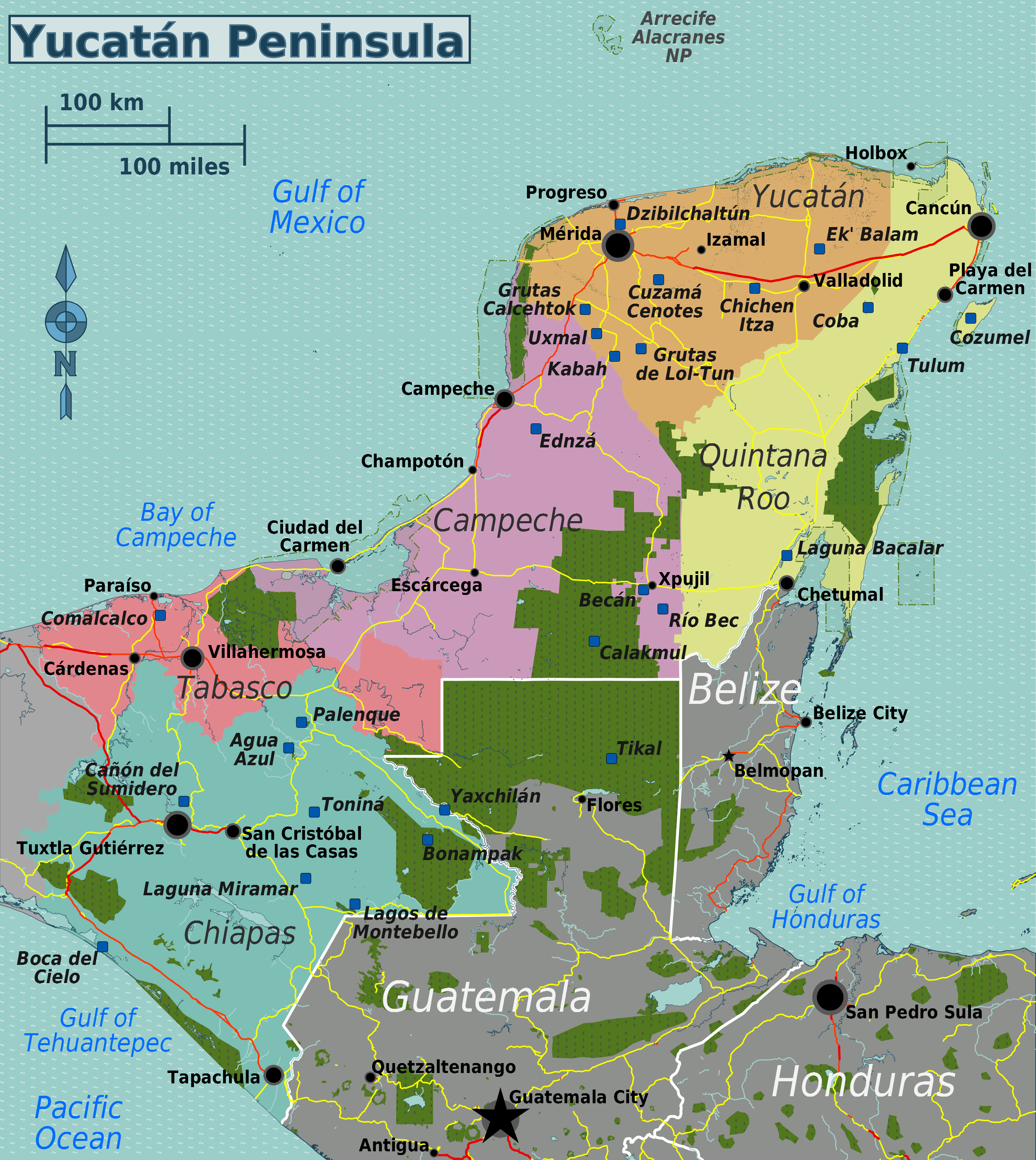
Leaving the lagoon of seven colours behind and heading west to the walled city is a long crossing — roughly 400 km from Bacalar to Campeche with no single transport mode that excels on both speed and simplicity. The bus is the cheapest option at around 500–850 MXN but takes most of a day. Driving cuts the time to about 5.5–6 hours but adds toll and fuel costs of 1,500–1,800 MXN. The Tren Maya adds a comfortable middle ground if you are willing to plan around limited departure times.
This guide covers all three options with the details you need to choose and book.
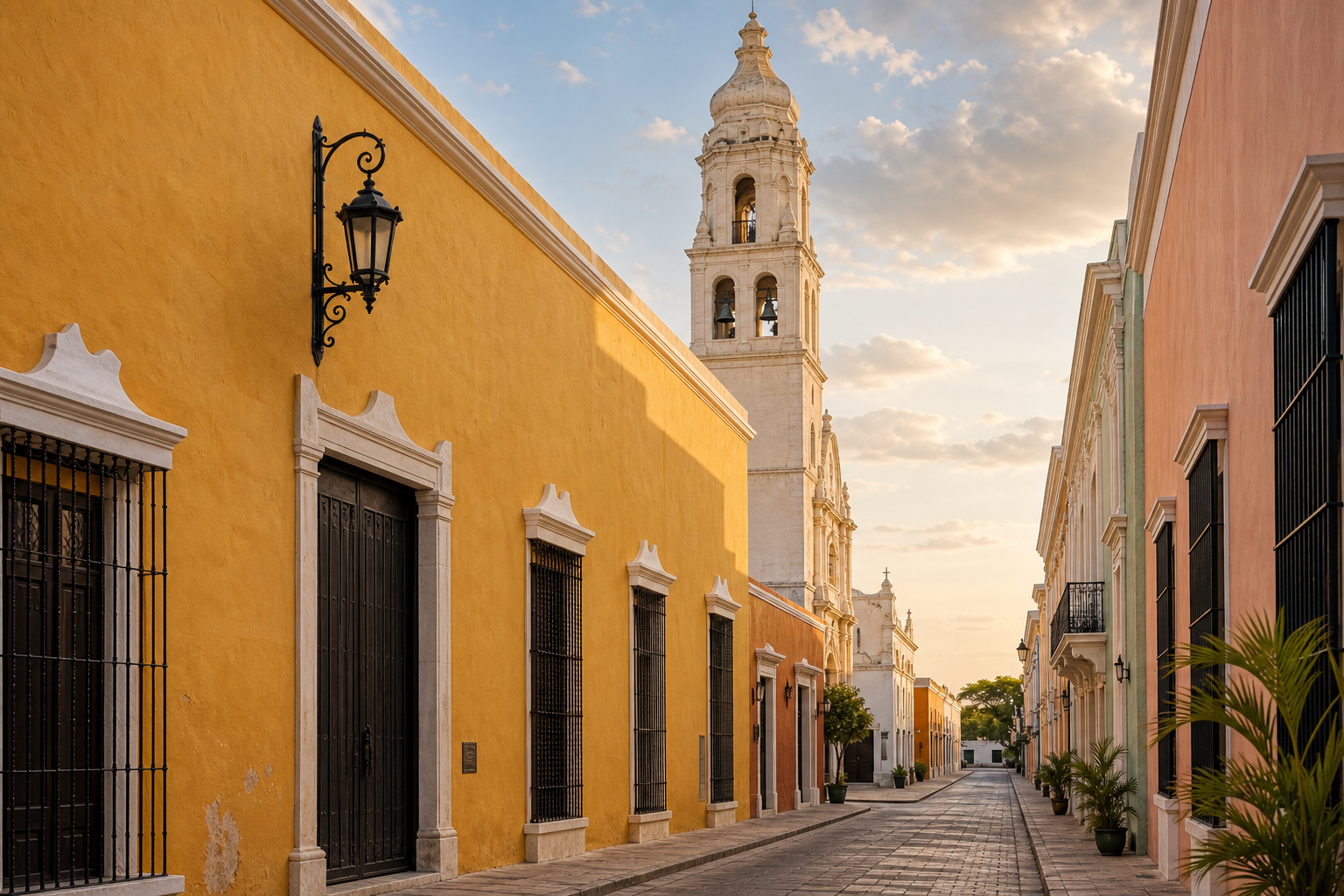
 Bacalar Lagoon, the starting point for this westward crossing
Bus: The Budget Route
ADO operates daily service from Bacalar to Campeche with departures spread across the day. The average journey runs 8–9 hours, though some combinations via Chetumal or Escárcega stretch longer.
Practical details:
- Departure point: ADO Bacalar, located on Calle 19 Libramiento
- Arrival point: ADO Campeche, Av. Patricio Trueba de Regil 237, Tepeyac
- Frequency: Approximately 4 departures daily
- Fares: 500–850 MXN per person (about US$27–46)
- Classes available: ADO (first class) and ADO GL (premium with wider seats, fewer passengers)
The fastest bus clocks in around 7h 20m. Longer itineraries involve a transfer at Escárcega or Chetumal, which adds waiting time. If you book, aim for a departure between 12:35 and 16:50 to arrive at a reasonable hour — the late-night departures arrive between midnight and 4:00 AM, which works only if you have accommodation sorted.
On-board experience: ADO first-class buses have reclining seats, air conditioning (often strong — bring a light jacket), a restroom at the rear, and overhead screens. ADO GL adds more legroom and fewer seats per row. Wi-Fi is advertised but unreliable on this route. The road from Bacalar to Campeche is paved and generally smooth, though the stretch through Escárcega can have rough patches.
Where to buy: Book through ado.com.mx or the ADO app. You can also buy at the Bacalar station ticket counter, but advance booking matters during holiday periods (July–August, December, Semana Santa).
Terminal notes: The Bacalar ADO stop is a small station with a ticket counter, waiting area, and basic restrooms. It is not a full-service terminal — there is no café or luggage storage. Arrive 20–30 minutes before departure, especially for early-morning buses when staff may still be setting up. The Campeche ADO station is larger, with a café, restrooms, taxi stand, and a small convenience store. It sits on the eastern edge of the city, about 2 km from the walled centre.
Need transport? Book a transfer on WhatsApp.
Driving: Fastest but Most Expensive
The drive from Bacalar to Campeche covers approximately 417 km and takes 5.5–6 hours under normal conditions. The route follows Highway 180 east to west across the southern Yucatán Peninsula, passing through or near Chetumal, Escárcega, and Champotón.
Route overview:
- Head north from Bacalar on Highway 307 toward Chetumal (about 40 km)
- Merge onto Highway 180 west toward Escárcega
- Continue through Escárcega, then take the Champotón–Campeche toll road (Highway 180D) for the final stretch
- Arrive at Campeche City via the Periférico
Tolls and fuel costs (approximate):
| Segment | Toll (MXN) |
|---|---|
| Champotón–Campeche (180D) | 63 |
| Fuel (417 km, mid-size car) | 1,400–1,600 |
| Total estimated cost | 1,500–1,700 MXN |
Tolls are paid in cash or by card at CAPUFE plazas. The Champotón–Campeche toll road is well-maintained and saves time compared to the free Highway 180, which passes through several towns with lower speed limits.
Road conditions: Highway 180 is mostly two lanes, paved, and flat. Watch for topes (speed bumps) entering towns and villages — they are often poorly marked. The stretch between Escárcega and Champotón has occasional potholes after heavy rain. The final 180D segment into Campeche is a modern four-lane toll road with regular rest stops.
Time zone note: Bacalar and the entire state of Quintana Roo observe Eastern Time (UTC-5). Campeche uses Central Time (UTC-6). When you arrive in Campeche, your phone may not auto-update the time zone immediately — set your clock back one hour to stay local. This matters for bus schedules, restaurant hours, and check-in times.
Rental car note: If you pick up a car in Bacalar, confirm with the rental agency that you can drop off in Campeche (one-way drop-off). Not all agencies permit this, and those that do often charge a fee of 1,500–3,000 MXN. International agencies (Hertz, Europcar, Sixt) operating out of Cancún or Chetumal tend to be more flexible than local outfits.
Rest stops and food on the road: Highway 180 has limited formal rest stops. The best place to break is Escárcega, where you will find several casual restaurants (try the cochinita pibil at the market stalls near the bus station), clean restrooms, and fuel stations. There is also a Pemex station with a small convenience store at the junction near Champotón. Beyond that, the road is mostly small villages with basic tiendas — do not count on finding a proper meal between Escárcega and Campeche.
Tren Maya: The Scenic Middle Ground
The Tren Maya connects Bacalar station to Campeche station as part of its southern route. The train is modern, air-conditioned, and comfortable — a significant upgrade from the bus for this distance.
Route and timing:
- Bacalar station → Campeche station (via Felipe Carrillo Puerto, Escárcega, Edzná)
- Duration: Approximately 6–7 hours including the full southern corridor
- Frequency: Limited — typically one to two departures daily on this segment
- Fares: 600–1,200 MXN depending on class (tourist vs. premier) and booking timing
The Tren Maya does not run a direct Bacalar–Campeche express. The train makes multiple stops including Felipe Carrillo Puerto, Limones-Chacchoben, and Escárcega before reaching Edzná and Campeche. Total travel time is comparable to the bus but with a smoother ride and better scenery — the train cuts through jungle and passes near archaeological sites.
Getting to Bacalar station: The Tren Maya station is located outside the town centre. A taxi from central Bacalar to the station costs about 80–120 MXN and takes 15–20 minutes.
Getting from Campeche station to the city centre: The San Francisco de Campeche Tren Maya station is on the east side of the city. The Tren Ligero (light rail) connects the Tren Maya station to the Centro Histórico in about 20 minutes. Taxis from the station to downtown cost 100–150 MXN.
Booking: Tickets are available at trenmaya.gob.mx and at station counters. Book ahead during peak season — the southern route has fewer trains than the Cancún–Mérida corridor and sells out faster than you might expect.
On-board experience: The Tren Maya runs modern carriages with air conditioning, large windows, reclining seats, and a small café car on longer-distance services. The ride is smooth and quiet compared to the bus, and the jungle scenery between Bacalar and Escárcega is genuinely impressive — dense canopy, occasional glimpses of wildlife, and the sense of crossing a sparsely populated stretch of the peninsula. Restrooms are available at the rear of each carriage. The train reaches a maximum speed of 160 km/h but averages lower due to stops and curves.
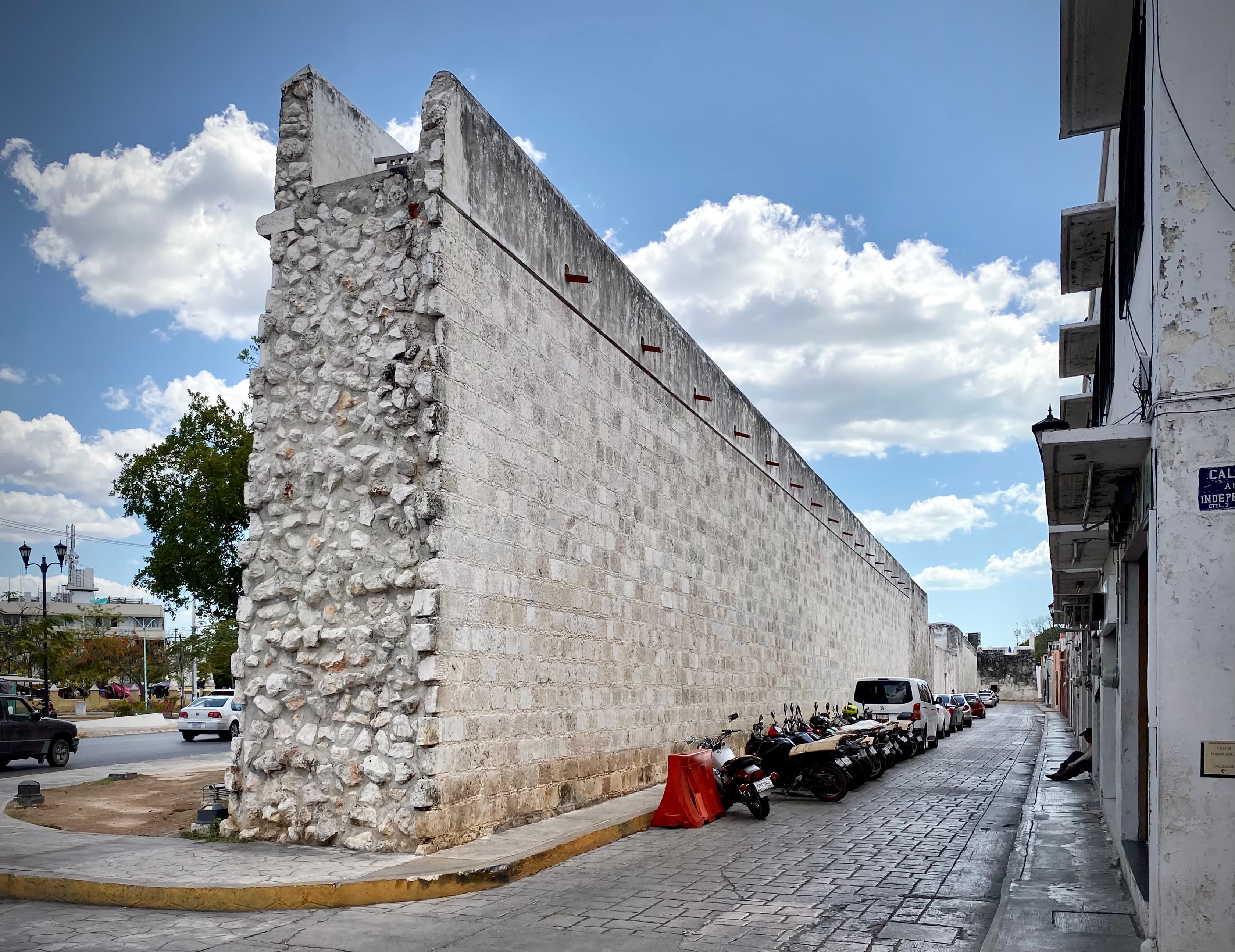
 The walled historic centre of Campeche, your destination
Quick-Reference Comparison
| Mode | Duration | Cost (MXN) | Best For |
|---|---|---|---|
| Bus (ADO) | 8–9 hours | 500–850 | Solo travellers, tight budgets |
| Driving | 5.5–6 hours | 1,500–1,700 | Groups splitting costs, flexibility |
| Tren Maya | 6–7 hours | 600–1,200 | Comfort, scenery, no driving fatigue |
Which Should You Choose?
Take the bus if: You are travelling solo or as a couple on a tight budget, you do not mind a long day in a seat, and you want the simplest booking process. The bus is also the best option if you are staying in central Bacalar and central Campeche — both stations are walkable from the main areas, so no taxi transfers are needed at either end.
Drive if: You are a group of three or four splitting costs, you want to stop at Edzná or the Champotón coast along the way, or you are continuing deeper into Campeche State (Calakmul, the Río Bec ruins) and need a car at your destination. Driving also makes sense if you are arriving in Bacalar with a rental from Chetumal or Cancún and want to loop through Campeche before returning the car elsewhere.
Take the Tren Maya if: You value comfort over speed, you want to see the jungle interior of the peninsula, or you are combining this leg with other Tren Maya stops (Edzná, Escárchega, Calakmul access via Xpujil). The train is also the best choice if you are not comfortable driving on Mexican highways or if you want to avoid the fatigue of a 6-hour drive after several days of travelling.
Skip flying: There is no practical air connection between Bacalar and Campeche. The nearest airports with commercial service are Chetumal (CTM) and Campeche (CPE), and no airline operates this route. Flying would require connecting through Mexico City, which takes longer and costs 10–20 times more than any ground option.
Practical Tips
When to travel: Morning departures work best for all three modes. The bus and train both run less frequently after 6:00 PM, and driving Highway 180 at night means sharing the road with trucks and unlit cyclists — avoid it if you can.
What to bring: Snacks and water for the bus or train — there are limited food options on board. For driving, download offline maps (cell service drops between Escárcega and Champotón). Cash in small denominations for tolls and roadside stops.
Where to break the journey: If 8 hours feels like too much in a single push, Escárcega is the natural halfway point. It has bus stations, a few basic hotels, and several casual restaurants. Splitting the trip across two days also lets you stop at the Edzná ruins, which sit just 30 minutes east of Campeche and make a worthwhile detour.
Arriving in Campeche: The ADO station is about 2 km from the Centro Histórico. A taxi to the walled city costs 60–80 MXN. If you arrive by Tren Maya, take the Tren Ligero to the Centro Histórico station — it runs every 15–20 minutes and costs 10 MXN. Driving in, follow signs for "Centro" and park near the Puerta de Tierra or the Malecón; the historic centre is best explored on foot.
Time zone reminder: Set your clock back one hour when you cross from Quintana Roo into Campeche. Your phone may not do this automatically, and missing a bus departure or restaurant reservation by an hour is an easy mistake to make.
Need transport? Book a transfer on WhatsApp.