
If you are arriving in San Francisco de Campeche by road, the ADO terminal is likely to be one of the first places you use. It is the city’s main long-distance bus station, a practical connection point rather than a sightseeing stop, and the place to organize onward travel toward Mérida, Ciudad del Carmen, Escárcega, Villahermosa, Palenque, Cancún, and other destinations in southeastern Mexico.
The useful thing about taking a bus from Campeche is that the network makes a car-free trip possible. The less convenient thing is that Campeche State is geographically wide. A route that looks simple on a map can take most of a day, and smaller archaeological sites, coastal villages, and jungle bases are not served with the same frequency as the major cities. A little planning at the station saves a lot of uncertainty later.
This guide explains where the terminal is, how to buy a ticket, what to confirm before boarding, which routes are most useful, when ADO is the wrong tool, and how to connect the bus station with the historic centre, the airport, the Tren Maya station, and southern Campeche.
Where the ADO Campeche bus station is
The terminal is on Avenida Patricio Trueba de Regil, beside the Casa de Justicia area and close to the Bodega Aurrera on the same avenue. Maps and ticket systems may label it “Terminal ADO Campeche,” “ADO Campeche,” or “Central de Autobuses de Campeche.” These names refer to the same main intercity terminal in the capital.
 ADO bus terminal in Campeche
It is outside the walled historic centre. That matters when you are choosing a hotel or estimating the time needed for an early departure. The terminal is not a pleasant place to discover that you have only five minutes before boarding, particularly if you have luggage and still need to find the correct platform.
The building is compact and functional. Expect ticket counters, a waiting area, restrooms, luggage handling, and taxis near the entrance. Services and conditions can change, and not every amenity is guaranteed at every hour. Treat the station as a transport facility: useful for buying, confirming, and boarding a bus, but not as a place to spend a long layover if you can avoid it.
For a first visit, save the terminal in your map application before leaving your hotel. Search for the terminal name rather than only “Campeche bus station,” because the city has other stops and local transport points. If a taxi driver seems unsure, say “la terminal ADO” and show the destination on your phone.
Need transport? Book a transfer on WhatsApp.
Getting there from the historic centre
A taxi is the simplest choice from the walled city, especially with a suitcase, a child, or a departure before sunrise. Leave extra time for traffic and for the possibility that the driver needs the terminal entrance rather than a nearby avenue. Ask about the fare before the journey if the taxi is not metered. Prices change, so it is better to confirm locally than rely on an old guide or a number remembered from another trip.
The historic centre is compact, but the terminal is not inside it. Walking with luggage is generally not the sensible option. Local buses and colectivos can be cheaper, but routes and stopping points are less intuitive for a visitor, and a service that works during the day may not be convenient for an early intercity departure. If you use public transport, ask at your accommodation or at a nearby shop which current route passes close to the terminal, then allow a buffer for waiting.
From the malecón, the calculation is similar: the waterfront and the terminal are different parts of Campeche City. Do not assume that a hotel overlooking the Gulf is next to the bus station simply because both places appear close on a city map. Heat, luggage, and divided roads make the journey feel longer than the straight-line distance suggests.
For a late arrival, use the official taxi area or ask your accommodation to arrange a pickup. Keep your booking details available offline. The station may have a taxi stand, but the person meeting you may be waiting on the street rather than inside the building.
Getting there from the airport
Campeche International Airport is on the city side of the capital, while the ADO terminal is in a different urban area. A taxi is normally the least complicated connection with luggage. There is no reason to travel through the historic centre first unless you are stopping there for a stay.
Do not book a bus with an unrealistically tight connection after an arriving flight. Flight delays, baggage collection, airport exit procedures, and the taxi ride all add uncertainty. If the bus is important, choose a later departure or plan to sleep in Campeche City first. The same advice applies in reverse: a bus arriving at an unpredictable time is not a good reason to book a flight with a short airport connection.
Airport transport arrangements and fares can change. Use the airport’s current taxi process, ask the driver to confirm the terminal name, and check the bus ticket for the exact departure time. A screenshot of the ticket is useful if mobile data is weak.
Buying ADO tickets in Campeche
You have two main choices: buy through the official ADO website or app, or buy at the station. The official search is the best place to check current schedules, fare classes, seat availability, and the precise destination name. It is also the only sensible source for a price that applies to your date; fares vary by route, departure, demand, and advance-purchase conditions.
At the terminal, go to the ticket counter and state the destination, date, and approximate departure window. Have the name of the city written down. Some destinations have similar names, and a spoken request can be misunderstood in a noisy station. Confirm whether you want a one-way or return ticket, and check the printed ticket before leaving the counter.
Look at these details:
- Origin terminal and destination terminal.
- Date and departure time.
- Service brand or class.
- Seat number, if assigned.
- Number of passengers.
- Any connection or intermediate stop.
- Luggage instructions.
Keep the ticket until you leave the destination terminal. Some services use a digital ticket, while others may issue a printed receipt or require a code at boarding. The operating practice can vary by service and may change as the company updates its systems.
Booking ahead is most useful for Friday and Sunday travel, public holidays, school holidays, Christmas, New Year, and Semana Santa. It is also wise when you need a particular morning departure, when several people are travelling together, or when a missed departure would disrupt a hotel reservation. On quieter dates, same-day purchase is often possible, but availability is never a promise.
Check current ADO schedules and tickets for Campeche · Compare bus routes and departures with Campeche inventory on CheckMyBus
GuideBest Hotels in Campeche: Where to Stay in the CityExplore
What to bring to the counter and the platform
Carry identification that matches the passenger name on the ticket. A passport is the simplest document for an international visitor. Keep it in your small personal bag rather than in checked luggage. Take a screenshot of the confirmation, because a station Wi-Fi connection or roaming signal is not something to depend on.
Bring pesos for small purchases, snacks, and contingencies. Card payment may be available at the counter, but a card terminal can be offline or a foreign bank may decline a transaction. Smaller shops and informal food sellers are more likely to require cash.
Pack a light layer even in hot weather. Air conditioning on long-distance buses can feel cold, and the temperature is not always adjustable from your seat. Water, a simple snack, headphones, charging cable, and any medication you need during the journey belong in your carry-on. Do not put essential medication, travel documents, or valuables in the luggage compartment.
Arrive early enough to identify the boarding area and check whether your bus is shown on a departure board. For a straightforward local or regional departure, a modest buffer may be enough. For a long route, a first departure of the day, a holiday journey, or travel with several bags, allow more time. The exact boarding routine can change, so follow the station staff and the information on your ticket rather than an old internet timetable.
ADO service types and what the differences mean
ADO is a group of brands and services rather than one identical bus on every route. The name printed on the ticket tells you more than a generic promise of “bus travel.” Standard ADO services are generally the normal choice for intercity travel in the peninsula. ADO GL and ADO Platino, where offered, provide a higher level of seating and onboard comfort. OCC and other regional services may operate on selected corridors with different equipment and stopping patterns.
Do not assume that every route offers every class. The available service is controlled by the route and the date. When booking, compare the actual departure options instead of choosing a brand in the abstract.
Standard long-distance service normally means reserved seating, air conditioning, a luggage compartment, and an onboard restroom on many intercity buses. Equipment can differ between vehicles. Wi-Fi, electrical sockets, entertainment screens, and food service should be treated as possible extras, not as essentials for your journey.
A higher class can make sense on a long southbound or northbound trip, for an overnight journey, or when a small price difference buys a seat layout that helps you sleep. It is less important on a short Campeche–Mérida journey, where the total time on the bus is limited. Families may value assigned seats together more than the label on the service.
Luggage rules also depend on the ticket and operator. Ask before handing over a large bag. Keep the claim tag or receipt and make sure the bag you receive at the destination is yours. A similar-looking black suitcase is easy to pick up by mistake.
Main route: Campeche to Mérida
Mérida is the most frequent and useful northern connection from Campeche City. The highway route links the two state capitals and is used by both residents and visitors. Services normally arrive at a central Mérida bus terminal, but verify the destination shown when you book because Mérida has more than one transport facility.
The journey commonly takes a few hours, depending on the service and stops. Rather than memorize a fixed duration, check the departure selected for your date. A bus can be the simplest option if your hotel is near the Mérida terminal, if you want many departure choices, or if the rail schedule does not fit.
This corridor is popular with visitors combining Campeche’s walled city with Mérida. A same-day move is possible, but do not turn the transfer into a rushed sightseeing day. If you want a full morning in Campeche and a full evening in Mérida, choose a departure that leaves enough time for the taxi to the terminal and the arrival transfer at the other end.
The Tren Maya is another option between the two cities. Its station is separate from the ADO terminal and may be more convenient for some itineraries, but not for every hotel or departure time. Compare the complete journey: hotel to station, waiting time, ride, station to hotel, and baggage handling. The fastest vehicle on paper is not always the fastest door-to-door option.
GuideCampeche to Yucatán: How to Combine Campeche and MéridaTwo colonial capitals, one straightforward journey. Practical options for combining San Francisco de Campeche and Mérida in a single Yucatán Peninsula trip, including bus, train, driving, and itinerary planning.Explore
Main route: Campeche to Ciudad del Carmen
Ciudad del Carmen is Campeche State’s main western coastal hub and the practical gateway toward Isla Aguada, Laguna de Términos, Sabancuy, and the road south to Tabasco. ADO services make it possible to travel between the two cities without renting a car, although you should check the day’s timetable before building a detailed coastal plan.
The route usually takes several hours. Leave food, water, and a layer for the air conditioning within reach. If you are continuing toward Isla Aguada, do not assume that a bus ticket to Ciudad del Carmen places you beside a boat, wildlife tour, or beach. You still need to organize the local leg and allow time for the connection.
Ciudad del Carmen is a working city as well as a travel base. Its terminal and central neighborhoods serve a different purpose from Campeche’s historic centre. If your onward activity begins early, consider staying overnight rather than trying to connect from an arrival that leaves no margin. For current accommodation availability, compare Campeche and Ciudad del Carmen stays on Booking.com and Ciudad del Carmen hotels on Trip.com.
GuideCampeche to Ciudad del Carmen: Bus, Car, and Road Trip GuideA complete guide to travelling from San Francisco de Campeche to Ciudad del Carmen — bus routes, driving directions, ticket prices, and what to expect on both options.Explore
Main route: Campeche to Escárcega
Escárcega is the important road and bus junction for southern Campeche. It is the place many public-transport itineraries use when heading toward Xpujil, Calakmul, the Río Bec area, or Candelaria. It is not a substitute for those destinations, and a ticket to Escárcega does not include the next connection.
This is where bus travel requires more patience. Southern Campeche has long distances, fewer services, and a less tourist-oriented transport network. Check the onward departure before committing to a same-day connection. If the next leg leaves early, sleeping in Escárcega may be the practical choice; if the connection is uncertain, a rental car or organized tour can be easier.
Keep your phone charged and save the names of every transfer point. Ask station staff where the onward service leaves rather than walking around with luggage looking for a platform. Local conditions, schedules, and the exact stopping pattern can change. A printed note with “Escárcega,” “Xpujil,” and “Calakmul” can help when your Spanish is limited.
Do not underestimate the heat while waiting outside. Shade, drinking water, and a small amount of cash matter more in a road junction than they do in a well-equipped tourist terminal. If you are travelling with children or have mobility limitations, ask whether the next service is a full-size bus, a smaller regional vehicle, or a roadside pickup before you buy.
Going onward to Xpujil and Calakmul
The ADO terminal in Campeche City is not the entrance to Calakmul and there is no simple “bus to the ruins” experience comparable to a city route. Calakmul is deep inside the Calakmul Biosphere Reserve. Even after reaching the southern part of the state, the archaeological site involves a long road journey and a separate visit plan.
Public transport can work for determined travellers who accept a slower itinerary and confirm each connection. A typical plan uses a bus toward Escárcega or Xpujil, then a local taxi, colectivo, transfer, or tour for the reserve and ruins. Availability may be limited, especially outside the busiest periods. Do not arrive in Xpujil late at night assuming that a vehicle to the ruins will be waiting.
For many travellers, staying in or near Xpujil and visiting Calakmul the following morning is more realistic than attempting a return to Campeche City the same day. This reduces the risk of missing the last connection and gives you a better chance of reaching the reserve early, when the heat is less severe. Check current Xpujil-area hotel availability on Booking.com · Compare Xpujil stays on Trip.com.
If you prefer a guided day trip or private transfer, compare the current Calakmul and Campeche-area tours on GetYourGuide and Calakmul options on Viator. Read the itinerary carefully: some listings use “Calakmul” to describe a broad region, while the time at the ruins, transport from Campeche, and included fees may differ.
GuideCalakmul Travel Guide: Maya City Above the JungleCalakmul is a vast Maya city inside a biosphere reserve near Campeche's southern border, best approached with an overnight near Xpujil rather than a rushed day from the capital. This guide explains driving times, reserve fees, what to expect at Structure II and the stelae groups, wildlife etiquette, and how Calakmul compares to easier day trips like Edzná. It covers dry-season road notes, guide options, and how to slot Calakmul into a longer Campeche itinerary when you have two or more days for the jungle south.Explore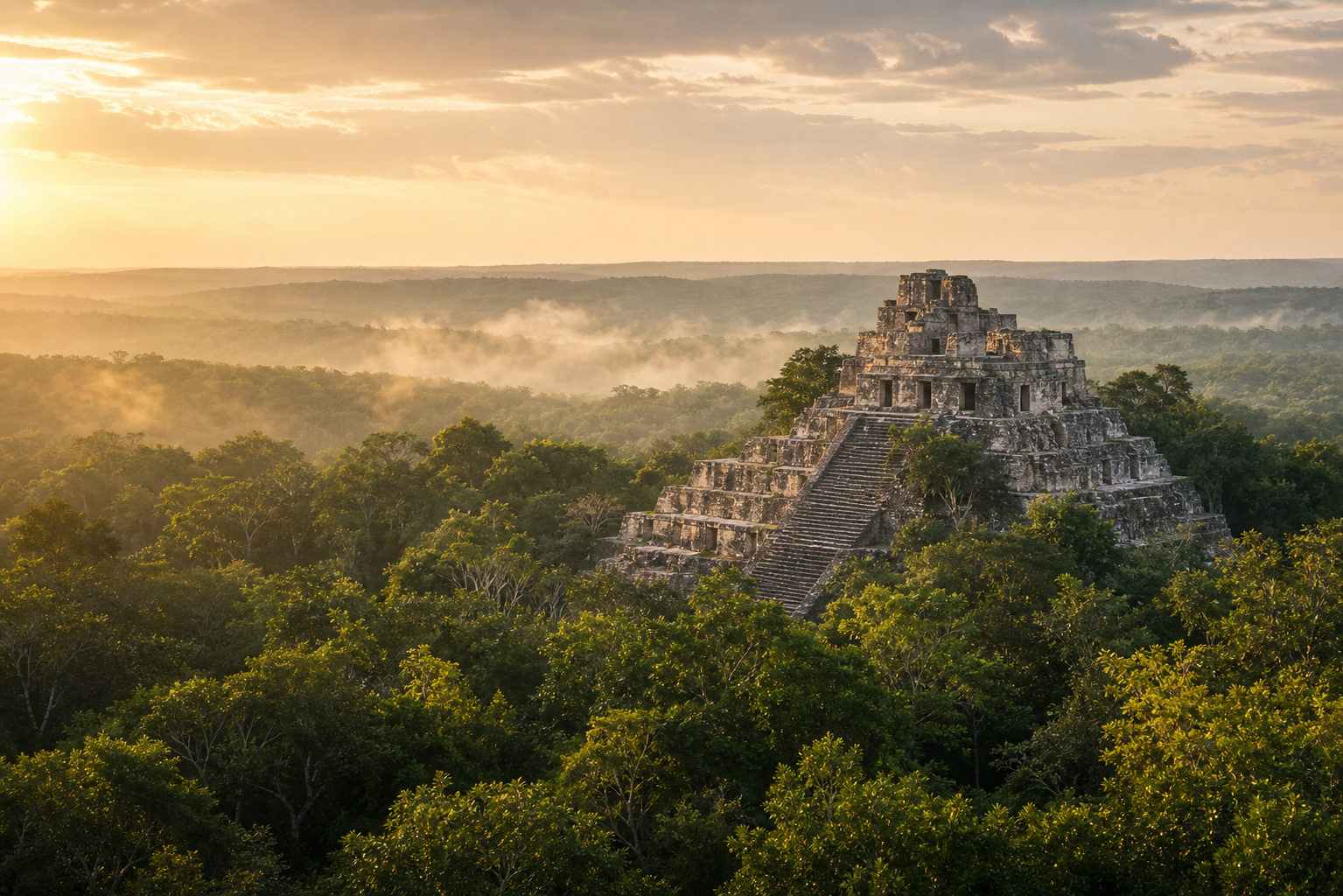
Main route: Campeche to Villahermosa and Palenque
Westbound and southbound journeys connect Campeche with Tabasco and Chiapas. Villahermosa is the principal larger connection point, while Palenque is a destination in Chiapas reached by a longer route or by changing transport. These journeys are useful if your trip continues through the Gulf and southern Maya region, but they are not quick city hops.
Check whether the ticket is direct or requires a connection. Confirm the arrival terminal and the length of the transfer. A connection that looks comfortable during the day may be stressful if the first bus is late, and a night arrival changes how you should arrange your hotel transfer.
For Palenque, compare a direct departure with a split journey through Villahermosa only after checking the full schedules. A direct bus can be worth choosing for simplicity even if it costs more or leaves at a less convenient hour. If you are travelling to the ruins, remember that the bus terminal, accommodation area, and archaeological site are separate places.
Main route: Campeche to Cancún and the Riviera Maya
Cancún is a long-distance destination from Campeche. The bus can be useful if you are travelling overland through the peninsula or connecting to an airport, but you should treat the journey as a full travel day. Travel time varies by service and intermediate stops, so use the official search for your date.
If you are catching a flight, leave a large margin. A bus can be delayed by road conditions, traffic, loading, or a late departure. A ticket that arrives at the airport area is not the same thing as a guarantee that you will be at your airline’s check-in desk on time. For an important flight, staying near the airport or travelling the previous day is safer.
The same principle applies to Playa del Carmen, Tulum, and other destinations east of Cancún. These places are outside Campeche State and belong in a broader peninsula itinerary, not in a rushed Campeche day plan. If Campeche is one stop in a long route, write down the exact terminal at each end and allow time for local transfers.
Travelling locally within Campeche State
ADO is strongest on the major intercity corridors. It is not a universal answer for every town, beach, archaeological site, or village in the state. Champotón, Seybaplaya, Calkiní, Hecelchakán, Hopelchén, Sabancuy, Isla Aguada, Palizada, and smaller communities may be served by regional buses, colectivos, taxis, or combinations of these.
A destination page or a generic route search may show a bus stop without showing the complete last-mile journey. Ask three questions before leaving Campeche City: where exactly does the bus arrive, how often does the return service run, and what is the backup if the last bus is full or cancelled? If the answer to the third question is “a taxi,” find out whether taxis are realistically available at that place.
For beach and wildlife trips, a car or locally arranged transport can be more practical than a long series of buses. This is especially true for Laguna de Términos, Los Petenes, rural communities, and sites with no regular public entrance road. A tour may also solve the problem of timing, but check what is included and whether the operator actually visits the place named in the itinerary.
The ADO terminal and the Tren Maya station are different
Campeche has both long-distance buses and the Tren Maya. They are not at the same station. A ticket for one does not include a transfer to the other, and an itinerary that changes from bus to train needs a real city transfer between them.
 San Francisco de Campeche Tren Maya station upper level
The train can be appealing for the northern corridor, particularly when the departure time and station connection work for your hotel. The bus remains important for destinations and schedules that the railway does not serve. Compare both options on the day you intend to travel instead of assuming the train is always faster or the bus is always cheaper.
When changing between them, plan for luggage, heat, and possible delays. Do not book a train departure immediately after a long-distance bus unless you are prepared to accept the risk of missing it. A taxi is usually easier than trying to improvise a local-bus connection with heavy bags.
Where to stay before or after a bus journey
For sightseeing, staying inside or near the walled historic centre gives you easier access to the plazas, gates, museums, and evening streets. It does mean arranging a taxi to the ADO terminal. For a very early departure, a hotel closer to the terminal can reduce the morning transfer, but it may be less convenient for walking around the old city.
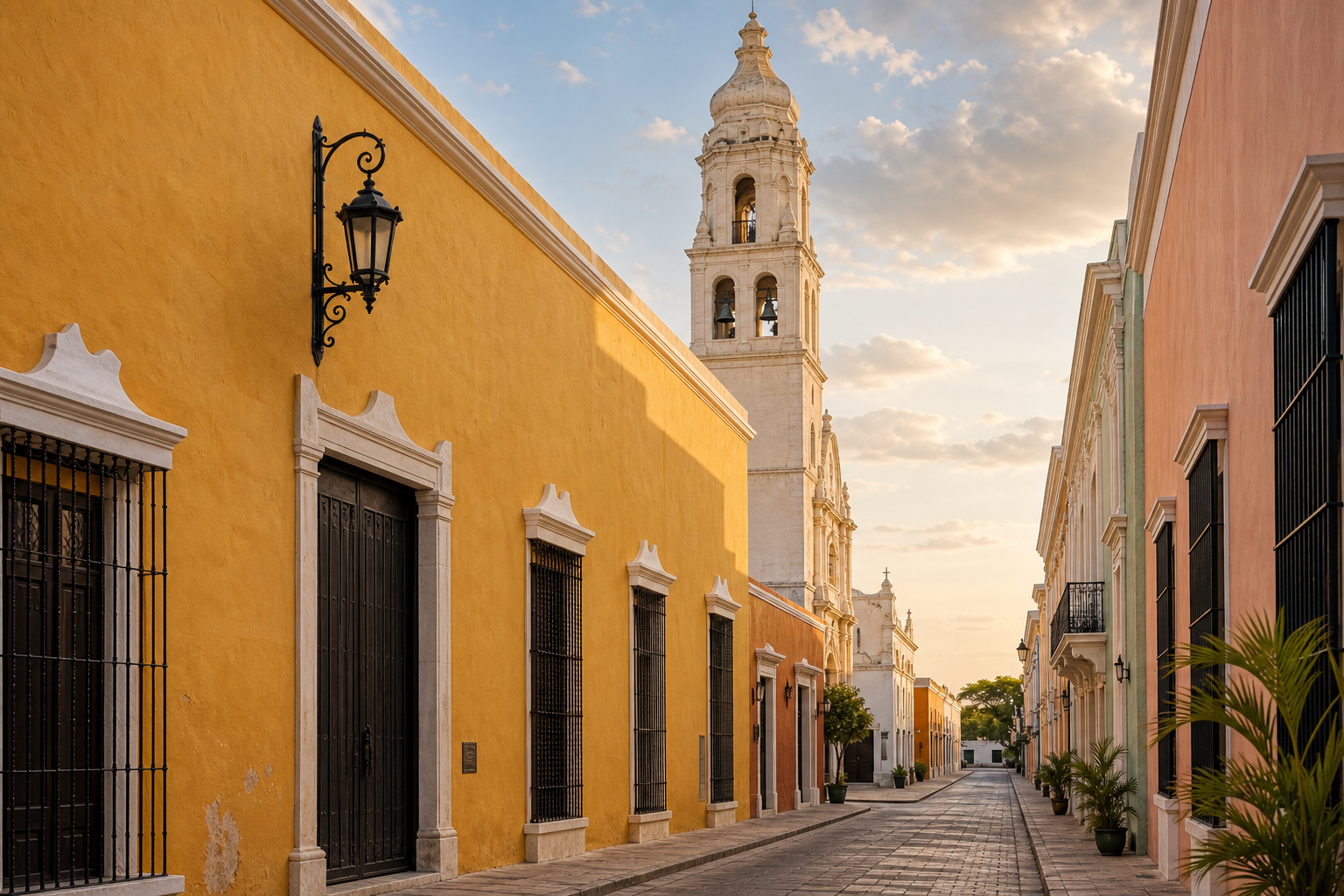
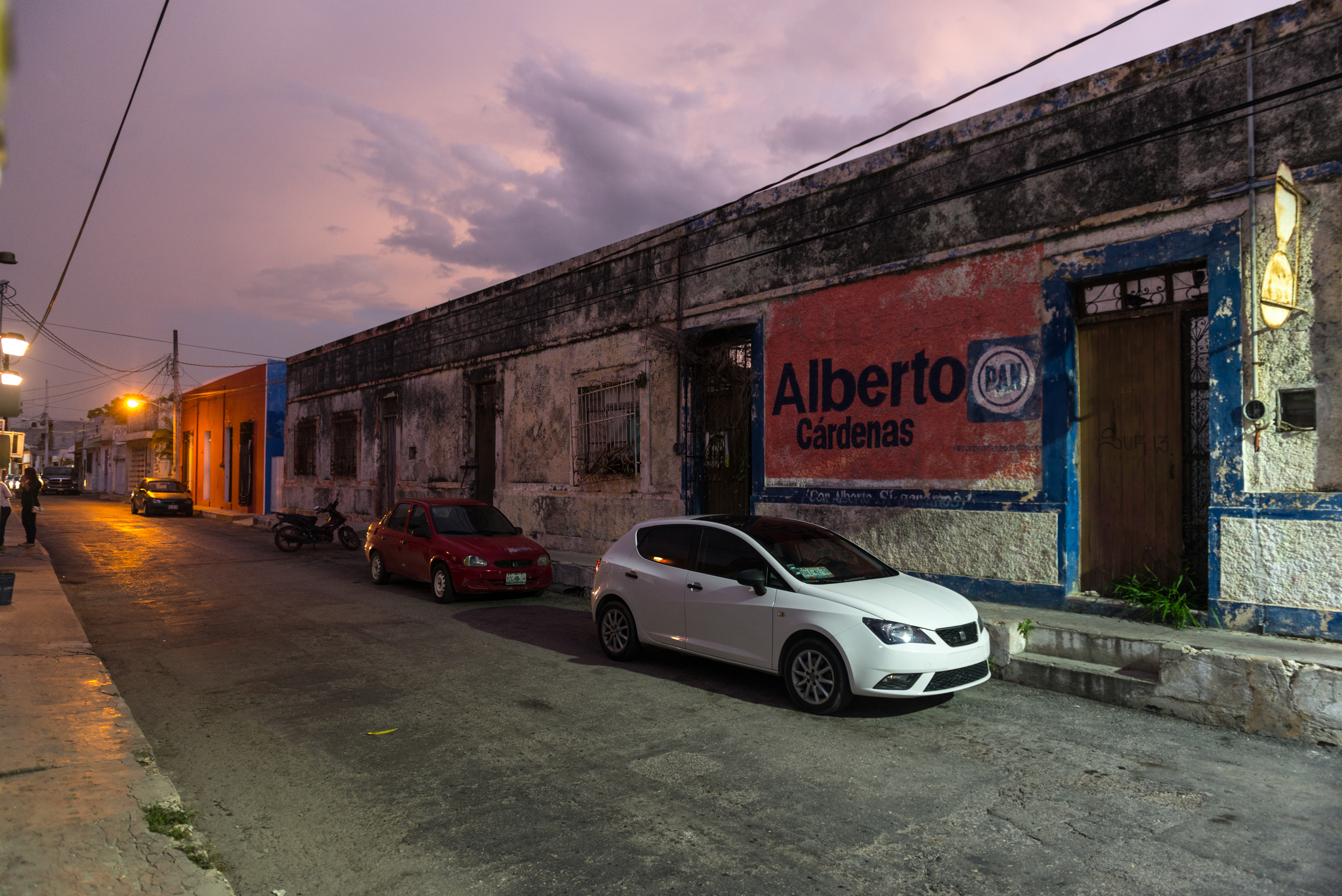 Street and colonial architecture in the historic centre of San Francisco de Campeche
There is no single best base. Choose the historic centre when the trip is mainly cultural and you want to walk to dinner or the plazas. Choose a more practical location outside the walls when parking, a highway departure, or a quick taxi connection matters more. If you arrive late, ask the accommodation about check-in after your bus’s scheduled arrival.
Compare Campeche City hotels on Booking.com · See current Campeche stays on Trip.com
If you are using Campeche as a base for a bus-and-ruins itinerary, count nights rather than only destinations. A night before a long southern departure, a night near Xpujil for Calakmul, and a return night in Campeche may be less tiring than trying to cover everything from one room.
Food, water, and waiting at the station
Bring a bottle of water and a snack for any journey longer than a short regional hop. Food options at the terminal can be limited, and a bus may depart before you have time to search for something suitable. If you have dietary restrictions, buy supplies in advance in the city and keep them sealed in your personal bag.
Avoid carrying an oversized amount of food that will become difficult to manage on a crowded bus. Simple items that do not spill are easiest. A small bag for rubbish is useful, particularly if the bus does not have an obvious bin at your seat.
The climate is hot for much of the year, but the bus interior and waiting room may feel cool. Sun protection is useful during an outdoor wait: hat, water, and breathable clothing. Rain can make the trip to the platform inconvenient, so a compact waterproof layer is more useful than an umbrella when you have luggage.
Accessibility and travelling with children
Tell the ticket agent if you need extra assistance, have limited mobility, or are travelling with a wheelchair, stroller, or large medical equipment. Facilities and boarding procedures vary. Do not assume that a vehicle or platform will be step-free simply because the terminal has a paved entrance.
For families, reserve seats together when the booking system allows it. Put a change of clothes, snacks, medication, wipes, and entertainment in the small bag that stays with you. Checked luggage may be inaccessible during the journey.
Short routes such as Campeche to Mérida are usually easier for young children than a full-day trip to Cancún or a southern connection with multiple changes. For a longer journey, schedule a proper overnight stop rather than expecting children to tolerate a rushed transfer and a late arrival.
Safety and belongings
The main risks at a bus station are ordinary travel problems: a missed departure, a misplaced bag, a phone running out of power, or a ticket with the wrong destination. Keep your documents and money in a zipped personal bag. Do not leave a phone on a counter while buying snacks, and check your seat area before stepping off the bus.
Use the marked taxi area and be cautious about accepting unsolicited transport offers. If someone offers to “fix” a ticket or change a destination outside the counter, return to official staff. Keep the accommodation address written down, preferably with the neighborhood and city.
At night, wait inside the terminal where possible and arrange your onward ride before the bus arrives. If you are travelling alone, share your route and expected arrival with someone you trust. These are simple measures, but they matter more on a long route through places you do not know.
A practical bus-day routine
The evening before departure, check the ticket time, origin, destination, and service. Look at the route to the terminal and decide whether you need a taxi booked in advance. Charge your phone and download the ticket or take a screenshot.
On the morning, keep your passport, ticket, wallet, medication, water, and a light layer in the personal bag. Leave earlier than the journey planner suggests if rain, a holiday, or a large amount of luggage is involved. At the terminal, check the board and ask staff if the platform is unclear.
Before handing over a suitcase, remove valuables and confirm the luggage tag. At boarding, compare the bus destination with your ticket. Once seated, note where the restroom is and keep your small bag within reach. If the bus stops, follow the driver’s instructions about whether passengers may leave the vehicle.
At arrival, collect your luggage before walking away from the terminal. Check the seat pocket and overhead area. Arrange a taxi or local connection, and do not assume a late-night arrival will have the same transport choices as a daytime one.
When to choose ADO, a train, a car, or a tour
Choose ADO when you are travelling between major cities, want to avoid driving, or prefer a predictable ticketed service with reserved seating. It is particularly useful for Campeche City, Mérida, Ciudad del Carmen, Escárcega, and longer connections toward Tabasco and Chiapas.
Choose the Tren Maya when its Campeche station, destination, and schedule fit your complete journey. The separate station transfer is part of the calculation. Choose a rental car when you want to combine several rural places, archaeological sites, or coast-and-jungle stops that do not share a convenient public-transport route. Read the driving conditions before setting an ambitious timetable; distances in Campeche are substantial.
Choose a guided tour when the main challenge is not the road itself but the logistics at a remote site. A tour can bundle transport, timing, and a guide, but compare departure time, return time, entrance fees, group size, and the exact places included. Browse current Campeche experiences on GetYourGuide · Compare Campeche-area activities on Viator.
There is no universal winner. A bus is excellent for a city-to-city move and inefficient for a collection of isolated attractions. A car is flexible and tiring if the driver has planned too many hours. A tour is convenient and less independent. Match the transport to the shape of the trip.
Questions travellers often ask
Is the ADO station in Campeche’s walled city?
No. The main terminal is outside the historic centre, on Avenida Patricio Trueba de Regil near the Casa de Justicia area. Take a taxi if you have luggage or an early departure.
Can you buy a ticket on the day?
Often, but availability depends on the route, date, service, and demand. Same-day travel is less risky on quieter regional journeys than on holiday departures or the most convenient morning services. Check the official ADO search before going to the station.
Does a Campeche bus ticket include a taxi to the hotel?
No. The bus ticket covers the service printed on it. Arrange the taxi or local connection separately.
Can you take a bus directly to Calakmul?
Do not plan on a simple city bus that drops you at the ruins. Calakmul is deep in the biosphere reserve. Public-transport itineraries normally require a southern base and a separate transfer or tour, with careful planning for return connections.
Is the Tren Maya station the same as the ADO terminal?
No. They are separate transport facilities. Allow time and money for a city transfer if you change from bus to train.
Should you stay near the terminal?
Only if the departure time or a long connection makes it useful. The walled centre is more convenient for sightseeing; a hotel near the terminal can be more practical for an early bus. Compare the whole itinerary, not just the distance to one station.
The simplest way to use the station
Treat the ADO terminal as a starting point for a route, not as proof that every Campeche destination is easy by bus. Confirm the exact departure, arrive with a buffer, keep essentials in your personal bag, and build realistic time around every connection. For the main city corridors, ADO is a straightforward way to travel without driving. For Calakmul, remote reserves, and small coastal communities, the bus may be only the first part of the journey.
A good Campeche itinerary leaves room for the state’s distances. Use the terminal for the journeys it handles well, stay overnight when a southern connection demands it, and choose a car or a properly described tour when public transport would turn a visit into a chain of uncertain transfers. That approach is slower on paper but usually produces a calmer trip.
Need transport? Book a transfer on WhatsApp.