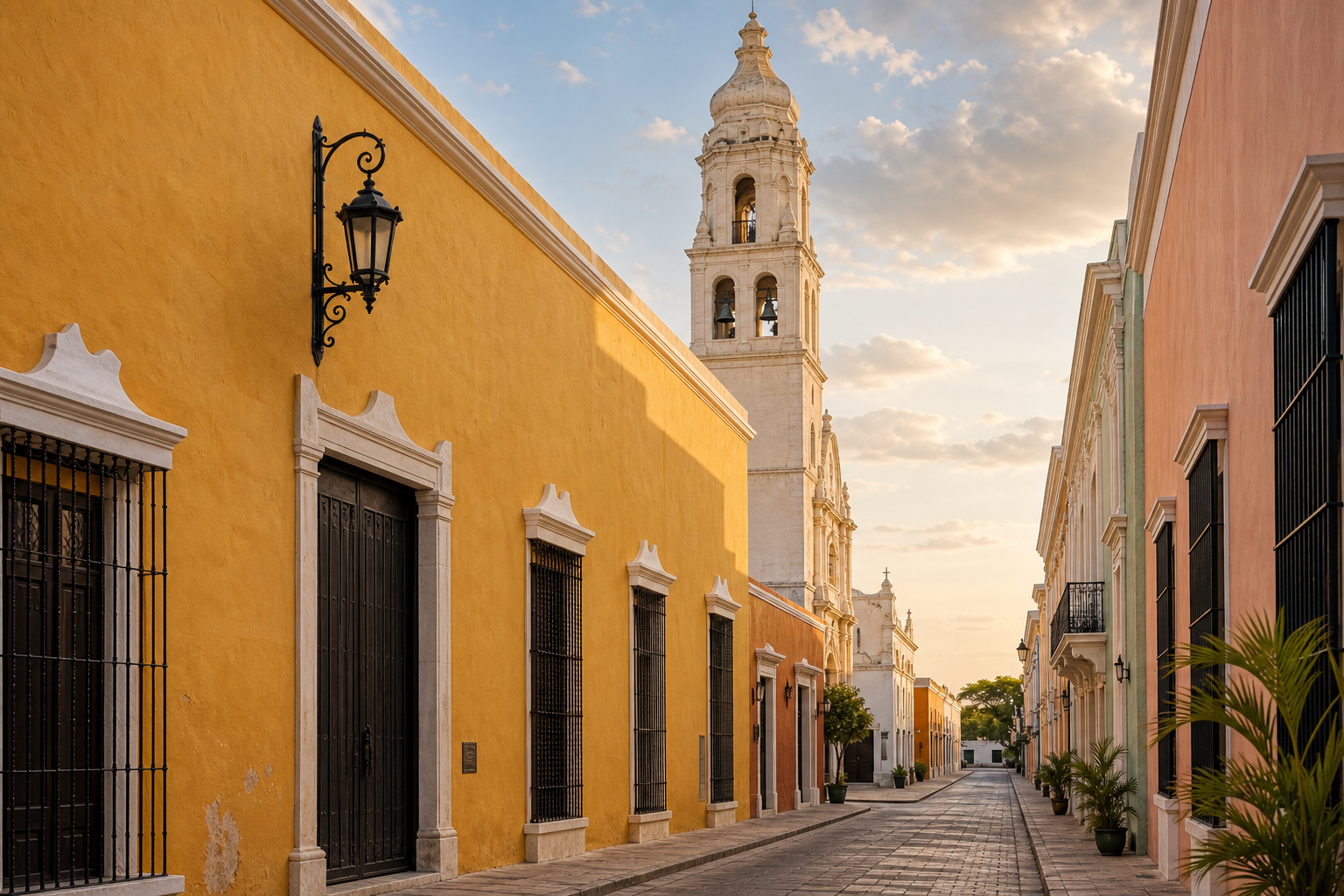
Getting from Campeche to Ciudad del Carmen
 Sunset over Ciudad del Carmen, Campeche
San Francisco de Campeche and Ciudad del Carmen are the two most-populated cities in Campeche State, yet sit at opposite ends of the capital's territory — the walled capital in the far west, Ciudad del Carmen on the southern coast where the state meets the Gulf of Mexico. Between them stretches approximately 188 kilometres of flat lowland, mangrove lagoons, and bridges, most of it covered by Federal Highway 180. The route is straightforward and well-served, whether you ride by bus or drive yourself. This guide covers both options in detail so whichever you choose, you know what to expect.
GuideBest Restaurants in Ciudad del Carmen, Campeche: Where to EatA practical guide to eating in Ciudad del Carmen, Campeche, from Gulf seafood and pan de cazón to markets, casual meals, and choosing a restaurant by neighbourhood.Explore

Need transport? Book a transfer on WhatsApp.
The Quick Facts
| Detail | Bus | Driving |
|---|---|---|
| Distance | 188 km | 188 km |
| Duration | 2h 55m – 3h 30m | 2h 30m – 3h |
| Cost from | 250 MXN ($12–14 USD) | 600–900 MXN total (fuel + tolls) |
| Capitalize | Departures 2–3 times hourly, early morning to late evening | Leave any time |
| Best for | Travellers without a car, budget-first travellers | Families, photographers, anyone stopping at Seybaplaya or Laguna de Términos en route |
By Bus: The Default Option for Most Travellers
The Station: Central de Autobuses ADO Campeche
The bus from Campeche to Ciudad del Carmen departs from the ADO terminal, situated short distance south of the patio dentro. The address: Avenida Patricio Trueba de Regil, on the corner with Playa Bahamita. From inside the walled city centre, a taxi to the terminal costs 40–60 MXN and takes roughly 10 minutes by normal traffic. If you arrive by ADO from Mérida or Tulum, this is where you have already just landed — no transfer needed.
The terminal is small but functional. There are snack automat machines, restrooms, and a ticketing hall with several serving positions. You can buy at the counter or on the ADO app (the app accepts international cards, though success varies). Booking 2–3 days in advance helps secure a better price, particularly on weekends when coastal workers ride between the cities.
Operators and Classes
The route is served by four bus companies on a rolling schedule that totals roughly 29 departures per day:
- ADO — First Class, the most reliable carrier on this junction. Plush AC, reclining seats with decent legroom, onboard entertainment, restroom. Inner overhead luggage. fares for this trip start at 240–290 MXN one-way.
- ADO GL — ADO's semi-luxury tier. Similar comfort with slightly additional amenities. Around 235–285 MXN.
- Ómnibus Cristóbal Colón (OCC) — Second Class, cheaper but clean. No onboard entertainment system but seats recline and AC works. Often around 230–270 MXN on this route.
- BlaBlaCar Bus — The cheapest option, marketed as a button-seat service. Acceptable ride quality for this distance. Promo fares grip as low as 170–230 MXN when booked last-minute.
The differences for a 3-hour ticket are modest. If you have any prior back trouble, go with ADO — the seat ride is noticeably better over this distance. If BlaBlaCar undercuts by 60–80 MXN, it is a sensible way to save cash on a short swing.
Schedules and Timing
On this corridor, the first departures board before dawn, with subsequent departures staggered at regular time bands through the evening. A small number of red-eye runs run to cover shift workers in Ciudad del Carmen's oil and gas sector. Most travellers, however, will catch a morning or early afternoon bus. Full timetables and exact departure times shift practically overnight with operator roster changes — always confirm the specific day's departures on the ADO app or at the terminal ticketing counter on the day you board.
Peak-hour premiums are more noticeable on this route. Buying a few days early normally keeps you in the lower fare band; same- day tickets can add 30–50 MXN at the register.
Children under 6 travel free on ADO if seated on an adult's lap. Beyond that they buy a ticket at a discount rate, and anyone over 60 with INAPAM ID often receive a 50% cut at the counter (not always available on the app).
Booking online vs. terminal counter: The ADO website and most aggregator sites accept international cards, but completion is finicky with some non-Mexican chip-and-PIN cards. Buying at the terminal counter is foolproof when you have cash in pesos. With pesos, the pricing is the same as the app — you just show up a half-hour ahead and confirm the next available seat.
The Ride: What to Expect
The bus departs the terminal heading east, passes outskirts of Campeche city, then merges onto Federal Highway 180 roughly 10 minutes out. The riding surface is smooth for almost the entire trip — this stretch of 180 had resurfacing finished in recent years with resurfacing done on a scheduled basis. In the dry season, the road is in good condition all along.
The first 40 km cuts through low scrub and agrarian holdings. By the hour mark, palm groves thicken and the bus crosses the Sabancuy estuary zone, where the landscape widens into lagoon lowlands. About halfway — around the 95 km mark — you'll pass through Seybaplaya, a small coastal town some travellers combine with a same-day break. Buses normally pause here for 5–10 minutes to let off passengers and stretch.
Beyond Seybaplaya the road crosses the municipality of Carmen's northwestern edge. Mangrove lagoons gleam on both sides, and you begin seeing the offshore oil infrastructure that identifies this region — drilling platforms on the horizon, supply vessels in the channels. The final 20 km approach Ciudad del Carmen via the Zacatal Bridge (Puente El Zacatal), a long concrete span crossing the Laguna de Términos. The bridge is a landmark in itself — once you are on it, you are minutes from arrival.
The bus arrives at Ciudad del Carmen's Central de Autobuses ADO, located on Avenida Periférico, a few blocks from the city centre. From there, a taxi to the downtown area or the malecón costs 50–70 MXN. There are also colectivo vans right outside the terminal that run fixed routes for 10–15 MXN per person.
GuideEscárcega Bus Station Guide for Campeche TravellersA practical guide to the ADO bus station in Escárcega: where it is, which operators run there, key routes and fares, on-board experience, and how to connect to the Tren Maya, Xpujil, and Calakmul.Explore

By Car: Driving from Campeche to Ciudad del Carmen
The Route
The drive is simple: take Federal Highway 180 east out of Campeche city and stay on it for the entire journey. There are no turns, no forks, and no confusing junctions. The road is well-signposted and the surface is in good condition for the full 188 km.
The route passes through the following waypoints:
- Campeche City → Seybaplaya (95 km) — Flat lowland, palm groves, small towns. Speed bumps (topes) appear at every town entrance. Slow down; they are unmarked in some places.
- Seybaplaya → Sabancuy (56 km) — This section runs on Highway 259 (the Díaz Ordaz–Sabancuy connector), a toll-free federal road. Mangrove lagoons on both sides. Light traffic.
- Sabancuy → Ciudad del Carmen (37 km) — Rejoins Highway 180. Oil infrastructure becomes visible. Crosses the Zacatal Bridge into the city.
Driving Time and Conditions
At normal speeds with no stops, the drive takes 2 hours 30 minutes to 3 hours. Add 15–20 minutes if you stop in Seybaplaya for a break or a meal.
The road is two lanes in each direction for most of the route, with occasional single-lane stretches near bridge works. Traffic is light outside of morning and evening rush hours in the two cities. The biggest hazard is speed bumps through small towns — they can be severe enough to damage a car if taken at speed. Watch for the standard Mexican topes sign (a black-and-white bump icon) and slow to 20–30 km/h through every populated zone.
There are no toll booths on this route. Highway 180 and Highway 259 are both toll-free federal roads. This is a genuine advantage over the Mérida–Campeche corridor, where tolls add 200–300 MXN each way.
Fuel and Services
Fuel stations (Pemex and others) appear at regular intervals along the route — you will find at least three between Campeche and Ciudad del Carmen. Fill up before leaving Campeche city; stations in Seybaplaya and Sabancuy are reliable but sometimes run short on premium fuel.
Rest stops are informal. Seybaplaya has a handful of seafood restaurants right off the highway where you can eat well for 120–180 MXN. Sabancuy has basic services — a market, small shops, and a Pemex station. There are no large commercial plazas or fast-food chains on this route; pack water and snacks if you prefer brand-name provisions.
Car Rental in Campeche
If you need a rental car, several agencies operate in Campeche city and at the airport. Expect rates of 600–1,200 MXN per day for a compact car, depending on season and insurance level. Booking through aggregators like Discover Cars or directly with local agencies (Hertz, Europcar, and local firms near the terminal) both work. A compact car is fine for this route — no 4WD needed.
Important: Mexican law requires the driver to carry third-party liability insurance. Rental agencies include this in the base rate, but confirm the paperwork is in the car. Federal police checkpoints occasionally stop vehicles between Campeche and Ciudad del Carmen; having your rental agreement and passport accessible speeds things along.
Road Safety Notes
- Night driving: Not recommended between Seybaplaya and Sabancuy. The road has no street lighting, and livestock or wildlife can wander onto the pavement. If you must drive after dark, reduce speed and keep high beams on when no oncoming traffic is present.
- Rainy season (June–October): Puddles form on the road surface, and spray reduces visibility. The route drains well, but hydroplaning risk increases above 80 km/h in heavy rain.
- Checkpoints: Federal or military checkpoints appear randomly. They are routine and non-confrontational. Stay calm, lower your window, and have documents ready. Most stops last under 5 minutes.
GuideBest Restaurants in Ciudad del Carmen, Campeche: Where to EatA practical guide to eating in Ciudad del Carmen, Campeche, from Gulf seafood and pan de cazón to markets, casual meals, and choosing a restaurant by neighbourhood.Explore
Which Should You Choose?
Take the bus if:
- You are travelling solo or as a couple on a budget. The fare is a fraction of the cost of renting a car.
- You do not want to deal with speed bumps, checkpoints, or night driving.
- You are heading to Ciudad del Carmen itself and do not plan to stop along the way.
Drive if:
- You are a family or small group. The per-person cost of a rental car often beats four or five bus tickets.
- You want to stop at Seybaplaya, Sabancuy, or Laguna de Términos viewpoints en route.
- You plan to explore Ciudad del Carmen's outskirts (Isla Aguada, Playa Norte) where a car saves taxi fares.
- You are combining this with a longer road trip — for example, Campeche → Ciudad del Carmen → Laguna de Términos → Champotón.
A note on flying
There is no direct flight between Campeche and Ciudad del Carmen. The two cities are too close for commercial service. The bus or car are your only practical options, and both work well.
Practical Tips
- Cash: Carry pesos for bus tickets (if buying at the counter), taxi fares, and small-town meals. ATMs in Seybaplaya and Sabancuy are unreliable.
- Luggage: ADO allows one carry-on and one checked bag per passenger. Rental car trunks easily fit a family's full luggage load.
- Time zone: Both cities are in Central Time (UTC-6). No adjustment needed.
- Phone signal: Good along Highway 180, patchy between Seybaplaya and Sabancuy. Download offline maps before departure.
- Arriving in Ciudad del Carmen: The ADO terminal is on the city's western edge. Taxis to the malecón or downtown take 10–15 minutes. If you are staying at a beach hotel on Isla Aguada, budget an additional 20-minute taxi or bus ride south from the terminal.
Quick Reference
| Option | Duration | Cost (from) | Frequency | Comfort |
|---|---|---|---|---|
| ADO bus | 3h | 240 MXN | 2–3x/hour | High |
| OCC bus | 3h 15m | 230 MXN | Several/day | Medium |
| BlaBlaCar Bus | 2h 55m | 170 MXN | Several/day | Medium |
| Rental car | 2h 30m | 600 MXN/day | On demand | High |
| Private taxi | 2h 30m | 1,800–2,200 MXN | On demand | Highest |
The Campeche–Ciudad del Carmen corridor is one of the easiest intercity routes in Campeche State. The road is good, the bus service is frequent, and the drive is straightforward. Whether you ride or drive, you will be on the Gulf coast in under three hours.
Need transport? Book a transfer on WhatsApp.