
Laguna de Términos is a huge estuarine wetland on the southwest coast of Campeche State. It is not one viewpoint, one beach, or one neatly fenced attraction. It is a connected landscape of lagoon water, mangrove channels, river mouths, barrier islands, tidal flats, fishing grounds, and coastal towns. The two most useful visitor bases are Isla Aguada, at the lagoon’s Gulf-facing edge, and Ciudad del Carmen, on Isla del Carmen to the west. Other parts of the protected area extend toward Palizada, Candelaria, and Champotón, but they are not interchangeable day-trip access points.
The main reason travelers come is the possibility of seeing bottlenose dolphins in the wild. Boat outings also pass mangroves, shallow channels, bird islands, and working fishing areas. A dolphin sighting is never guaranteed, and the lagoon is more rewarding when you treat the whole outing as a wetland trip rather than a wildlife show. The light, birds, changing water, and quiet distance from the city are part of the experience.
Laguna de Términos works best for travelers who can give it at least one flexible day. It can be added to a Campeche coast route, paired with an overnight in Isla Aguada, or approached from Ciudad del Carmen when you need more accommodation and transport options. It does not make sense as a rushed detour from the walled city if the plan leaves no time for a boat departure, weather changes, or the return drive.
What Laguna de Términos is — and what it is not
The name refers to a broad lagoon system in Campeche, not simply the open water visible from a waterfront. The protected area is officially the Área de Protección de Flora y Fauna Laguna de Términos, created by federal decree in 1994. CONANP describes it as an area of more than 700,000 hectares containing mangroves, wetlands, lagoons, rivers, coastal dunes, and other habitats. It is one of the largest protected coastal systems in Mexico.
Geographically, Isla del Carmen helps separate the lagoon from the open Gulf of Mexico. Several rivers and smaller water bodies feed the system, including the Palizada, Chumpán, and Candelaria watersheds. The result is an estuary: salt and fresh water mix, tides move through channels, and conditions change with wind and rainfall. That explains why one side of a boat route can look calm and glassy while another has chop, muddy water, or a stronger current.
This is also why generic beach expectations can be misleading. Laguna de Términos is not the Caribbean coast of Quintana Roo. The water may be brown or green rather than turquoise, and mangrove edges replace long resort beaches in many areas. The landscape is productive and alive: fish nurseries, shellfish beds, bird nesting areas, and fishing communities all depend on the same waters that visitors explore.
The protected designation does not mean every point is a public park with marked trails, ticket booths, or standardized visitor facilities. Access is local and varied. A boat operator in Isla Aguada may offer a different route from one in Ciudad del Carmen. A river community toward Palizada is a separate logistical proposition from a lagoon excursion. Confirm the departure point, route, duration, weather policy, and what is included before you travel to the dock.
 Laguna de Términos coast with mangroves on the Campeche Gulf
The best bases: Isla Aguada or Ciudad del Carmen?
Isla Aguada for the most direct nature visit
Isla Aguada is a small coastal community in Carmen Municipality and a Pueblo Mágico. It sits close to the lagoon’s connection with the Gulf and is the most natural base if the purpose of the trip is a boat ride, mangroves, dolphins, and a quieter coastal atmosphere. The waterfront is compact enough to orient yourself on foot, and local outings commonly include lagoon scenery, bird islands, and a search for dolphins.
The town’s advantages are atmosphere and proximity. You wake near the water, can speak with boat operators locally, and do not need to cross Ciudad del Carmen before starting the day. The disadvantages are limited services and fewer choices if a room, restaurant, or boat schedule does not work out. Do not assume every operator runs every day or that a late arrival will leave a choice of departures. If the lagoon is the centerpiece, arrive with daylight and arrange the outing as early as practical.
Isla Aguada also works for a slower overnight. Walk the waterfront, look at the fishing boats, visit the lighthouse area if it is open, and leave time for a beach or sunset. It is a poor choice for travelers who want a busy evening, a large range of restaurants, or a predictable chain-hotel experience.
Compare Isla Aguada and Laguna de Términos tours on GetYourGuide · See available lagoon activities on Viator
Check current Isla Aguada hotel rates on Booking.com · Compare Isla Aguada stays on Trip.com
Ciudad del Carmen for transport, hotels, and a flexible base
Ciudad del Carmen is the practical base when you want more accommodation, supermarkets, banks, restaurants, and transport connections. It lies on Isla del Carmen, west of the lagoon, and has a different character from Isla Aguada: larger, busier, and shaped by commercial activity and the energy industry as well as fishing and coastal life.
From the city, access to lagoon outings depends on the operator and meeting point. Some experiences use a waterfront or marina departure; others may require a transfer to Isla Aguada or another access point. Ask exactly where the boat leaves. “Laguna de Términos tour” is not specific enough to plan a taxi or estimate your morning. A listing that says Isla Aguada is not necessarily a Ciudad del Carmen departure.
Ciudad del Carmen is a good choice when Laguna de Términos is one part of a longer southern Campeche route. You can combine the lagoon with the city’s waterfront, Nuestra Señora del Carmen church, local markets, and beaches such as Playa Norte, while keeping more options for an early departure or a weather-related change of plan. It is also easier to arrive by long-distance bus or flight than Isla Aguada.
Browse Ciudad del Carmen and Laguna de Términos activities on GetYourGuide · Compare Viator experiences around Ciudad del Carmen
Check current Ciudad del Carmen hotel rates on Booking.com · Compare Ciudad del Carmen hotels on Trip.com
Palizada and the river side of the system
Palizada is another Campeche State destination connected to the wider wetland landscape, but it should not be treated as an alternative dock for the standard Isla Aguada dolphin trip. The town is inland along the Palizada River and is known for its colorful historic streets, river setting, and small-town pace. A river excursion from Palizada explores a different environment: freshwater-influenced channels, riverbanks, vegetation, and birdlife rather than the open lagoon route most visitors imagine.
Reaching Palizada requires a separate plan, and it is better suited to travelers making a west or southwest Campeche itinerary than to someone who only has a few hours. If you want to include both places, allow time for the roads and confirm transport locally. The distance on a map can look manageable while river access, weather, and infrequent services make the day longer than expected.
GuideCiudad del Carmen, Campeche: Complete Travel Guide & Things to DoA practical guide to Ciudad del Carmen, Campeche: beaches, the waterfront, local history, Laguna de Términos, transport, food, and how long to stay.Explore
What to do in Laguna de Términos
Take a boat trip for dolphins, birds, and mangroves
A boat outing is the central visitor activity. Routes vary, but the typical experience combines open lagoon water with narrower mangrove edges and a stop or slow pass near bird habitat. The captain’s knowledge matters more than a polished brochure. Ask whether the trip is private or shared, where it departs, how long it normally takes, and whether the route changes with tide or weather.
Wild bottlenose dolphins are the headline sighting. They may surface beside the boat, travel in a group, or remain distant. They may also be absent. Avoid operators who promise a guaranteed performance or encourage chasing, crowding, feeding, or touching animals. A good excursion keeps a respectful distance, cuts engine speed when appropriate, and accepts that observation is not control.
Expect sun, glare, spray, and heat even when the air feels comfortable at the dock. A hat with a secure strap, long sleeves, sunglasses, reef-safe or locally appropriate sun protection, and a dry bag are more useful than elaborate camera equipment. Bring water. Keep phones and cameras protected because a calm lagoon can still throw spray over a small boat.
 Boat dock and palapa on Laguna de Términos at Isla Aguada
Compare current Laguna de Términos boat rides on GetYourGuide and Viator lagoon options before choosing. If neither marketplace has the exact local departure you need, ask at the waterfront in Isla Aguada or through your accommodation, and verify the meeting point directly.
Watch birds without turning the lagoon into a checklist
The lagoon supports resident and migratory birds across open water, mudflats, mangroves, and islands. Pelicans and frigatebirds are conspicuous around the coast; herons, egrets, cormorants, kingfishers, and smaller waders appear in suitable conditions. The precise mix changes with season, water level, tide, and the route taken.
Birdwatching here rewards patience. Keep binoculars in a dry case, use a camera lens that does not require you to approach a nesting site, and ask the captain before requesting a closer pass. A bird island is not an invitation to land. Nesting birds need distance, and repeated boat approaches can change their behavior even if no animal appears visibly disturbed.
Early departures generally offer softer light and more active wildlife, but there is no universal “best hour” for every route. Tide, wind, and the operator’s schedule can be more important. If photography is the priority, ask about sun direction and whether the route spends time in open water or shaded mangrove channels.
See the mangrove edge and learn how the estuary works
Mangroves are not scenery placed behind the attraction; they are the infrastructure of the wetland. Their roots slow water, trap sediment, shelter juvenile fish, and provide nesting or feeding areas. Red, white, and black mangrove communities can occur in different conditions, though you do not need to identify every species to understand why the channels are protected.
A narrow channel can feel like a separate world from the open lagoon. Water darkens under vegetation, birds call from branches, and the boat’s engine echoes against the roots. Do not reach into the water or step onto muddy edges. Crocodiles and other wildlife may be present in the wider system, and slippery banks are more dangerous than they look. A kayak route can be beautiful, but it requires more attention to current, heat, tides, and the operator’s safety practices than a short motorboat trip.
Ask whether a proposed kayak or paddle route stays in sheltered channels. Wind can make an open crossing tiring for inexperienced paddlers. Children and weak swimmers should wear properly fitted flotation equipment, and every passenger should receive a clear briefing rather than being handed a life jacket without explanation.
Visit the waterfront and lighthouse area in Isla Aguada
The town itself gives the lagoon visit context. Isla Aguada developed around fishing and maritime movement, and its waterfront remains a place to see boats, nets, docks, and everyday activity. The lighthouse is associated with the settlement’s coastal identity and is a useful orientation point, but access and opening conditions can change. Treat it as a local landmark, not an attraction with guaranteed hours.
Walk respectfully around working areas. Do not climb on boats, handle gear, block a loading area, or photograph people at close range without permission. The best photographs often come from a little distance: hulls against lagoon light, pelicans near the water, or the town’s low buildings facing the Gulf.
The waterfront also helps you understand the difference between a protected landscape and a wilderness empty of people. Conservation here has to coexist with fishing, transport, tourism, and communities that depend on the water. That is a more useful story than the idea of a pristine place untouched by human life.
Add a beach stop, with realistic expectations
The coast around Isla Aguada and Ciudad del Carmen offers beach possibilities, but facilities and swimming conditions vary. A beach can be attractive for a walk, a quiet afternoon, or a sunset without being ideal for swimming every day. Wind, sargassum, currents, debris, jellyfish, and weather can alter conditions.
Ask locally where swimming is currently considered safe and whether there are lifeguards. Do not swim near boat traffic, river mouths, or a channel entrance simply because the water looks calm. Keep children within reach, use shade when available, and carry drinking water. Many coastal stops are more lightly serviced than resort beaches, so do not assume there will be toilets, lockers, rental chairs, or a place to buy food.
Playa Norte in Ciudad del Carmen is a separate urban beach option and can make sense if you are staying in the city. It is not the same place as Isla Aguada’s lagoon edge, and it should not be described as a mangrove excursion. Use the city beach for a straightforward coastal break; use a boat trip for the wetland experience.
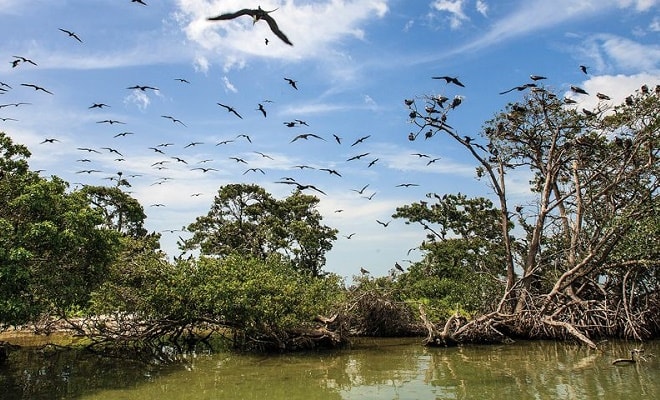 Birds above mangroves on a Laguna de Términos boat route
How to plan a boat trip
Decide whether you need a private or shared outing
A shared trip can cost less and may be easy to arrange at a busy waterfront, but the route and timing are less flexible. A private boat gives a couple or family more control over pace, photography, and how long to wait in an area, but the total price may be higher. Do not use an old online price as a promise; local rates change with fuel, group size, season, and route.
Ask four questions before paying: Where exactly is the meeting point? How long is the trip on the water? Is the rate per person or per boat? What happens if wind or rain makes the route unsafe? Also ask whether the trip includes a life jacket for every passenger, and whether the stated duration includes boarding and waiting at the dock.
If a listing uses a broad name such as “Laguna de Términos,” check whether it actually starts in Isla Aguada, Ciudad del Carmen, or another town. A tempting tour page can be a poor fit if the transfer to its dock takes longer than the excursion itself.
Choose the right day, but keep a weather fallback
The dry season is often more comfortable for road travel and outdoor time, while the rainy season can bring lush scenery and dramatic skies. Neither season guarantees calm water. Tropical showers can arrive quickly, and wind can make a small boat uncomfortable or unsafe. Keep your schedule flexible enough to move the excursion to another morning when possible.
A cancellation is not necessarily a failed trip. Operators should prioritize safe conditions. If the weather is marginal, ask whether the trip can be rescheduled rather than pressuring the captain to leave. Confirm the policy before booking, especially when reserving online.
Avoid building a same-day long-distance connection around the boat. If your excursion runs late because dolphins, tide, or weather change the route, a carefully timed bus may become impossible. Overnight locally when the lagoon is the reason for the visit.
What to bring and what to leave behind
Bring a refillable bottle, dry bag, lightweight layers, hat, sunglasses, insect repellent, cash for small local purchases, and a charged phone. A small towel or spare shirt is useful. Binoculars are more practical than a huge zoom lens for many passengers because the boat moves and wildlife may be close one moment and distant the next.
Leave drones, speakers, disposable plastic, and anything you cannot secure. Drone use can disturb birds and may be restricted around protected habitat; ask before considering it. Keep food sealed and take all packaging back to shore. Do not throw tortillas, bread, fruit, or fish to dolphins, birds, or crocodiles. Feeding changes behavior and can create dangerous associations with boats.
If you are prone to motion sickness, eat lightly and ask where the calmest seats are. The lagoon may look smooth from shore, but an open crossing can move differently from a mangrove channel. Bring medication only if it is appropriate for you and already familiar; do not experiment with a new remedy immediately before departure.
Getting there from inside Campeche State
From Ciudad del Carmen
Ciudad del Carmen is the most practical transport hub for the southern lagoon. Depending on the departure point and the operator, Isla Aguada is reached by road across the connection between the city and the mainland. The trip is straightforward by car or taxi when traffic and bridge conditions cooperate, but confirm the return plan rather than assuming a taxi will be waiting after a remote beach or dock visit.
If you are not driving, ask your hotel whether a local taxi can take you to Isla Aguada and return at a prearranged time. Agree on the arrangement before leaving the city, and keep the driver’s details. App availability and coverage can vary outside the urban core. A boat operator may also provide a transfer, but treat that as a separate service and confirm the price and waiting time directly.
From Campeche city
San Francisco de Campeche is a useful cultural base but is not next door to Laguna de Términos. The drive south and east toward the Carmen area takes a substantial part of the day, and a public-transport itinerary may require a change. A same-day return can leave too little time for the boat and becomes especially fragile in rain.
If the lagoon matters, spend the night in Ciudad del Carmen or Isla Aguada. You can then start the water activity without turning it into a race against the road. Campeche city is better paired with the walled centre, forts, the malecón, and Edzná; Laguna de Términos belongs on a southern-coast segment.
From Isla Aguada
Within Isla Aguada, the dock or meeting point may be close to the waterfront, but never rely on a map pin alone. Ask for a recognizable landmark and arrive early enough to find the boat. Smaller local operations may coordinate by phone or in person, and the exact departure can depend on tide, weather, or which boat is available.
The town has fewer fallback options than Ciudad del Carmen. Carry enough cash, charge your phone, and do not expect every business to accept cards. For a multi-night stay, buy essential snacks and medication before arriving if you need a specific item.
From Palizada, Candelaria, or Champotón
The protected area reaches beyond the classic Isla Aguada route. Palizada provides river scenery; Candelaria is a separate inland and river corridor; Champotón is a coastal town north of the lagoon system. These places can be included in a broad Campeche itinerary, but they are not quick substitutes for each other.
A rental car gives the most control, particularly if you want to combine small towns and natural areas. Fill the tank before long rural legs, download maps for offline use, and allow daylight for unfamiliar roads. Bus routes can work between major towns, but local nature access often requires a taxi, guide, or prearranged transfer for the final stretch.
Where to stay and how many nights to allow
One night is enough for a focused visit if you arrive early, take a boat the next morning, and leave after a waterfront meal. Two nights are better when you want a weather buffer, a beach stop, or time to explore Isla Aguada without packing the day around a single departure.
Choose Isla Aguada when the lagoon and small-town setting matter most. Check whether your lodging has air conditioning, secure parking if driving, reliable water, and a clear late-arrival process. Ask about the nearest place to eat and whether the property can help arrange a boat.
Choose Ciudad del Carmen when accommodation choice, transport, and services matter more than being beside a village dock. The city also makes a sensible base for travelers who want to combine Laguna de Términos with Playa Norte or other city stops. Look at the map carefully: a hotel in the urban center may be convenient for restaurants but not necessarily close to your boat meeting point.
Check current lodging availability in Ciudad del Carmen on Booking.com · Compare Ciudad del Carmen stays on Trip.com
For a river-focused route, Palizada is a different overnight choice. It suits travelers who want historic streets and river atmosphere rather than the most direct dolphin access. Do not book it as a last-minute replacement for Isla Aguada without checking transport and departure times.
Food, supplies, and daily rhythm
Seafood is central to the coastal identity of the area, but do not turn an environmental guide into a list of unverified restaurant names. Eat where local traffic is steady, ask what is fresh that day, and choose a place that handles food carefully. Fish, shrimp, shellfish, and regional preparations vary by town and season. If you have allergies, communicate them clearly in Spanish and ask about shared cooking surfaces.
Isla Aguada is quietest early and after the main daytime activity. Ciudad del Carmen has a broader range of places to eat and shop. Carry breakfast supplies when you have an early boat because a small town may not have a café open at the hour you want. Water, snacks, cash, sun protection, and insect repellent are more important purchases than souvenirs when you are preparing for the lagoon.
The heat changes how you should schedule the day. Put the boat or walking activity early, rest during the strongest sun, and return to the waterfront in late afternoon. Humidity can make a short walk feel longer than the distance suggests. Wear sandals only when they are secure; wet docks, boat steps, and muddy ground punish flimsy footwear.
Wildlife ethics and safety
Treat the lagoon as protected habitat first and a tourist activity second. Keep distance from dolphins, birds, turtles, crocodiles, and manatees. Do not feed wildlife, pursue a group that is trying to leave, or ask a captain to cut across a nesting island. A good photograph is never worth disturbing an animal.
Stay seated while the boat is moving and follow the captain’s instructions around shallow water. Wear a life jacket if conditions require it, even if you are a confident swimmer. Children need close supervision near docks and open water. Avoid swimming in unfamiliar channels, around mangrove roots, near boats, or where local residents advise against it.
Mosquitoes can be active around wetlands, particularly near dusk and after rain. Long, loose clothing and repellent help. Check yourself for ticks after time in vegetation and follow normal precautions for sun exposure. If you have a medical condition affected by heat or boat motion, plan conservatively and tell the operator.
Plastic and fishing line are especially harmful in a wetland. Keep waste aboard, do not leave cigarette ends on a beach, and use refill stations where available. Buy from local businesses without assuming that every “eco” label represents a regulated program; ask what the operator actually does to reduce disturbance and waste.
A practical one-day plan from Isla Aguada
Arrive the previous afternoon if possible. Use the first evening to locate the waterfront, confirm the dock, buy water and breakfast supplies, and ask about the next day’s weather. A short walk at sunset is enough; there is no benefit in exhausting yourself before an early boat.
Start the morning on the lagoon. Give yourself time to board without rushing. During the trip, pay attention to the changing habitat rather than measuring success only by dolphin photos. If the route includes a bird island or mangrove channel, keep the camera ready but remain quiet when the captain slows down.
Return for a late breakfast or early lunch, then take a rest during the hottest hours. Spend the afternoon walking the town, visiting the lighthouse area if open, or going to a locally recommended beach. Check swimming conditions before entering the water. End at the waterfront, where the light changes quickly across the lagoon and Gulf.
This plan leaves room for the realities of small-town travel: a boat that departs later than expected, a shower that passes through, or a meal that takes time. That margin is part of the destination, not wasted time.
A practical two-day plan from Ciudad del Carmen
Use the first day for Ciudad del Carmen itself. Settle into your hotel, identify the boat meeting point, and see the waterfront or Playa Norte without trying to add a distant excursion. This also gives you a chance to confirm road conditions if the boat leaves from Isla Aguada.
On the second day, take the lagoon outing early. If your operator departs in Isla Aguada, build in the road transfer and arrive before the stated boarding time. Return to the city for a relaxed afternoon, or remain in Isla Aguada if your transport and lodging are arranged there. Do not schedule a flight or long-distance bus immediately after the water activity.
If you have a third day, choose one additional focus instead of adding every nearby attraction: a second, different nature outing; a beach day; or more time in Ciudad del Carmen. Laguna de Términos is large enough that “seeing the lagoon” can mean several distinct experiences, but only if the route is planned rather than improvised.
GuideBest Restaurants in Ciudad del Carmen, Campeche: Where to EatA practical guide to eating in Ciudad del Carmen, Campeche, from Gulf seafood and pan de cazón to markets, casual meals, and choosing a restaurant by neighbourhood.Explore
Is Laguna de Términos right for you?
Choose it if you want wildlife in a working wetland, are comfortable with uncertain sightings, and enjoy travel that depends on local weather and water conditions. It is especially good for photographers, birdwatchers, families who can handle heat, and travelers building a slower Campeche coast route.
Think twice if you have only a few hours between fixed connections, need resort-level facilities, or want a guaranteed animal encounter. A boat trip can be quiet, hot, and visually subtle. The reward is a living landscape rather than a sequence of dramatic viewpoints.
Families should choose an operator with clear safety practices and a boat that has shade or a manageable route. Couples may prefer a private departure or a simple overnight in Isla Aguada. Solo travelers should confirm the return transport and avoid depending on a last boat or an unstaffed dock after dark.
Common planning mistakes
The first mistake is confusing Laguna de Términos with a single attraction near Campeche city. The second is booking a generic “dolphin tour” without checking the departure town. The third is expecting a sighting on schedule. The fourth is trying to combine the lagoon with Calakmul in one day; those are separate southern Campeche experiences with very different distances and conditions.
Another mistake is choosing a hotel only by price or name. Look at the actual location, air conditioning, parking, cancellation terms, and distance to the dock. A low rate is not useful if you need an expensive early transfer or cannot reach the departure point.
Finally, do not assume that protected means fully developed. Carry water, cash, sun protection, and a charged phone. Confirm current access locally because docks, roads, beach facilities, and tour operations change. The most reliable plan is specific enough to be safe but flexible enough to respect the lagoon.
Final recommendation
Make Laguna de Términos a one- or two-night nature stop, not a hurried checkbox. Base yourself in Isla Aguada for the closest small-town connection to the lagoon, or in Ciudad del Carmen for services and transport flexibility. Book or arrange the boat only after confirming its real departure point, keep the day open to weather, and judge the outing by the quality of the wetland experience rather than by whether a dolphin surfaces on cue. When you give the lagoon time, its scale becomes the attraction: mangrove shade, fishing boats, bird calls, open Gulf light, and a protected coastal system that is still part of everyday Campeche life.

