Campeche is an easy city to visit badly and an easy city to visit well. Choose a hotel in the wrong part of town and you may spend your short stay arranging taxis, searching for parking, or walking through hot, traffic-heavy streets to reach the places that made you come. Choose the right base and the city becomes pleasantly simple: breakfast near the historic centre, a shaded walk beside the walls, an afternoon rest, then a sunset outing along the Gulf waterfront.
The best hotel for most first-time visitors is inside or immediately beside the walled historic centre. That is where Campeche’s colonial streets, plazas, cathedral, bastions, museums, evening atmosphere and restaurant streets are concentrated. The malecón is a better choice if you care more about sea views, a pool, a breeze and space than about stepping directly into the old city. Hotels in the modern parts of the city can make sense for road trips, larger rooms, parking and early departures, but they give you less of Campeche’s character at street level.
This guide compares those bases without pretending that one hotel suits every traveller. It focuses on how to choose a room, what to check before paying, and how each area changes a visit. Hotel names and availability change, so use the location advice first and then compare the current listings. Check current Campeche rates on Booking.com · Compare Campeche stays on Trip.com
The short answer: where should you stay in Campeche?
Stay inside the walled historic centre if this is your first visit, you have one or two nights, you want to walk to dinner, or you are travelling without a car. The centre is the strongest all-round choice for atmosphere and sightseeing. A small room in a restored colonial building can be more memorable than a larger modern room outside town, although you should accept that old buildings may have narrow stairways, uneven floors, small lifts or limited sound insulation.
Stay along or near the malecón if you want a pool, a more open setting, a running or walking route, easier vehicle access, or a sea-facing room. The malecón is Campeche city’s Gulf-front seawall, not a sandy swimming beach. It is excellent for light, wind and sunset walks, but it does not put you in the middle of the walled streets. Depending on your exact hotel and the weather, the historic centre is walkable or a short taxi ride away.
Stay in the modern city or road-access areas if parking and room size matter more than colonial atmosphere, or if Campeche is a stop on a longer drive to Edzná, Calakmul, Champotón or Ciudad del Carmen. This can be a sensible practical decision, especially when you need an early start. It is less convenient for spontaneous evening walks and usually requires transport for the old centre.
For a family, look for a room configuration that genuinely fits everyone, air-conditioning that can run overnight, and a pool or shaded common area if the budget permits. For a couple, decide whether the priority is a quiet courtyard and historic architecture or a breeze and a view. For a road-tripper, confirm parking directly with the property rather than assuming that a listing’s “parking” label means a private, secure car park.
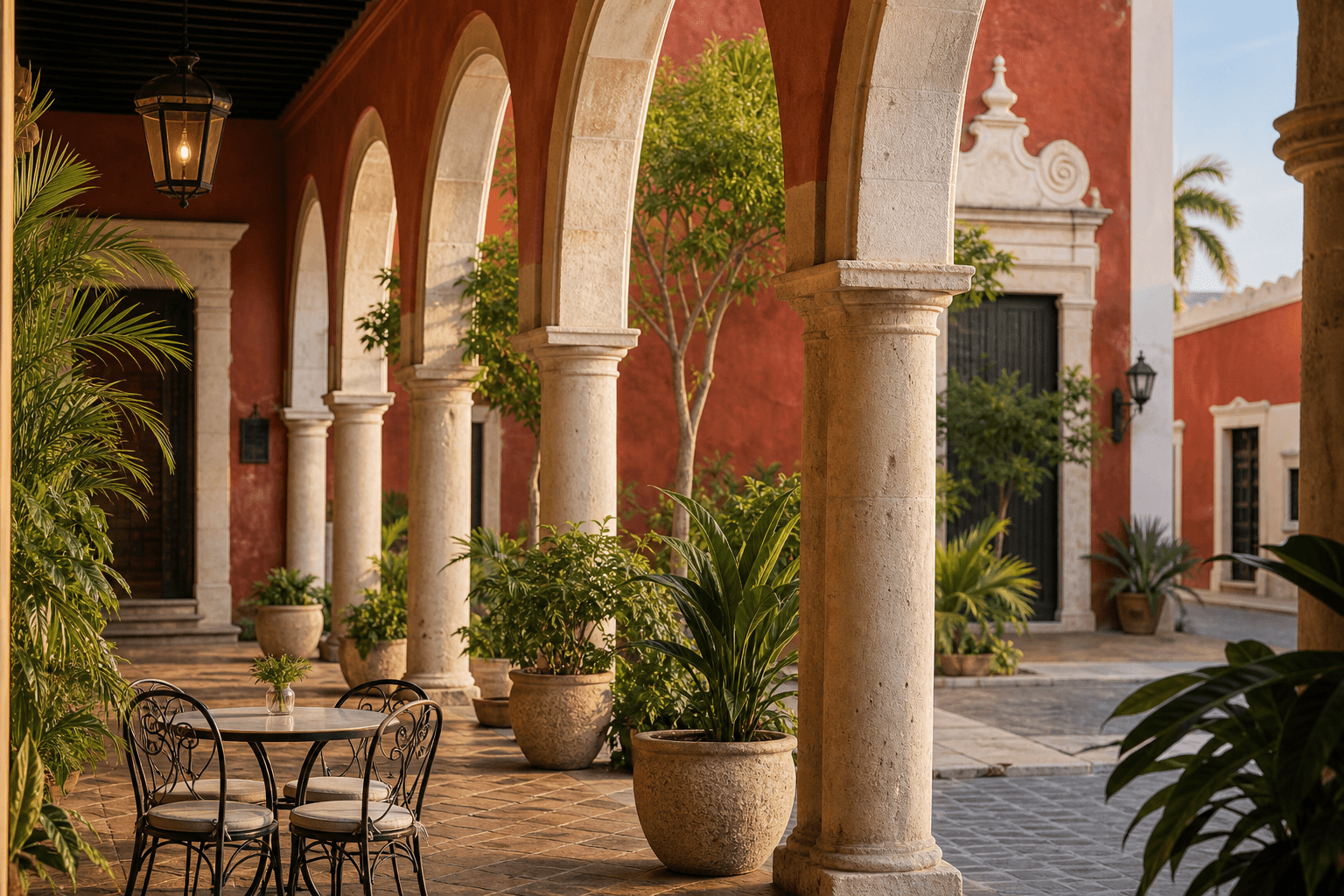
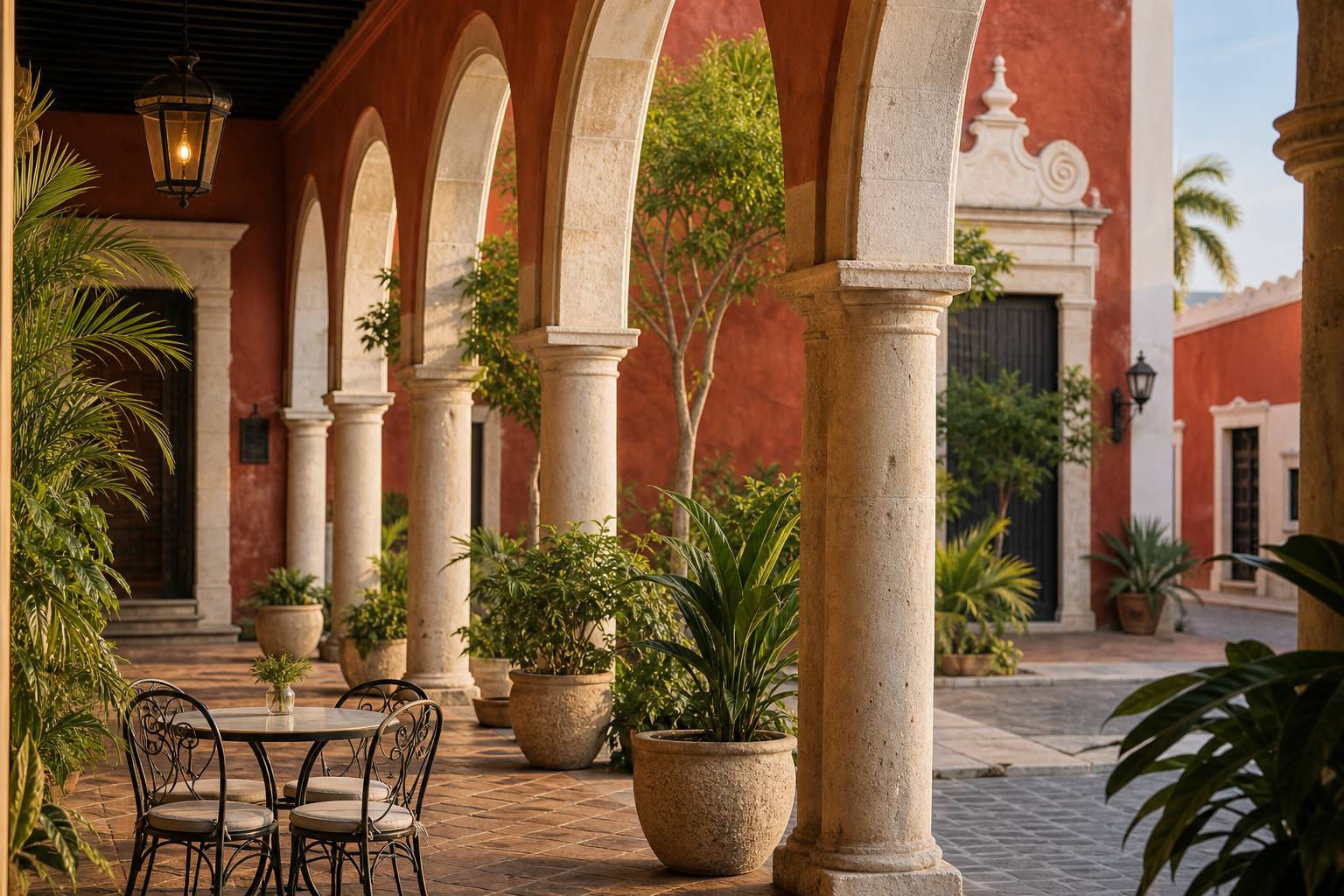
 Hotel Colonial, Cd Campeche, 2009 Courtyard
1. Hotels inside the walled historic centre
The historic centre is the default choice because it turns sightseeing into a series of short walks. You can reach the main square, cathedral, Calle 59, sections of the city wall and several museums without planning a transfer. That matters in Campeche’s heat: the option to return to your room in the middle of the day is not a luxury but a useful way to pace the visit.
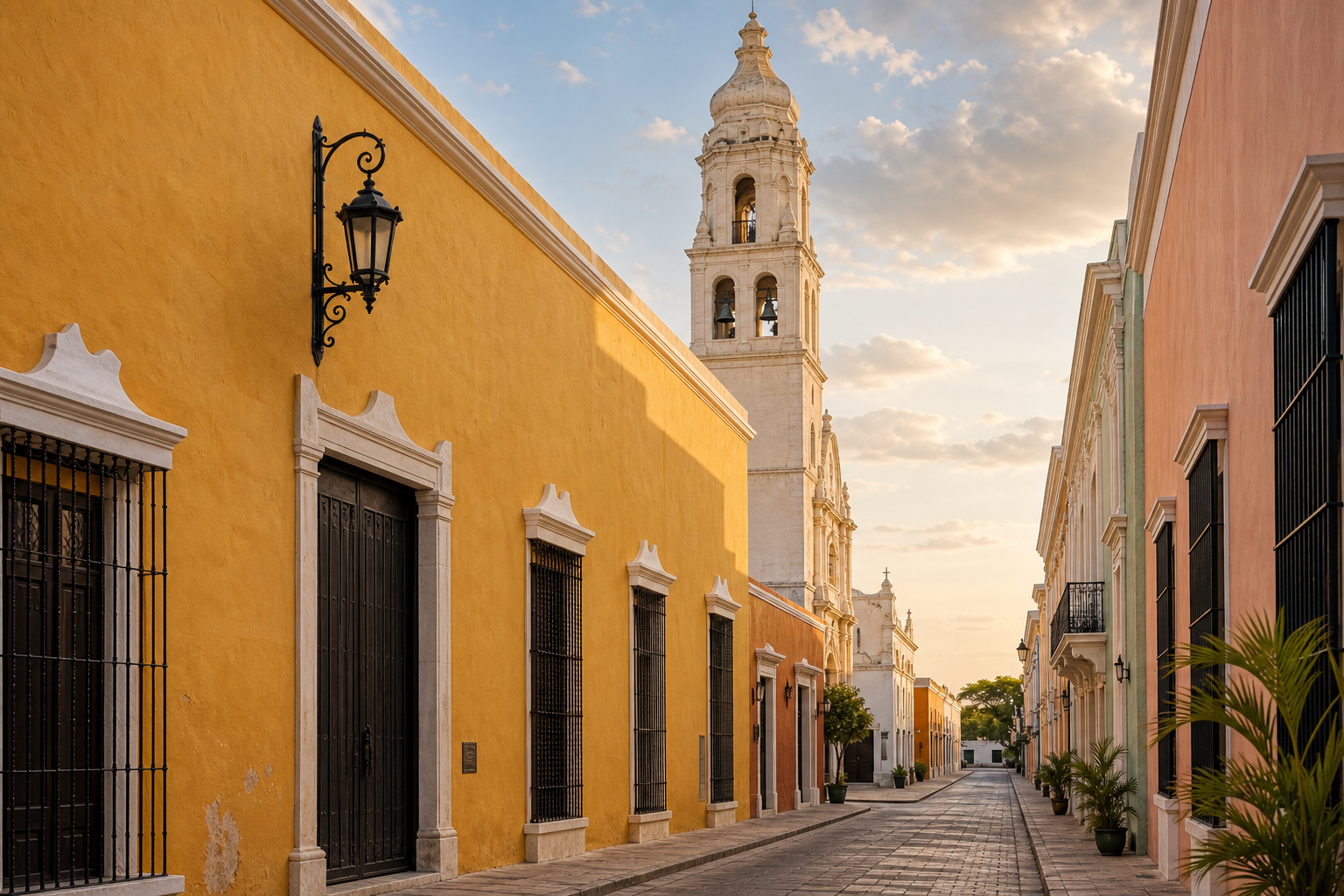
The area is made up of restored colonial houses, public squares, narrow streets and the surviving fortification system. Hotel buildings may have central courtyards, high ceilings, colourful façades and rooms that open toward an interior patio. Those features create atmosphere, but they also mean that properties vary considerably. Some are quiet behind thick walls; others carry sound from a bar, square or busy street into the rooms.
Why the centre works so well
The biggest advantage is time. A two-night stay can include an early walk before the heat, a museum visit, a late lunch, an afternoon rest and an evening circuit without repeatedly crossing the city. You can watch the centre change from working streets to evening pedestrian life. If you are interested in architecture or photography, being nearby lets you go out when the light is softer rather than trying to fit every photograph into the hottest part of the day.
The centre also works well for travellers who do not want to drive after dark. Campeche’s evening activity is concentrated enough that a central hotel makes dinner and a post-meal walk straightforward. You still need normal city awareness, especially with bags and phones, but the practical benefit is clear: your route home is a familiar walk rather than a search for a driver.
The compromises
Historic-centre rooms can be smaller than rooms in newer buildings. A listed balcony may face an interior patio rather than the street. Stairs can be part of the experience, and a building that looks beautiful in photographs may not have the layout you expect. Ask about lift access, luggage help, ground-floor rooms and the location of the air-conditioning unit if those details matter.
Noise is another variable. A room close to an active restaurant street or a plaza may be lively at night. That is not necessarily a problem, but it is different from a quiet resort. If you sleep lightly, request an interior-facing room, bring earplugs, and read recent reviews for comments about music, doors and street noise rather than relying only on the property’s star category.
Parking is often the decisive issue for drivers. The old streets were not designed for modern cars, and a hotel may have a nearby arrangement rather than spaces directly beneath the building. Ask where you will leave the car, whether access is restricted, and how far you must carry bags. If you are renting a large vehicle, confirm the dimensions of the route and parking area.
Who should choose this area?
Choose the walled centre for a first visit, a short city break, a culture-focused itinerary, a food-and-architecture trip, or any stay where walking to dinner matters. It is also the best base if Campeche is the main destination rather than a sleep stop between other parts of the peninsula.
It is less ideal if you need a large pool, guaranteed on-site parking, a modern gym, a very quiet room, or a quick highway departure before sunrise. Those needs do not make the centre impossible, but they make the malecón or modern districts worth comparing.
Browse historic-centre hotels on Booking.com · Compare city-centre availability on Trip.com
2. The best central hotel for different kinds of traveller
There is no single “best” hotel category in Campeche. The right choice depends on how you will spend the hours between arrival and departure.
Best for a first-time visitor: a small hotel in the centre
A compact property in or close to the walls gives you the clearest introduction to Campeche. Look for a location near the main squares and the pedestrian restaurant streets, but not directly over the busiest late-night activity. A courtyard, shaded terrace or pool is useful because it gives you somewhere to cool down without leaving the building.
Do not overvalue decorative details while ignoring the room basics. Confirm that the room has strong air-conditioning, reliable hot water, practical luggage storage and a bathroom layout that works for you. In a historic property, the charm is often in the public spaces, while the most comfortable rooms may be the less photogenic ones at the rear.
Best for couples: restored architecture with a quiet room
Couples often prefer a small restored property because the building itself becomes part of the trip. The most useful distinction is not luxury versus budget but quiet courtyard versus active street. A beautiful room facing a lively bar street may be less relaxing than a simpler room facing an internal patio.
Check the walking route to the waterfront and ask whether the property has a shaded place to sit. Campeche evenings invite slow movement rather than a packed schedule. A hotel that lets you start with coffee, return after a museum and leave again for sunset can be more satisfying than one with more formal facilities but a less convenient location.
Best for families: space, pool and easy returns
Families should be realistic about the heat and about the need for downtime. A room with two proper beds, a family suite or adjoining rooms may be more useful than a charming but tight room. Confirm occupancy rules, bed sizes, cot availability and whether children can use the pool. Do not assume that a central property’s small plunge pool is suitable for extended family swimming.
The malecón can be a strong family base because the setting feels open and the evening walk is easy to combine with a hotel break. A family travelling with a stroller should ask about steps, pavements and lift access in advance. The walled centre is walkable, but its historic surfaces are not always smooth.
Best for a road trip: predictable parking and early access
A road trip changes the calculation. If you plan to reach Edzná early, drive toward Escárcega and Calakmul, or continue west toward Champotón and Ciudad del Carmen, a hotel with dependable vehicle access may save stress. You can still visit the centre by taxi or car, then return to a property where luggage handling and parking are simpler.
Ask whether the car park is on the premises, whether it is covered, whether it closes at night, and whether staff need to move cars. Confirm the route to the property before arrival; a map pin can lead you into narrow historic streets that are awkward with luggage. If the hotel uses street parking, treat that as a different product from private parking.
Best for a tight budget: location before decoration
Budget travellers should compare the total cost of a room and transport rather than just the nightly rate. A cheaper hotel outside the centre can lose its advantage if you pay for several taxis and spend time travelling to every meal. Conversely, a simple central room with no pool may be ideal if you spend your days at museums, ruins and markets.
Look carefully at recent comments about air-conditioning, water pressure, cleanliness and noise. Those details affect sleep and comfort more than a decorative lobby. If breakfast is included, check what “breakfast” means and whether it suits your departure time; an early excursion may make the inclusion irrelevant.
3. Hotels near the malecón and Gulf waterfront
The malecón gives Campeche a different rhythm from the walled centre. The Gulf is present as a broad horizon, the road is more open, and the seawall becomes a natural place for walking, cycling, watching the evening light and feeling the breeze. Waterfront hotels generally suit travellers who want a pool or a room with more space, but “waterfront” does not automatically mean beach access.
Campeche’s city waterfront is a seawall and promenade. The water, tides and coastal conditions are not the same as a Caribbean resort beach, and swimming may not be the reason to choose this area. If your priority is sand and bathing, investigate beaches elsewhere in the state rather than booking a city hotel on the assumption that every Gulf-facing property has a swim-friendly shore.
Advantages of the waterfront
The main advantage is breathing room. You can begin or end the day outdoors without committing to a museum route. This is especially useful for families, older travellers and anyone who wants a lower-pressure day after a long drive. Many travellers also prefer the visual openness of the coast to the enclosed streets of the old town.
Waterfront properties may have larger public areas, pools, gyms or easier drop-off arrangements. These are not guaranteed, so compare the actual facilities and recent reviews. If you are staying three or more nights, the extra space can matter more than being a few blocks closer to the cathedral.
The centre is also useful for a split itinerary. You can spend mornings in the historic centre, take a break at the hotel during the hottest hours, and return to the waterfront for sunset. A taxi can make the distance easy; confident walkers may prefer the promenade when temperatures are comfortable.
 Campeche colonial street with pastel houses and city wall
 Malecón de Campeche at sunset
Disadvantages of the waterfront
You may be farther from the evening streets and need transport after dinner. The route between the malecón and the old centre can feel much longer in midday heat than it looks on a map. If your plan is to visit museums, plazas and bastions repeatedly, the central location will usually be more efficient.
Sea-facing rooms can also be exposed to wind, road noise and glare. Ask which direction the room faces and whether windows are sound-insulating. A “view” may be partial, distant or blocked from lower floors. The best waterfront booking is one where the location remains worthwhile even if the view is not exactly as pictured.
Who should choose the malecón?
Choose it for a longer stay, a family trip, a pool-oriented break, a relaxed couple’s itinerary, or a stop after several days of driving. It is also a sensible compromise if one traveller wants the historic centre while another wants more modern hotel facilities.
If this is your only night in Campeche and you want to walk out of the door into the old city, stay central instead. If the hotel’s pool, parking and quiet matter more than being able to walk to the cathedral, the malecón is likely the better fit.
Compare Campeche waterfront and city hotels on Booking.com · See current Campeche hotel inventory on Trip.com
4. Modern districts and practical road-trip bases
Campeche extends well beyond the tourist core. Newer parts of the city offer wider roads, larger buildings and more predictable access for cars. They may not feel like the Campeche shown in travel photographs, but they can be exactly right for a traveller with an early departure, a large vehicle, heavy luggage or a schedule built around several archaeological sites.
The benefit is operational rather than atmospheric. You may find larger rooms, chain-style facilities, easier lifts, more straightforward check-in and better parking. These properties can be comfortable after a full day in the heat. The trade-off is that you will usually travel to the centre for the evening and may find fewer interesting walks immediately outside the hotel.
When a modern base is the smart choice
Choose this area when you are driving and will not spend much time in the centre, when you need a reliable early breakfast or when your main goal is to sleep before a long route. It can also work for business travel, longer stays and travellers who prefer contemporary bathrooms, desk space and consistent room layouts.
A modern base is useful for an itinerary that combines the city with Edzná and then continues south. It may reduce the temptation to drive through the old streets when you are tired. If you are using a rental car, check fuel access, road connections and the hotel’s policy for leaving luggage while you make a day trip.
What you give up
The old city’s evening atmosphere will not be outside your door. You may need to budget time for traffic and find a driver after dinner. A hotel can be geographically close but still inconvenient if a divided road, one-way streets or difficult turns separate it from the centre.
If you choose this area, make one deliberate evening plan rather than assuming you will casually wander into the historic district. Visit the centre for a concentrated walk, dinner and perhaps the city-wall views, then return to the hotel. This approach turns the location into a practical base instead of a disappointment.
Search Campeche hotels with parking and current availability · Compare larger-room options on Trip.com
How many nights should you book?
For a quick introduction, book one night only if your arrival and departure times leave enough usable daylight. One night in the centre can work well: arrive, walk the old streets, see the waterfront at sunset, sleep, then leave after breakfast. One night outside the centre is less rewarding unless Campeche is primarily a road stop.
Book two nights for the best balance for most visitors. This allows one day for the historic centre and malecón and another for a slower morning, a museum, Edzná or a flexible coastal plan. Two nights also make the hotel location more important because you have time to use the property rather than simply sleep there.
Book three nights if you want the city without rushing, are travelling with children, or plan an excursion outside town. A pool or comfortable shaded area starts to matter more on a third night. You can alternate active and quiet periods instead of treating the room as a place to store luggage.
Book four or more nights if Campeche is your base for several day trips, but compare the drive times before assuming every excursion is convenient. Calakmul is not a casual day trip from the city: the route is long, and many travellers use an overnight base nearer the ruins. Edzná is a more natural pairing with a Campeche stay. The city is also a useful starting point for parts of the coast, but each route needs a realistic return plan.
What to check before booking
Air-conditioning
Campeche is hot and humid for much of the year. Confirm that the room has air-conditioning rather than only a fan, and read recent reviews for performance. A unit that is technically present but weak, noisy or unable to cool the room affects sleep quickly. If the building is historic, ask whether the system is individual or centrally controlled.
Noise
Look at the map, then read reviews. A central hotel near a square, restaurant street or event space may have evening noise. A waterfront hotel may face a busy road. A modern hotel can still have thin internal walls. If you need quiet, request a room away from the street, lift and communal courtyard, while understanding that requests are not guarantees.
Parking
“Parking available” can mean a private lot, a nearby garage, reserved street spaces or a parking arrangement with another property. Ask the hotel directly for the exact process. Confirm arrival access, opening hours, vehicle size limits and whether you can unload at the door. Keep valuables out of the car regardless of the arrangement.
Stairs and lifts
Restored colonial buildings may be beautiful but complicated for heavy bags or limited mobility. Check the number of floors, lift access, handrails and whether bedrooms are reached through open-air corridors. Contact the property if a ground-floor room is important; do not infer accessibility from photographs.
Pool and shade
A pool is useful in Campeche, but the size, shade, opening rules and depth vary. Families should verify whether children need supervision and whether the pool is suitable for swimming rather than cooling off. A small courtyard pool can be a valuable feature after a hot walk, even if it is not an all-day recreation facility.
Breakfast and departure times
If you plan to visit Edzná early or begin a long drive south, ask when breakfast begins and whether an early option exists. Do not pay extra for a meal you cannot use. Also ask about check-in after a late bus arrival and luggage storage if your departure is later than check-out.
Internet and work space
Wi-Fi quality can vary by building, room and time of day. If you need to work, ask whether the signal reaches the room and whether there is a desk or stable table. A colonial courtyard may be pleasant for reading but not practical for video calls. For a short holiday, this may not matter; for a longer stay, it can.
Staying central without suffering from heat
The most comfortable central itinerary is not a continuous walk from morning until night. Start early, when streets and façades are cooler and less crowded. Return to the hotel around the strongest heat, then go out again later. This is one reason the centre wins even when its rooms are smaller: the hotel is close enough to function as a pause in the day.
Carry water, use shade and treat the city wall and open plazas as exposed areas. The old streets can feel manageable in the morning and intense after lunch. Wear shoes that cope with uneven paving. If you have a room on an upper floor, use the lift when available and avoid carrying more than necessary.
A central hotel also lets you separate sightseeing from swimming. Spend one morning on architecture and museums, then use the malecón for a late walk. The Gulf view is a change of setting, not a replacement for the walled city. Planning both keeps the visit from becoming a checklist of monuments.
Hotels as bases for Edzná and other day trips
Edzná is the most straightforward archaeological excursion from Campeche city. It can be paired with a city stay because the site and the city offer contrasting experiences: open, sun-exposed Maya architecture outside town and shaded streets, museums and evening life back in Campeche. Go prepared for heat and check current site conditions locally before setting out.
For guided options, compare the actual departure point, included transport and language rather than choosing only by headline title. Compare Campeche and Edzná tours on GetYourGuide · See Campeche sightseeing options on Viator
Calakmul needs a different hotel strategy. The ruins lie deep in the state, beyond a long approach through the reserve. A Campeche city hotel is not the natural base for an easy Calakmul visit; staying nearer Xpujil or the reserve can reduce the day’s driving. If a listing or itinerary makes the journey sound effortless, check the route carefully and account for an early start, fuel, water, signal limitations and time at the site.
The same principle applies to wildlife and coastal excursions. Choose a city hotel when you want Campeche city to be part of the trip. Choose a local base when the attraction is many hours away. Hotel location is an itinerary decision, not just a room decision.
Central hotel versus malecón: a simple decision table
| Your priority | Better base | Why |
|---|---|---|
| First visit and old-city atmosphere | Walled historic centre | Walk to the principal streets, plazas and museums |
| Sunset walks and open views | Malecón | Immediate access to the Gulf-front promenade |
| Pool and family downtime | Malecón or a larger modern property | More likely to offer space, but verify facilities |
| Dinner without arranging transport | Walled historic centre | Evening streets are close |
| Secure, easy vehicle access | Modern district or verified parking property | Fewer narrow historic streets and simpler drop-off |
| Early road departure | Modern district or exit-side base | Easier access to the main roads |
| Architecture-focused photography | Walled historic centre | You can walk out during the best light |
| Longer, slower city stay | Centre or malecón | Choose between atmosphere and room facilities |
| One-night transit stop | Depends on route | Prioritize arrival, departure and parking logistics |
Booking strategy for different seasons
Availability and rates move with holidays, school breaks, events and weekends. The practical response is not to assume a fixed “best price” month but to compare dates if your schedule is flexible. For a central hotel, book earlier when you need a particular room type, a family configuration or parking. Smaller properties have fewer rooms, so they can sell out even when larger hotels still show availability.
Read recent reviews rather than relying on an old score. Look for patterns: air-conditioning, noise, cleanliness, water, parking and staff communication. A single complaint may be unusual; repeated comments are useful evidence. Check the cancellation terms carefully if your route depends on bus or train schedules.
If you are travelling during a festival or a major local event, expect the centre to be more active and possibly louder. That can be exactly the atmosphere you want, but it changes the value of a street-facing room. If sleep is the priority, choose a quieter room or the malecón and visit the event deliberately.
What not to assume about Campeche hotels
Do not assume every historic-centre hotel is luxurious. Some are simple guesthouses in attractive buildings; others have extensive services. Do not assume every waterfront hotel has a beach. Do not assume a pool is open all day or that a room labelled “sea view” looks directly over the Gulf. Do not assume parking is free, on-site or large enough for a rental SUV.
Do not choose a hotel solely because it is closest to the airport or bus station. Campeche city’s most useful hotel location depends on what you plan to do after arrival. If you arrive by bus and spend the visit in the old town, a central base can save more time than a cheaper property farther out. If you are collecting a car and leaving at dawn, the calculation changes.
Finally, do not treat a hotel’s star rating as a substitute for reading the location. A smaller central property may deliver the experience you want with fewer facilities. A larger modern hotel may deliver better sleep and logistics while feeling less connected to the city. Both can be good choices when matched to the trip.
A practical two-night hotel plan
On arrival day, leave bags, drink water and take a short orientation walk rather than trying to see everything. If you are central, explore the main square, cathedral area and nearby streets before the heat peaks. Rest at the hotel, then walk toward the malecón for the evening light. Return to the centre for dinner if that is where you are staying, or arrange transport back if you chose the waterfront.
On the second day, start with the part of the city that requires the most walking. Visit a fort or museum when it opens according to current local information, then retreat from the heat. In the afternoon, choose either more historic-centre time or a relaxed waterfront circuit. If you have a car, use the evening to prepare for the next route rather than moving it repeatedly through narrow streets.
This plan works because the hotel is used as a real base. You are not paying for a location you never experience, and you are not forcing every hour into the hottest part of the day.
Final recommendation
For most visitors, book a well-reviewed hotel inside or just beside Campeche’s walled historic centre, prioritising air-conditioning, noise information and a room layout that suits your group. Choose the malecón when a pool, sea-facing setting, space and easy downtime matter more than immediate access to the old streets. Choose a modern district when parking and an early road departure are the central problems to solve.
Campeche rewards a hotel choice that matches the pace of the trip. The centre is best for walking and atmosphere, the malecón for breathing room and sunsets, and the outer districts for straightforward logistics. Compare the current listings after making that decision, then verify the details that photographs cannot show: stairs, parking, noise, air-conditioning and the actual route to the door.
Check current rates for Campeche hotels on Booking.com · Compare available Campeche stays on Trip.com
Frequently asked questions
Is it better to stay inside the walls or on the malecón?
Inside the walls is better for first visits, short stays and walking to dinner. The malecón is better for pools, open views, family downtime and travellers who prefer a larger modern property. Neither is universally better; the choice is about whether you want the historic centre immediately outside the door or more space and waterfront access.
Is Campeche a beach-resort destination?
Campeche city is a Gulf-front historic city, not a conventional beach resort. The malecón is a seawall and promenade. If swimming and sand are the main purpose of your trip, research a coastal base elsewhere in Campeche State and treat the city as a culture-and-history stop.
Can you stay in Campeche without a car?
Yes. A central hotel is particularly convenient without a car because many city sights and evening streets are walkable. For Edzná or farther destinations, compare a current tour, taxi arrangement or public transport option and confirm the return logistics. A car becomes more useful when you are combining several distant sites.
Should you stay in Campeche before visiting Calakmul?
You can, but Campeche city is far from Calakmul. For a comfortable Calakmul visit, many travellers split the trip and stay closer to the ruins. Use Campeche for the city and nearby sites, then move south if Calakmul is a major objective.
Are historic-centre hotels noisy?
Some are and some are not. Noise depends on the street, courtyard, nearby evening activity and room position. Ask for an interior room if you sleep lightly and read recent reviews for specific comments about music and late-night sound.
Is parking available in the walled centre?
Some properties offer parking on-site or nearby, but it is not universal. Ask the property exactly where the car stays, how you reach the hotel for unloading and whether the arrangement suits your vehicle. Never assume that a central location includes a private car park.
How early should you book a Campeche hotel?
Book as soon as your dates are fixed if you need a central room, family beds, a pool, parking or a specific cancellation policy. Otherwise compare current availability and recent reviews, especially around weekends, holidays and local events.
What matters most in a Campeche room?
Reliable air-conditioning, a quiet sleeping position, comfortable beds, usable bathroom facilities and a practical luggage route matter most. In a historic building, add stairs and lift access to the list. In a waterfront or modern property, check the actual distance and transport route to the historic centre.
Are there hotels near Campeche’s attractions?
Yes, the strongest concentration is around the walled historic centre. The cathedral, plazas, Calle 59, bastions and museums are close enough to combine on foot. The malecón is also a major city attraction but is a separate waterfront zone rather than part of the compact old-town street network.
What should road-trippers ask the hotel?
Ask about the exact parking location, vehicle access, unloading, opening arrangements, early check-out and whether the route to the main road avoids narrow historic streets. Also confirm whether breakfast is available before your planned departure and whether luggage can be stored safely.
Is a pool necessary?
No, but it can be valuable in Campeche’s heat, especially for families or stays of several nights. A central hotel without a pool can be the better choice if you plan to spend your time walking and visiting museums. Treat a pool as a comfort feature, not a substitute for a good location or reliable air-conditioning.
Where should you stay for a one-night visit?
Choose the walled centre if you want the city experience. Choose a practical outer or waterfront hotel if you arrive late, leave very early, need parking or are continuing a long road journey. The best one-night base is the one that protects your usable time rather than simply showing the lowest room rate.
Do hotels in Campeche usually include breakfast?
Some do and some do not, and the included meal varies. Check the exact booking conditions and serving time. If you are leaving early for a ruin or long drive, ask whether an early option is possible rather than assuming the advertised breakfast will be available.
Can you walk from the malecón to the historic centre?
Often yes, depending on your exact starting point, weather and walking pace. The distance can feel different in intense midday heat or with children. A short taxi ride may be the practical choice, while the promenade is more enjoyable in the cooler morning or evening.
What is the quietest hotel area?
There is no guaranteed quiet zone. A room away from a central restaurant street may be quieter than a street-facing room, while a waterfront hotel can have road or event noise. Read current reviews and request a room away from bars, lifts and active courtyards.
How do you compare hotels fairly?
Compare location, total transport needs, room conditions, parking, air-conditioning, cancellation terms and recent review patterns—not just price or star rating. Decide first whether the trip is centred on walking, waterfront relaxation or road logistics. That decision narrows the hotel search more effectively than a generic “best hotel” list.
Is the historic centre suitable for older travellers?
It can be, especially because attractions are close together, but historic paving, steps and heat require planning. Ask about a ground-floor or lift-access room, use taxis for longer connections and schedule breaks during the hottest hours. Accessibility varies by building, so confirm details directly.
What is the best hotel area for an evening walk?
The walled historic centre is the clear choice for an evening walk through colonial streets, plazas and restaurant areas. The malecón is the better choice for a long open-air sunset walk beside the Gulf. You can enjoy both during a two-night stay, but staying centrally makes the old-city walk easiest.
Should you book a hotel near the bus station?
Only if your transport schedule makes that useful. For most sightseeing stays, the historic centre is more rewarding. A bus-station-adjacent location may help with a very early departure or heavy luggage, but compare the actual transfer time and the hotel’s surroundings before choosing it over the centre.
What if all central hotels are sold out?
Search the immediate edge of the historic district, then the malecón. A hotel a short taxi ride away can still work well if you plan one concentrated visit to the old city. Check cancellation options and search again closer to the date, but do not rely on last-minute availability for a particular room type.
Should you choose a hotel with a courtyard?
A courtyard is useful for shade, atmosphere and a quiet place to sit, but it does not guarantee a quiet room. Ask where your room faces and whether the courtyard is used for breakfast or evening gatherings. Courtyard design is a bonus; reliable cooling and sleep remain more important.
What is the most important location detail in the listing?
Look beyond “historic centre” or “near the beach.” Check the walking route, street access, parking arrangement and distance to the specific places you plan to visit. In Campeche, a few blocks can change whether you walk comfortably, carry bags over uneven streets or need a taxi after dinner.
Is Campeche good for a longer hotel stay?
Yes, if you use it as a base for a balanced city-and-day-trip itinerary. For more than two nights, prioritise a comfortable room, shade, pool or common area, laundry access and a location that makes daily errands easy. If every day involves a distant destination, consider moving between bases rather than returning to the city each night.
What is the final booking rule?
Pick the area first, then the property. A clean, well-cooled room in the right zone will usually serve you better than a more impressive hotel that fights your itinerary. For most first-time travellers that means the walled centre; for space and waterfront time, the malecón; for driving, a verified practical base.
If you want the most character with the least transport planning, choose the historic centre. If you want a slower hotel day with wind, open views and room to spread out, choose the malecón. If you need a dependable start for a long route, let parking and road access decide. Campeche has enough variety for all three styles, but the city is most enjoyable when the hotel supports the way you actually plan to travel.