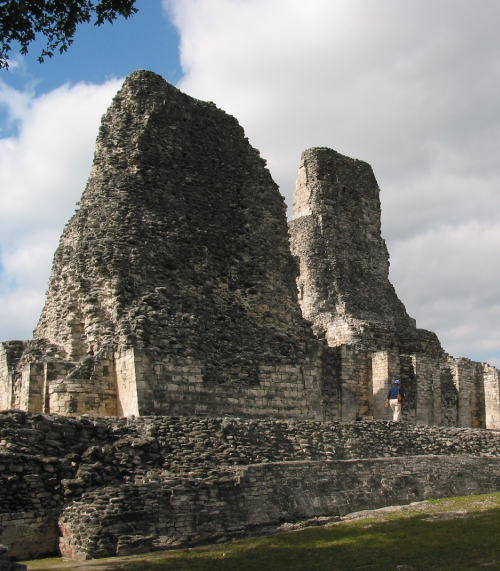
Balamkú is a small Maya archaeological site in southern Campeche with an unusually intimate reward: a preserved, modeled stucco frieze inside Structure I. The monument is not a giant skyline pyramid and the site is not a full-day expedition by itself. Instead, Balamkú offers a close look at Maya sculpture, painted surfaces, and Early Classic architecture in a forest setting, on the same broad corridor that leads toward Xpujil and Calakmul.
That combination makes it easy to misunderstand. Balamkú is not a substitute for Calakmul, and it is not simply another stop to tick off beside Becán and Chicanná. Its value is concentrated in the frieze and in the way the small site lets you slow down. The cleared groups are compact, while the surrounding forest reminds you that the ancient settlement was part of a much larger landscape than the restored buildings suggest.
This guide explains what you see, why the stucco matters, how to reach the entrance, how to combine Balamkú with the Río Bec sites, and what to prepare for in the southern Campeche heat. Official opening times, fees, access rules, and monument restrictions can change; check the INAH Balamkú listing shortly before your visit.
Where Balamkú is and what kind of visit to expect
Balamkú is in the municipality of Calakmul, Campeche, along the Federal Highway 186 corridor between Escárcega and Chetumal. The access road branches from the highway near kilometre 93, and the site is reached by a short approach road rather than by the long interior drive used for the Calakmul archaeological zone. Xpujil is the most practical nearby base for travellers exploring several southern sites, although the exact route and travel time depend on road conditions and your starting point.
The entrance sits in a rural, forested landscape. There is no urban visitor district around the gate, and you should not plan on solving every need after you leave the highway. Carry drinking water, sun protection, insect repellent, and enough fuel and cash for the wider route. Small sites and rural stops in Campeche do not offer the same range of services as the state capital or a large resort destination.
Balamkú is a walking visit on uneven ground. The paths pass through shade, but humidity and heat remain serious factors, especially in the middle of the day. You may encounter roots, loose stone, steps, and surfaces made slippery by rain or leaf cover. Comfortable shoes with a firm sole are more useful than sandals designed only for pavement. A light long-sleeved shirt helps with sun and insects without making the walk unnecessarily difficult.
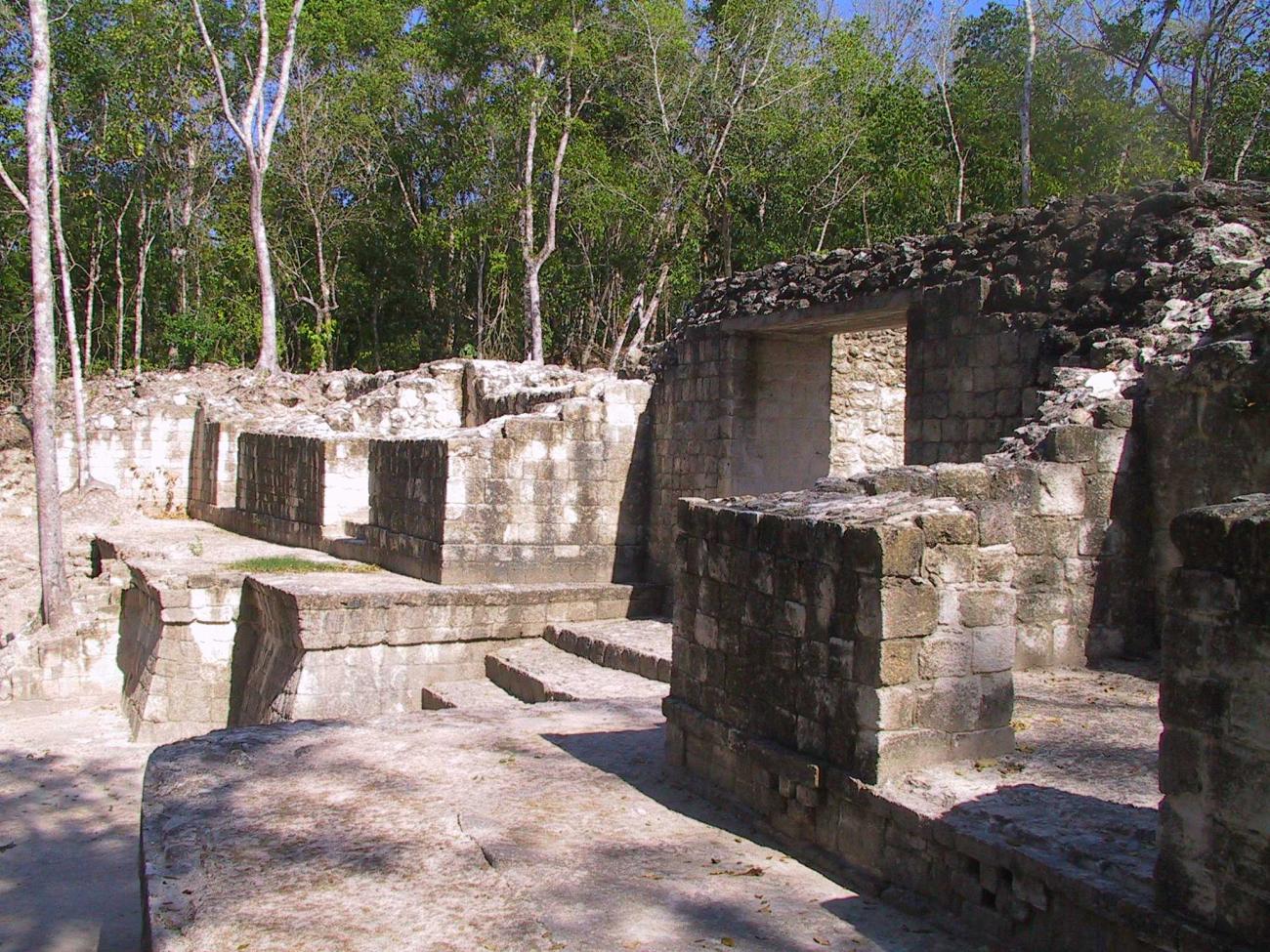 The Balamkú archaeological zone in Campeche, with Maya architecture in the forest
The experience is quieter and more enclosed than the broad plazas at Calakmul. You move between trees and low-density architectural groups, then focus closely on the protected frieze. If you prefer monumental scale, panoramic views, or a long route through a large ancient city, Balamkú works best as one part of a larger day. If you are interested in conservation, iconography, and the details that disappear when a site is seen only from a distance, it can be one of the most memorable stops in the region.
Why the Balamkú frieze is important
The central reason to come is the modeled stucco frieze associated with the substructure of Structure I in the Central Group. It is not a modern decorative reconstruction placed on a building for effect. It is ancient Maya artwork preserved in situ, with modeled forms and traces of polychrome pigment. The survival of stucco at this scale is unusual because exposed plaster is vulnerable to rain, humidity, roots, temperature changes, and the collapse of the building that once protected it.
The frieze is usually described through jaguar imagery, masks, and cosmological symbolism. Its central composition includes large supernatural figures and feline associations that have given Balamkú its name: “jaguar temple” is the familiar interpretation of the Maya words balam and kú. That translation is a useful way into the site, but it should not turn the monument into a simple story about one animal. The imagery belongs to a broader visual language about rulership, sacred space, creation, and the relationship between human communities and the forces represented in the built environment.
Look at the frieze as a constructed surface rather than as a flat mural. The sculptors built volume in stucco, creating projections, contours, and layered figures. Pigment would have changed the appearance further when the building was new. The red and darker tones visible today are fragments of a once more vivid architectural programme. Maya cities were not colourless limestone ruins; façades, rooms, masks, and monuments were designed to be seen as painted and modelled environments.
The frieze also shows why conservation controls access. A close view is valuable, but breath, touch, flash, moisture, and accidental contact all create risks for fragile material. Follow the current instructions from the caretakers. Do not lean on barriers, reach across a protective line, or assume that photography rules from an older guide still apply. If the chamber or viewing area is temporarily restricted, that is a conservation decision, not a failure of the visit.
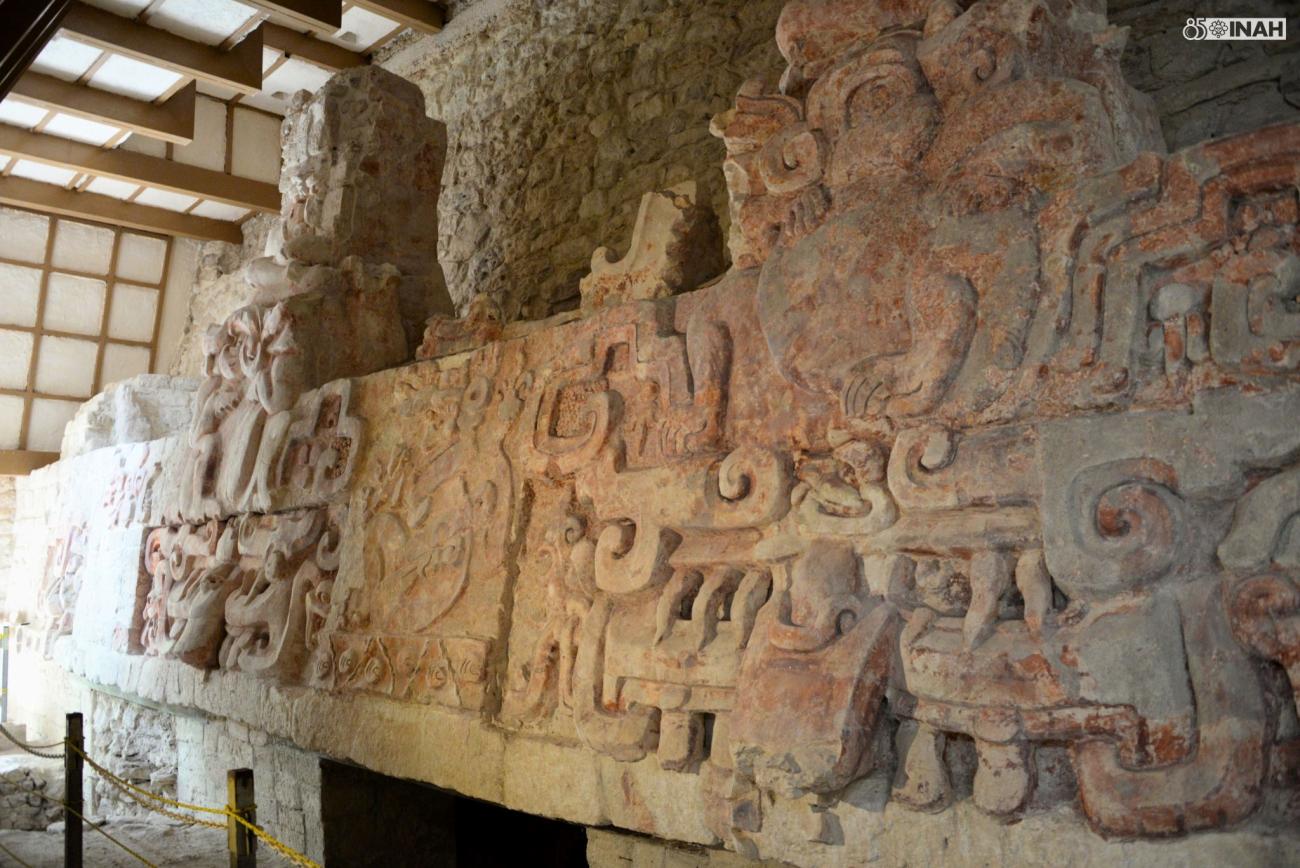 The modeled stucco frieze of Balamkú’s Structure I in Campeche
A useful way to look is to begin with the large shapes, then move to smaller details. First notice how the frieze fills the architectural surface and how the figures are arranged in relation to one another. Then look for pigment, repeated eyes or masks, animal features, and the way the relief projects from the wall. The lighting inside a protected space can be subdued, so allow your eyes time to adjust instead of rushing through a single photograph.
A short history of the ancient settlement
Balamkú was occupied over a long period, beginning around the Late Preclassic and continuing into the Classic and later phases of Maya history. The buildings visible to travellers represent only the part that has been investigated, stabilised, and made accessible. Forest growth and unexcavated mounds are not empty space; they are part of the archaeological record, even when their original function is not yet clear to a visitor.
The site became widely known to archaeology in the modern period after an investigation connected to reports of looting in 1990. The looters’ trench exposed part of the stucco frieze, bringing attention to a monument that might otherwise have remained hidden behind later architectural layers and vegetation. Archaeological work then focused on documenting, excavating, and conserving the Central and South groups. That history is a reminder that discovery is not the same as creation: the settlement and its artwork had existed for centuries before modern research reached them.
Balamkú’s ancient community was connected to the wider southern lowlands. Its architecture shows relationships with traditions commonly discussed under the Río Bec and neighbouring regional styles, while the frieze reflects visual ideas shared across the Maya world. The modern highway can make the area look remote, but ancient settlements were linked by paths, exchange, political relationships, and movement through the forest. A small site does not mean an isolated one.
The later history of the buildings is equally important. Maya structures were often modified, enlarged, covered, or repurposed. A visible temple may contain an earlier building inside it. That is one reason a protected interior surface can be more informative than a completely exposed façade: the later construction accidentally preserved an earlier programme. At Balamkú, the frieze survived because architecture and collapse created a form of shelter, though that same concealment also meant it was vulnerable to looting when opened.
Modern archaeology cannot restore every lost detail. It can document surviving masonry, analyse materials, stabilise surfaces, and explain what is known. When you walk through Balamkú, distinguish the ancient fabric from modern supports and reconstructed edges. The contrast is part of the story of how a forest-covered city becomes a protected archaeological zone.
The Central, South, and North groups
INAH describes Balamkú as a site composed of three main building complexes. The Central and South groups are the principal areas explored and restored for visitors. The North Group and surrounding features contribute to the overall understanding of the settlement, even where the route does not offer the same level of architectural exposure.
The Central Group is the place to concentrate your attention because it contains Structure I and the famous frieze. Its plazas and platforms give the frieze a civic setting rather than presenting it as an isolated museum object. The building was part of an architectural ensemble in which movement, elevation, façade, and restricted interior space worked together. The meaning came from the relationship between image and building.
The South Group helps balance that focus. Its structures are less famous internationally, but they show the scale and organisation of the settlement beyond the single celebrated monument. Look for platforms, stairways, rooms, and the spaces between buildings. Archaeology is often most legible when you think about how people moved through a plaza: where a visitor would stand, what could be seen from below, and which routes might have been reserved for particular people or ceremonies.
The route is compact enough to make a second pass worthwhile. On the first circuit, orient yourself and identify the major groups. On the second, compare the way the buildings sit in the forest and notice details missed while navigating. A second look does not mean adding another overlapping attraction section; it is simply a practical strategy for a small site whose most important feature deserves time.
Some structures retain traces of rounded corners, masonry details, or architectural forms associated with the southern Campeche region. Do not expect every building to be fully excavated or symmetrical in the way a modern reconstruction might be. Uneven preservation is normal. A mound with a partially exposed stairway can be as significant to the settlement’s plan as a restored temple, because it records the limits of current investigation.
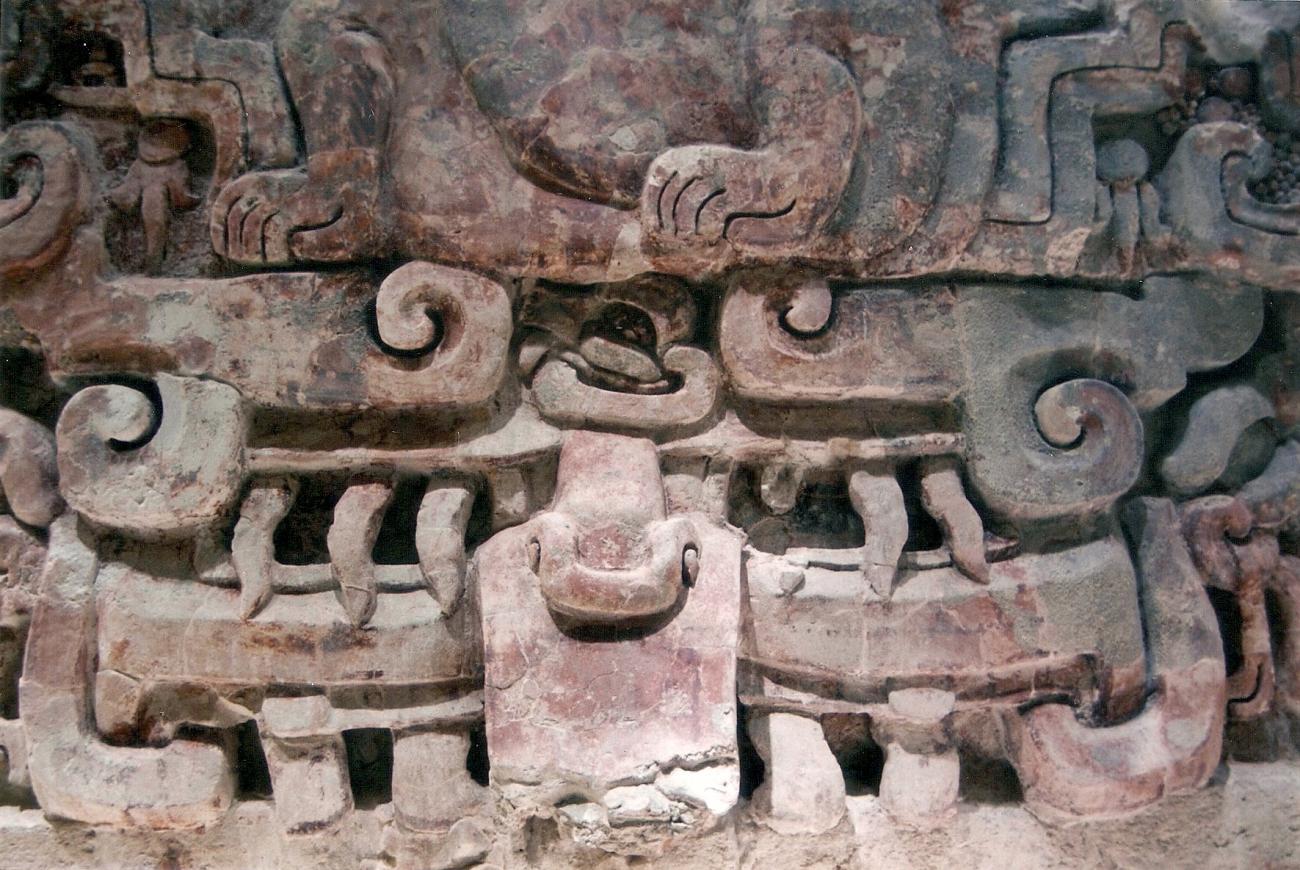 Maya architecture in the Central Group of Balamkú, Campeche
How Balamkú compares with nearby ruins
Balamkú belongs in a route with nearby sites, but each stop answers a different question. Becán gives you a larger civic centre with a prominent moat and broad plazas. Chicanná is known for a powerful zoomorphic façade and a route that can be visited without the long interior journey to Calakmul. Xpuhil presents distinctive Río Bec architecture, including the famous three-towered building. Calakmul offers scale, distance, forest, and the remains of a major ancient power centre.
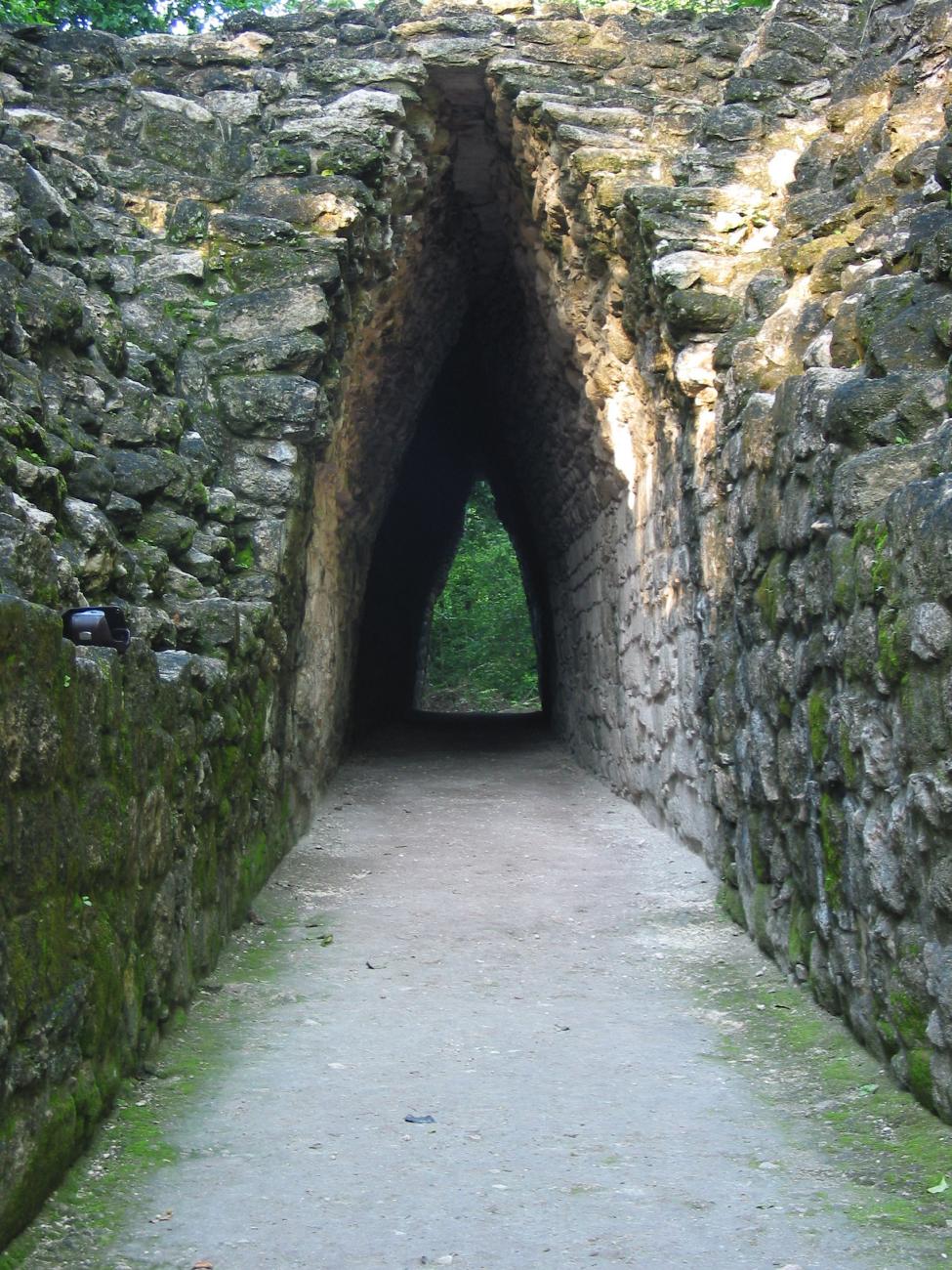 A vaulted passage in the Maya archaeological zone of Becán, Campeche
The contrast with Becán is useful because it prevents Balamkú from being reduced to a single image. At Becán, the passage, moat, plazas, and larger civic layout help you read how movement was organised through an ancient centre. At Balamkú, the emphasis falls more heavily on the protected sculptural surface and the smaller groups around it. Both sites are in Campeche’s Río Bec region, but they reward different kinds of attention.
Balamkú is the specialist stop in that group. Its importance is concentrated in the preserved stucco, while its surrounding architecture provides the context. It is not the best choice if you have only a few hours and want the largest possible ruins. It is a strong choice if you want to understand how a sculpted façade was made, how a protected interior can survive, and how conservation changes the way an ancient monument is viewed.
A realistic southern-Campeche plan might place Balamkú with one or two roadside Río Bec sites on a day based in Xpujil, then reserve another day for Calakmul. Combining every site and Calakmul in one rushed outing usually sacrifices the very qualities that make Balamkú worthwhile. Distances on the map are not the only issue: heat, walking pace, road conditions, stops for fuel and food, and opening arrangements all affect the day.
If travelling from Campeche city, Balamkú is a poor choice for a casual short excursion. The corridor to Xpujil and the site lies deep in the state, and the return journey makes for a long day even before you add other ruins. A guided day trip can solve some planning problems, but verify the actual itinerary and departure point rather than assuming a product includes every southern site. For a confirmed Balamkú-and-Calakmul product from Campeche, compare the GetYourGuide Balamkú tour inventory with the Viator Balamkú and Calakmul tour. Read the current inclusions, physical demands, and cancellation terms before booking.
Getting to Balamkú from Xpujil
Xpujil is the most convenient base for a multi-site southern-Campeche route. From town, follow Federal Highway 186 toward the Balamkú access junction. The entrance road is separate from the road into the Calakmul reserve, so confirm the turn before setting out. INAH identifies the access as the Balamkú road at the junction near kilometre 93 of the Escárcega–Chetumal highway, followed by the short approach to the site.
A rental car gives you the most control. It lets you visit Balamkú early, continue to another Río Bec site, and stop when the heat or road conditions make a break sensible. Drive in daylight, reduce speed around settlements and junctions, and do not treat a straight rural highway as a reason to drive aggressively. Wildlife, pedestrians, bicycles, topes, road works, and vehicles entering from side roads can appear with little warning.
A taxi from Xpujil may be possible, but do not assume that a spontaneous return ride will be available at the gate. Arrange the round trip and waiting time locally before leaving town, and confirm whether the driver understands the separate Balamkú entrance. Rural transport is less like a continuous urban taxi system and more like a pre-arranged journey. Keep the driver’s contact details and enough battery for navigation.
Public transport is less straightforward than reaching Xpujil itself. The highway corridor has intercity services, but they are not a substitute for a confirmed last-mile connection to the archaeological entrance. If you are travelling without a car, ask at your accommodation or in Xpujil about current local options and verify the return plan before paying for the outward trip. Do not walk the highway shoulder as a backup: the distance, heat, traffic, and lack of shade make that an unsafe and unpleasant plan.
From Campeche city, a private vehicle or an organised excursion is more practical than trying to assemble several local connections. If you are driving east or south, use the trip as part of a wider itinerary that includes an overnight base near Xpujil or another suitable corridor town. The journey becomes much more manageable when you are not committed to returning to the capital after a full day in the forest.
Opening information, fees, and facilities
The INAH listing currently gives Balamkú opening hours as Monday to Sunday from 08:00 to 17:00, with last access at 16:45. It lists an entrance fee of MXN 80 for national visitors and MXN 145 for foreign visitors. Sundays are listed as free for Mexican citizens, with additional exemptions for certain Mexican children, students, teachers, and senior citizens. These details are operational information, not a guarantee for your travel date; check the official listing before leaving.
The site listing identifies parking, an information module, and toilets. That does not mean the entrance has a shop, a restaurant, reliable card payment, or a broad selection of supplies. Bring water and a snack for the wider drive, while respecting any current rule against taking food into the protected area. Cash remains useful in the region even when a particular gate or town business has modern payment options.
Arrive with enough margin before last access. A late arrival can be especially frustrating because the frieze is the reason for the stop, and you may need time to find the entrance, pay, walk through the groups, and view the protected structure. Opening arrangements can also be affected by conservation work, weather, staffing, or local management decisions.
Do not rely on a photograph from an old blog for current access rules. Monument climbing, interior viewing, photography, and route length may change. Respect signs and staff even if a travel forum says that visitors previously entered a different area. The best visit protects the surface you came to see.
How much time to allow
Allow at least an hour for a hurried orientation and the main frieze, but a more comfortable visit gives you roughly two hours, depending on walking pace and the route open on the day. That time includes the entrance, the Central Group, the protected stucco, and a walk through the accessible surrounding architecture. People who enjoy archaeology, photography without flash, or careful observation may want longer.
Do not measure the visit only by the number of structures. The frieze rewards attention, and the forest changes what you can see from each path. Pause in the plazas. Look at masonry joints and the relationship between platforms. Listen for birds and insects, but do not turn the site into a wildlife feeding area or leave food behind.
If Balamkú is one stop on a driving day, build in time for the other site gates and for the possibility that a planned connection takes longer than expected. A route of Balamkú, Becán, Chicanná, and Xpuhil can sound compact because the sites are on the same highway. In practice, parking, walking, heat, interpretation, and meal or fuel stops turn it into a full day. Calakmul should generally be treated as its own major excursion rather than an afterthought.
Heat, insects, rain, and the forest
Southern Campeche is hot and humid for much of the year. The trees provide shade, but shade is not the same as cool air. Start early when possible, drink steadily, and take short pauses before you feel exhausted. A hat, sunscreen, breathable clothing, and a light layer that covers shoulders and legs are practical choices.
Insect activity varies with weather and time of day. Use repellent and check for ticks after walking through vegetation. Avoid strong fragrances that attract insects and make the visit less comfortable. If you have allergies or a medical condition affected by heat, plan a slower route and carry the supplies you normally need; do not expect a remote archaeological gate to function as a clinic.
Rain can make paths muddy and stones slick. The forest may look greener and feel cooler after a shower, but storms can affect driving visibility and the condition of unpaved approach roads. During the wet season, leave flexibility in the itinerary. A closed or altered route is better handled when the day does not depend on fitting several distant stops into a fixed return time.
Wildlife is part of the setting, not an attraction that can be guaranteed. You may hear birds or see movement in the trees, but Balamkú is an archaeological visit first. Keep distance from animals, never feed them, and do not play recorded calls. The surrounding Calakmul landscape has ecological value beyond the cleared monuments.
Visiting with children and older travellers
Balamkú can work well for children who enjoy short forest walks and stories about how buildings were constructed. The frieze gives the visit a clear focus, while the compact scale prevents the day from becoming an endurance test like a long archaeological circuit. Explain beforehand that some areas are protected and that touching the stone is not allowed.
The uneven paths and heat require more planning for older visitors or anyone with limited mobility. Ask at the entrance what route is currently practical, because access conditions can change and not every surface is smooth. Bring water, use shade, and avoid scheduling Balamkú after several hours of walking at another site.
A carrier can be more useful than a wheeled stroller on rough ground, but the choice depends on the child and weather. Keep children close near steps and raised platforms. There may be no convenient place to buy a replacement hat, drink, or snack once you are inside the rural corridor.
Where to stay for Balamkú
For a route that includes Balamkú, the Xpujil area is the clearest overnight base because it sits near the Río Bec sites and the road toward Calakmul. Choose your accommodation according to departure time, vehicle parking, air conditioning or ventilation, and the amount of food and water you want available before an early start. Do not choose a named lodge or hotel from an unverified list simply because it appears in an old itinerary; availability and property details change.
Check current Xpujil-area stays on Booking.com · Compare Xpujil hotels on Trip.com
Campeche city is a comfortable base for the walled centre, Edzná, and coastal plans, but it creates a much longer Balamkú day. Escárcega can be useful as a transport junction depending on your route, though Xpujil generally places you closer to the southern archaeological corridor. For any overnight stop, confirm the property’s current location and arrival policy directly through the booking page.
Is a guide worth it?
A guide is most useful if you want help reading the frieze and comparing Balamkú with the Río Bec sites. A local or specialist guide can explain the difference between observed architecture and interpretation, point out details that are easy to miss, and help you organise a route that does not waste time on backtracking. The quality of guiding varies, so verify what language, transport, entrance fees, and sites are included.
You do not need a guide to appreciate the site. Read the official INAH information before you arrive, take the route slowly, and ask staff about current access to the frieze. Independent travellers often get more from Balamkú when they arrive with a few questions: Why was the stucco preserved? Which parts of the building are original? What is known about the groups beyond the restored route? How does this architecture relate to Becán and Xpuhil?
If you book a tour, use a live product page rather than an invented itinerary. The GetYourGuide Balamkú listings and the Viator Campeche Balamkú product are useful starting points for comparing current inventory. Check whether the departure is from Campeche city or another base, whether the product is a private or shared excursion, and how much time is actually allocated at Balamkú.
Photography and respectful behaviour
The frieze is visually striking, but a good photograph is not the only measure of the visit. Follow instructions about flash, tripods, and proximity. Do not use a drone without the relevant permission. Avoid blocking other visitors in a small viewing area, and lower your voice near protected surfaces.
Photograph the architecture as a relationship between stone and forest. A wide image can show how the Central Group sits in its clearing, while a closer image records the scale of the relief. Keep captions geographically precise: Balamkú is in Campeche State, near the Xpujil and Calakmul corridor, not in Campeche city and not in Yucatán State.
Do not remove stones, plants, or fragments. Even a small object that looks loose may be part of an archaeological context. Stay on the route to reduce erosion and protect roots, soil, and hidden remains. The quiet atmosphere is one of Balamkú’s strengths; preserving it is part of being a responsible visitor.
A practical one-day route from Xpujil
Start with Balamkú if the gate schedule and your transport allow it. The early hours are kinder for walking, and the protected frieze is easier to appreciate before you are tired. After Balamkú, continue along Highway 186 to one or two nearby Río Bec sites rather than attempting to cover every possible ruin. Becán offers a different urban layout and the moat; Chicanná offers a strong façade and a compact route; Xpuhil provides another architectural comparison.
Choose the next stop based on your interests and the day’s conditions. If the heat is building, one substantial second site is better than three rushed entrances. Pause for water and food in an appropriate town stop, not inside a protected monument area where rules may prohibit eating. Refuel before the tank becomes a concern, because long highway stretches have fewer services than travellers used to city travel expect.
Return to Xpujil with enough daylight for the drive. If you are continuing toward Calakmul the following day, prepare the route that evening: water, fuel, cash, clothing, insect repellent, and a realistic departure time. The reserve road is a separate commitment from the short Balamkú approach, and it deserves a plan of its own.
Common mistakes to avoid
The first mistake is confusing Balamkú with Balamcanché, a different archaeological site in Yucatán State. Check the name and map before setting out. The second is confusing the Balamkú turnoff with the Calakmul reserve entrance. They are separate access points along the highway.
The third mistake is expecting an urban café or fuel stop at the gate. Carry what you need for the rural journey. The fourth is assuming that the famous frieze can always be viewed in exactly the same way. Conservation work and management rules can alter access; accept the current arrangement.
The fifth is trying to combine Balamkú, Calakmul, and several additional ruins in a single day from Campeche city. The map may look manageable, but the road and walking time are real. Stay near Xpujil when the southern corridor is the main purpose of your trip, or make Balamkú part of a longer route with a planned overnight stop.
Finally, do not judge the site by its size. Balamkú is not designed to compete with Calakmul’s scale. It is a focused encounter with ancient stucco, protected colour, and a small forest settlement whose surviving details reward patience.
Is Balamkú worth visiting?
Balamkú is worth visiting if you are already travelling through southern Campeche and care about Maya art, conservation, or the architectural links between the Río Bec sites. The frieze gives the stop a clear purpose, while the compact groups make it easier to visit without exhausting yourself. It is especially well suited to travellers who prefer close observation to a famous-name checklist.
It is less suitable as an isolated day trip from Campeche city unless you are comfortable with a long road day or have a specific tour arranged. It also should not replace Calakmul if your priority is the scale of a major Maya capital. The strongest plan is usually to stay near Xpujil, visit Balamkú early, compare it with one or two nearby sites, and give Calakmul a separate day when possible.
Balamkú asks you to look closely: at the modelling of stucco, the remains of pigment, the layers of an ancient building, and the forest that still conceals much of the settlement. Plan for the distance, protect yourself from the heat, and leave enough time for the frieze to be more than a quick photograph. That slower approach is what makes this small Campeche site stand out.