The Malecón is Campeche city’s open edge: a long Gulf-front promenade where the fortified historic centre gives way to broad sky, sea air, traffic, exercise, and the evening routine of local families. It is not a resort beach and it is not the same thing as the walled city. The Malecón is a public waterfront for walking, running, cycling, sitting, taking photographs, and watching the sunset over the Gulf of Mexico.
That distinction helps set expectations. You do not come here for swimming, a line of beach clubs, or a tightly managed attraction with a single entrance. You come because the promenade gives Campeche room to breathe. After several hours among stone walls, museums, shaded plazas, and narrow colonial streets, the waterfront offers a completely different view of the capital. The city feels wider here, and the light changes quickly as afternoon becomes evening.
 Sunset over the Gulf from the Malecón in San Francisco de Campeche
What the Malecón is — and what it is not
San Francisco de Campeche faces the Gulf of Mexico on the west side of Campeche State. The Malecón is the city’s seaside promenade, built alongside a coastal road rather than around a conventional swimming beach. Different stretches have different character: some are broad and formal, some are planted, some are more focused on exercise, and some feel like ordinary urban road frontage with a view of the water.
The surface is generally suitable for a relaxed walk, and current trail listings describe a paved, easy waterfront route used by walkers, runners, and cyclists. Conditions can vary by section. You may encounter uneven paving, construction, puddles after rain, or crossings where the road takes priority. Treat it as a city promenade rather than a wilderness trail or a closed pedestrian park.
The shore is also not a reliable swimming destination. Water conditions, traffic, weather, and the shape of the waterfront make the Malecón better for looking at the Gulf than entering it. If swimming is the main purpose of your day, choose a designated beach elsewhere in the state and use the Malecón for the sunset portion of a Campeche City visit.
There is no ticket to walk the public waterfront. You do not need to reserve a time slot for a stroll. Some businesses, museums, tours, and seasonal activities nearby have their own schedules and prices, so verify those separately rather than assuming that the promenade’s open access applies to everything beside it.
Where the promenade sits in the city
The Malecón is in San Francisco de Campeche, not in Calakmul, Champotón, Ciudad del Carmen, or Isla Aguada. That sounds obvious, but itinerary mistakes are common because Campeche State has several coastal destinations and because the word “Campeche” can mean both the city and the state.
The waterfront is west of the historic centre. The old town’s walls and colonial grid sit close enough that you can combine the two on foot, although the exact walking distance depends on where you start and how far along the promenade you go. The strongest plan is usually not to walk the entire waterfront in the hottest part of the day. Instead, explore the centre in the morning, rest through the strongest heat, and return to the sea edge in late afternoon.
The promenade extends well beyond the compact historic core. A complete out-and-back is a substantial outing, especially in heat and humidity. You do not need to cover every metre to experience it. Pick a section that fits your energy, daylight, and transport plans. A short walk near the historic centre can be enough for a first visit; runners and cyclists may prefer a longer stretch.
The best time to visit
Late afternoon is the practical answer for most visitors. The heat is still present, but the light becomes more forgiving, the breeze can be welcome, and local activity increases as people come out to exercise or spend time with family. Stay through sunset if the sky is clear. Campeche’s western-facing waterfront makes the changing light one of the main reasons to visit.
Early morning is better if you want quiet, exercise, or cooler conditions. The promenade can feel more local at this hour, with walkers and runners using it before the day becomes hot. It is also a good time for photographs when the surface is not crowded and the sun is less harsh. If you are sensitive to heat, an early walk is more comfortable than a midday walk even though it does not offer the sunset.
Midday is the least forgiving period. Shade is not continuous, the pavement can reflect heat, and a sea breeze does not guarantee cool conditions. Use the central city’s museums, market, cathedral, or a long lunch as a break, then return to the Malecón later.
The wet season can bring sudden rain and dramatic clouds. A shower may pass quickly, but lightning and slippery surfaces are reasons to postpone a walk rather than trying to force it. During the drier months, clear evenings are more common, although weather remains variable. Check the forecast on the day and carry a light layer or compact rain jacket if the sky is unsettled.
What to see along the Malecón
The waterfront works best as a sequence of small stops rather than a checklist of monumental attractions. You will encounter views, benches, planted areas, exercise spaces, public art, road crossings, and landmarks that help divide the walk. The famous oversized CAMPECHE letters are a natural photo stop, especially for visitors who want a simple arrival image without entering a museum.
The Monumento a Pedro Sainz de Baranda y Borreyro is another recognizable point on the waterfront. Pedro Sáinz de Baranda was a naval officer and politician born in Campeche, and the monument is associated with the city’s civic identity. It is positioned in a road environment, so do not step into traffic for a photograph. Use the pedestrian areas and take your time around the approaches.
The monument is not a separate paid attraction. Its value is contextual: it sits within the larger public landscape of the Malecón, where civic memory, exercise, and leisure share the same strip of coast. A photograph of the sculpture is more meaningful when paired with an understanding that this is a working city waterfront rather than an isolated landmark.
Other sculptures and markers appear along the promenade, though their presentation and condition can change. If a particular installation matters to your itinerary, confirm its current location locally. Public art may be moved, cleaned, repainted, or temporarily surrounded by works.
 The Campeche waterfront and public promenade along the Gulf
A simple sunset walk
For a first visit, start near the historic centre in the late afternoon and walk at an unhurried pace. Do not plan around a precise sunset minute: clouds, haze, and the season alter the experience. Give yourself enough time to stop at the letters, look for an open view of the Gulf, and continue if the first viewpoint is crowded.
Walk facing the direction that keeps the sea on your side and the road on the other, but choose the side with the safer pedestrian surface when the promenade changes. Cross only at marked or clearly safe points. The waterfront is urban, and traffic can be fast even when the walk itself feels relaxed.
Pause before the sun reaches the horizon. The most interesting colour often arrives before the final disk disappears, when the clouds begin to catch orange and rose light. After sunset, visibility drops quickly. If you are unfamiliar with the city, return toward the busier central sections rather than extending indefinitely into a dark or quiet stretch.
A sunset walk can take twenty minutes or several hours. A short version includes one photo stop and a bench. A longer version adds a drink or meal nearby and a return through the historic centre. There is no benefit in treating the Malecón as a distance challenge unless you specifically want exercise.
Walking, running, and cycling
The promenade is useful for gentle exercise because it is broadly level and easier to follow than a route through the old street grid. Walkers should stay aware of cyclists and runners, especially in busier sections. If you are travelling with children, establish a simple rule before setting out: stay on the pedestrian side, stop before every crossing, and do not run toward the water’s edge.
Cycling can be an efficient way to see more of the waterfront, but a rented bicycle is only useful if the provider explains the return arrangements and the bike is in safe condition. Check brakes, tyres, lights, and the lock before leaving. Do not assume that every part of the route is a dedicated cycleway. In some places you may need to slow down, share space, or dismount.
Runners often use the Malecón early or late in the day. If you are training, consider the heat rather than relying on distance alone. Humidity can make a familiar run feel harder, and the exposed waterfront provides limited relief. Carry water and stop if you feel dizzy, chilled, unusually tired, or nauseated.
The Malecón is also a good place for a slow walk after dinner. Keep valuables discreet, stay in lit and active areas, and use a taxi or ride service for the return if you have walked farther than planned. The sensible approach is the same as in any city: ordinary awareness, not alarm.
Accessibility and family use
Much of the promenade is flat and paved, and that makes it more approachable for wheelchairs, strollers, and travellers who find cobblestones difficult. Accessibility is not uniform. Kerbs, road crossings, broken surfaces, parked vehicles, and temporary works can interrupt an otherwise easy route. If you use a wheelchair or travel with a stroller, choose the section in person and allow extra time at crossings.
For families, the Malecón provides space that the compact historic centre sometimes lacks. Children can see the sea, watch cyclists, and use open areas without navigating a narrow colonial street at every step. The road is the main hazard. The Gulf is visually close, but the promenade is not a supervised swimming area, and children should remain with an adult near all edges and crossings.
Plan around food, water, and toilets rather than assuming that a facility will be directly beside every viewpoint. The historic centre has more dependable services and is close enough to combine with the waterfront. If you are travelling with a baby or young child, an early-morning or pre-sunset outing is usually easier than a long midday excursion.
How to combine the waterfront with the walled city
The most satisfying day uses the contrast between the two environments. Start inside the walls with the Plaza de la Independencia, the cathedral, the pedestrian streets, and one or two museums or bastions. Break during the hottest period. Then move toward the Gulf for late afternoon.
You could also reverse the order: walk the Malecón early, have breakfast or lunch in the centre, and visit museums while the sun is strong. This works well for visitors who want exercise first or who are staying near the waterfront.
Do not attempt to see every museum and then add a full waterfront circuit to the same day unless you are comfortable with a very long, hot schedule. The Malecón is most enjoyable when it is not squeezed into the final twenty minutes before a bus departure. Keep a buffer for photographs, traffic, and the possibility that the sunset is worth waiting for.
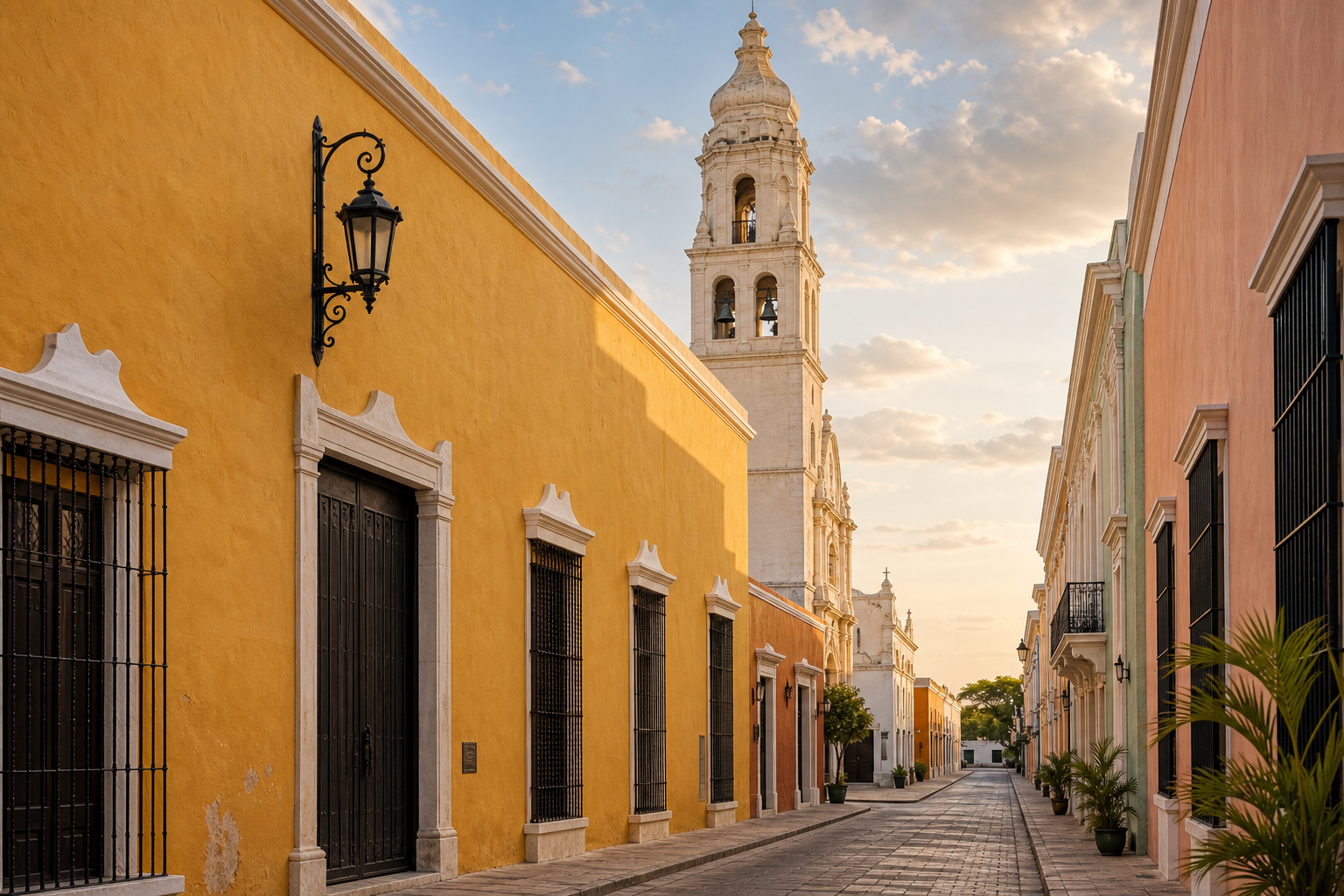
 Colonial houses and the old city wall in San Francisco de Campeche
A self-guided historic-centre route can connect the Puerta de Mar, the bastions, the main square, Calle 59, and the Puerta de Tierra before or after the Malecón. The waterfront is not a substitute for the walled city, and the walled city is not a substitute for the Gulf view. They explain different parts of Campeche’s identity: defensive architecture on one side, maritime openness on the other.
For a ready-made walking sequence through the old town, see the one-day walking route through Campeche’s walled city. Use it as a framework, then move the Malecón segment to the hour when the heat is manageable.
Guided tours and activities
You can walk the Malecón independently, but a guided city tour can help if you want the waterfront placed within Campeche’s history. The strongest match is usually a tour that combines the historic centre, fortifications, public landmarks, and a walk rather than a product described only as a beach excursion. Read the current itinerary carefully: inclusions, meeting points, languages, and transport can change.
Compare current Campeche City activities on GetYourGuide · See Campeche tours on Viator
A guided tour is particularly useful on a first visit if you want context for the walls, the port, pirate attacks, and the civic monuments along the route. It is less necessary if your aim is simply to sit by the sea at sunset. In that case, keep the outing flexible and let the weather decide.
Some listings combine Campeche city with Edzná or a longer day trip. Those can be useful for travellers with limited time, but they are not the same as a Malecón visit. Check how much time is actually spent in the city and whether the waterfront is included or merely mentioned in the description.
Where to stay for easy access
The historic centre is the best base if you want restaurants, plazas, museums, and a short walk to the city’s main landmarks. The Malecón-side areas can suit travellers who prefer a broader road network, sea views, or a quieter start and end to the day. Neither location automatically gives a better experience; the choice depends on whether you value walkability inside the walls or proximity to the open waterfront.
Look at a map rather than trusting the word “beach” in a listing. A hotel can be near the coast without being directly on a pleasant walking section, and a historic-centre address may still be only a short taxi ride from the Malecón. Read recent reviews for noise, parking, air-conditioning, water pressure, and the actual condition of the surrounding pavement.
Check current Campeche City hotel rates on Booking.com · Compare Campeche stays on Trip.com
If you are driving, confirm parking before booking. The old centre’s streets are compact and can be difficult for a large vehicle, while a waterfront property may have easier access but leave you farther from evening dining. If you are travelling without a car, prioritise a location from which you can reach both the historic centre and a comfortable Malecón section without depending on a single late-night transport option.
Food and drinks near the waterfront
The Malecón is not one continuous restaurant strip. Food options vary by section and season, and businesses open or close over time. Treat the promenade as a place to walk first, then choose a busy, clearly operating restaurant or café after you have seen the menu and confirmed the current service.
For a broader range of regional food, the historic centre is the safer planning base. Campeche specialties include pan de cazón, seafood, local tamales, and preparations influenced by the Gulf and Maya culinary traditions. A market meal and a waterfront sunset can make a better day than trying to find a specific establishment whose hours may have changed.
Carry water, especially if you begin far from the central streets. Small vendors may accept cash only, and card availability is not guaranteed at informal stands. Do not leave food or plastic behind on benches or planted areas. The Gulf edge is a public space shared by residents, wildlife, and visitors.
If you want dinner with a view, arrive before the sunset rush and ask where you will actually sit. “Near the Malecón” does not always mean an unobstructed sea view. Weather, roadworks, events, and traffic can also change the atmosphere from one evening to the next.
Photography tips
The Malecón gives you several kinds of photographs: wide Gulf horizons, silhouettes, public sculpture, cyclists, families, and city details. A phone handles the scene well if you avoid pointing directly into the strongest sun for every frame. Clean the lens, use the exposure control, and take a few images before and after sunset rather than only at the moment the sun disappears.
For the CAMPECHE letters, look for a composition that includes some waterfront context instead of photographing only the sign. At the Pedro Sainz de Baranda monument, frame from a pedestrian position and avoid standing in the road. The old city wall and colonial facades make a useful contrast with the open coast; you can photograph both in the same outing without pretending they are the same landscape.
Be considerate with people. The promenade is a daily public space, not a staged attraction. Ask before making a close portrait, especially of children or vendors. When an event or family gathering is taking place, step aside rather than blocking the route for a long exposure.
Sunset colour is never guaranteed. Clear skies may produce a sharp, pale horizon; clouds may create the strongest drama; heavy cloud may obscure the sun completely. The walk remains worthwhile even when the photograph does not match the forecast image in your head.
 Catedral de Campeche near the historic centre, a useful stop before or after the waterfront
Rain, wind, and hot-weather planning
Campeche’s climate affects every Malecón decision. The waterfront has little protection from sun and wind, and the reflective pavement can make the apparent temperature feel higher. Wear breathable clothing, use sun protection, and bring water. A hat helps, but secure it in strong wind.
After rain, allow surfaces to dry before cycling or walking quickly. Puddles can hide uneven sections. Thunderstorms deserve particular caution: the open coast is not the place to wait out lightning. Move into a substantial building or return to your accommodation until conditions improve.
Wind can be pleasant, but strong gusts make cycling harder and can blow sand, dust, or spray across the path. If the sea looks rough or the sky is changing rapidly, treat the view as a brief stop rather than committing to the longest route.
In the hottest months, the most comfortable schedule is often an early walk and a short sunset visit rather than one long afternoon. Visitors who arrive from cooler climates should be conservative for the first day. Heat exhaustion can develop even on flat ground when the route feels easy.
Transport and parking
You do not need a car to enjoy the central Malecón if you are staying in or near the historic centre. Walking, a short taxi ride, or local transport can get you to a suitable starting point. Ask your accommodation about the safest current drop-off location rather than relying on an old map pin.
A rental car is useful for a wider Campeche itinerary that includes Edzná, Champotón, the Río Bec area, or Calakmul, but it is not necessary for a waterfront stroll. If you drive, use legal parking and do not leave visible valuables in the vehicle. A road that looks quiet during daylight can become busier around sunset.
Ride availability and public-transport routes can change. Confirm the return option before walking far, particularly if you are visiting on a holiday or outside the city centre. Save your accommodation’s name and location offline. If your phone battery is low, return before dark instead of depending on a last-minute ride request.
The Malecón is easy to reach in geographical terms but not always easy to navigate at every crossing. Plan with the pedestrian surface in front of you, not just a straight line on a map.
Is it worth visiting if you have only one day?
Yes, if you treat it as part of Campeche City rather than a separate day trip. A one-day visitor can see the historic centre in the morning, pause during the heat, and spend the final part of the day on the waterfront. That gives you the two experiences that define the capital: fortified colonial architecture and a broad Gulf horizon.
If you have only a few hours between transport connections, shorten the walk. Leave enough time to get back to the bus station, railway station, or accommodation. A rushed waterfront visit is not better because it covers more distance.
If your interests are exclusively archaeological, you may prefer to spend the available daylight at Edzná or reserve a longer journey for Calakmul. The Malecón still works as a low-effort evening reset, especially after a day in a car or at a ruin site.
If you are travelling with children, older relatives, or anyone who dislikes long museum visits, the open space and sea view may be one of the most accessible parts of the city. Keep the route short, schedule shade and water, and avoid presenting it as a beach day.
Suggested half-day plan
Begin with a late lunch or an early afternoon break in the historic centre. Visit one museum or bastion while the sun is strong, then return to your accommodation if you need to cool down. Set out again with water shortly before the light becomes softer.
Walk a central section of the Malecón, stop at the large letters, and continue toward a clear viewpoint. Spend time watching rather than moving continuously. Look for fishermen, cyclists, local families, and the changing colour of the sky. If the wind or weather turns, return early.
After sunset, choose whether to eat in the historic centre or near the waterfront. The centre usually gives you more choice and makes it easier to connect the evening with Calle 59, the plaza, or the city gates. If you are staying on the coast side, a nearby dinner may be simpler.
This plan is intentionally modest. Campeche rewards a slower rhythm, and the Malecón is a place where an extra twenty minutes on a bench can be more memorable than another item crossed off a list.
Common mistakes to avoid
The first mistake is calling the Malecón a swimming beach. It is a waterfront promenade. Check the conditions and use designated swimming areas elsewhere when that is your goal.
The second is arriving at noon with no water or sun protection. Flat terrain does not remove heat risk. The third is assuming the entire route has identical pavement, lighting, shade, or amenities. It does not.
The fourth is planning a long walk immediately before a fixed transport departure. Sunset delays, photographs, traffic, and a wrong turn can all consume time. The fifth is crossing wherever the sea view looks best. Use marked crossings and obey local traffic.
The sixth is expecting the promenade to feel like a resort boardwalk. Campeche’s Malecón is more ordinary and more useful than that: a public city space used by residents. Its appeal comes from the combination of sea, sky, civic monuments, and everyday life.
Finally, do not judge the visit only by the sunset. Cloud cover is outside your control. The breeze, the open horizon, and the transition from the old city to the Gulf are the lasting reasons to include it.
Frequently asked questions
Is Campeche Malecón free?
The public promenade is free to walk. Nearby museums, tours, food, and other businesses may charge separately. Verify current prices locally.
Can you swim at the Malecón?
It is better understood as a waterfront promenade, not a designated swimming beach. Check local conditions and use an appropriate beach if swimming is important to your plans.
How long should you spend there?
Allow about thirty minutes for a short look and photograph, or one to two hours for a relaxed sunset walk. A complete out-and-back can be substantially longer and is unnecessary for most visitors.
Is the Malecón suitable for children?
Yes, with normal supervision. Much of the route is open and paved, but roads and crossings run alongside it. Keep children close to adults and do not treat the waterfront as a supervised swimming area.
Is it accessible by wheelchair?
Many sections are flat and paved, but accessibility varies at kerbs, crossings, and areas affected by repairs or parked vehicles. Check the specific section on arrival and allow extra time.
Should you visit in the morning or at sunset?
Choose morning for cooler conditions and a quieter exercise walk. Choose late afternoon for softer light and the possibility of a Gulf sunset. A short visit at both times is possible if the Malecón is central to your trip.
Can you combine it with the historic centre?
Yes. The Malecón is close to the walled city, and combining them is one of the best uses of a day in Campeche. Explore the centre when you want architecture and museums; move to the waterfront when you want space and sea air.
The practical verdict
Put the Malecón on a Campeche City itinerary, but give it the right job. It is the place to slow down after the walls and museums, to walk with the Gulf beside you, and to see how the capital uses its coast in ordinary daily life. Go early or late, carry water, choose a manageable section, and leave time for the sky to change.
The strongest visit is not a race from monument to monument. It is a simple sequence: fortified streets, a pause in the shade, a walk beside the Gulf, and a return through the city once the heat has eased. That balance is what makes the Malecón more than a photo stop and one of the most useful, low-pressure experiences in San Francisco de Campeche.
For more ways to plan the city, compare the best places to stay in Campeche and build the waterfront into a wider historic-centre itinerary.