Why visit Miguel Colorado?
The Cenotes de Miguel Colorado are one of the clearest examples of why Campeche rewards travelers who leave the colonial centre and the main highways. This community tourism and adventure area sits in the forested interior of the state, where limestone, groundwater and dense vegetation create a very different landscape from the Gulf coast. The attraction is not a single swimming hole with a row of shops. It is a group of cenotes connected by trails, viewpoints and activity areas, with kayaking, swimming, ziplining and guided walks forming one long outdoor day.
That combination makes Miguel Colorado useful for several kinds of travelers. An active couple can paddle across a large open cenote, take a canopy flight and cool off in blue water. A family with older children can divide the day between easier walks and supervised adventure activities. A traveler interested in community tourism can choose a slower visit with birdwatching, a local meal or an overnight stay rather than treating the cenotes as a quick photo stop. The setting is also a good counterpoint to Campeche city: instead of walls, plazas and sea light, you get shaded paths, limestone edges and the sounds of the forest.
The destination is in Campeche State, not in Yucatán State. It is associated with the Champotón and Escárcega region because those are the practical transport reference points, while the nearest major rail connection is the Tren Maya station at Escárcega. From Campeche City, a tour is usually the simplest way to make the visit in one day. With a car, Miguel Colorado fits better into a route that includes the central and southern parts of the state rather than a rushed out-and-back excursion.
The attraction is best approached with realistic expectations. This is an outdoor site in a hot, humid tropical environment. Paths can be uneven, wet or muddy after rain. Mobile coverage, card payment and activity availability should not be assumed. Confirm the day’s opening conditions, what is operating and whether food or transport is included before leaving your base. Details change, and the official or community contact should take precedence over an old blog post.
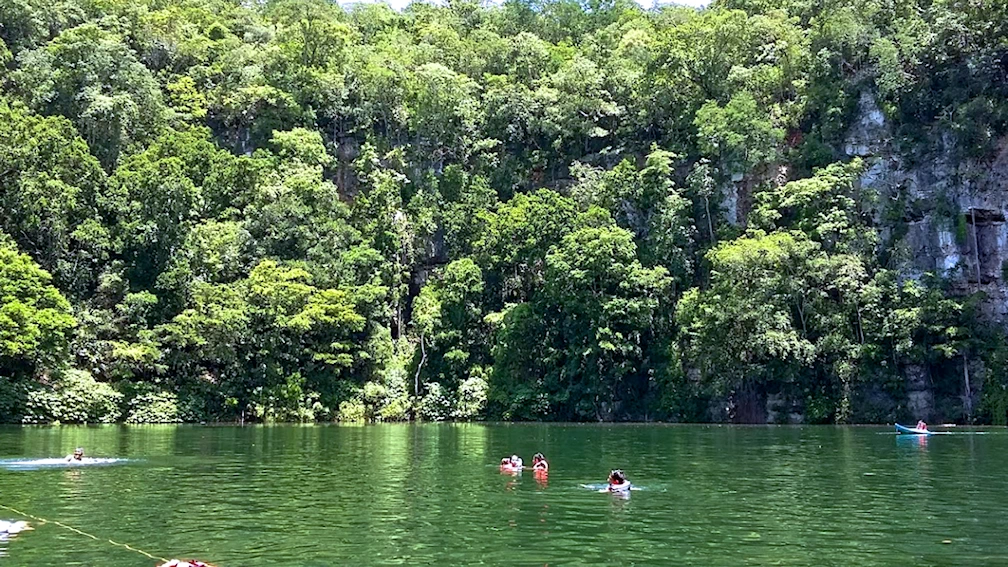 The Cenote Azul area at Miguel Colorado in Campeche
Where Miguel Colorado is in Campeche
Miguel Colorado is a rural community in the interior of Campeche. Travel descriptions place the cenotes in the broad corridor between Champotón and Escárcega, with the access road leaving the main route through countryside rather than a built-up resort strip. That geography matters when planning. You are not arriving at a large town with a choice of frequent taxis, late buses and several pharmacies. You are heading to a nature site whose activity centre works around daylight and pre-arranged logistics.
The relationship with Escárcega is particularly important for visitors using public transport or the Tren Maya. VisitMexico describes Miguel Colorado as roughly half an hour from the Escárcega station, though the exact transfer time depends on the road, meeting point and local transport arrangement. A rail ticket to Escárcega does not by itself solve the last mile. Arrange a confirmed pickup, private transfer or local excursion before boarding the train. Do not arrive at the station assuming a taxi will be waiting for a cenote trip.
 Parque Miguel Hidalgo in Escárcega, Campeche, a transport reference point
Champotón is another useful reference point. The cenotes are inland rather than on Champotón’s waterfront, and a map may show a route that looks easy while the final stretch takes longer than expected. Champotón can work as a road-trip base or a stop on a north-south itinerary, but check the return timing carefully if you are depending on a connecting bus. The countryside between towns is spacious, and services thin out away from the main settlements.
Campeche City is the most common overnight base for visitors booking a guided day trip. This is convenient but produces a long day on the road. A published GetYourGuide itinerary from Campeche lists a nine-hour experience with pickup, kayaking, swimming, hiking and ziplining. That is a useful indication of the scale of the outing, not a guarantee that every independent visit will take exactly nine hours. If you want a relaxed nature stay, spend the night closer to the site or in the Escárcega area instead of adding a city return after a full day of activity.
What the cenote area includes
Descriptions from Campeche’s tourism promotion and national tourism material identify several connected water features. The Cenote Azul is described as the largest and is the main setting for kayaking and a zipline circuit. Cenote Patos, also called the ducks’ cenote in some English descriptions, is another water body in the circuit. Cenote Km 41 is farther away and more difficult to access; it is associated with the evening emergence of bats. Names and activity arrangements can appear with slightly different spellings in travel listings, so use the local site’s current terminology when asking for directions.
The word “cenote” covers several kinds of limestone water landscape. Some are open to the sky, some are partly enclosed by rock and vegetation, and some are reached by a trail rather than a platform next to a parking area. Miguel Colorado’s appeal comes from that variation. You are not simply stepping into a tiled pool. You move through a forest setting, see the water from different levels and experience how the cenotes form part of a wider habitat.
The tourism infrastructure is intentionally modest compared with high-volume attractions elsewhere on the peninsula. That can mean a more natural feeling, but it also means fewer conveniences. Bring what you need for a day outdoors, follow instructions about where to change and keep valuables secure. Avoid expecting a restaurant menu, locker system, continuous Wi-Fi or a fully accessible path unless the operator confirms those services for your date.
The community and ecotourism dimension is central to the experience. VisitMexico describes a local cooperative and a small lodging operation connected with tours, meals and interpretation of the surrounding countryside. Other tourism descriptions emphasize guided hiking, birdwatching and local food. A responsible visit supports the people maintaining the trails and organizing the activities. Listen to the guide’s rules about swimming, wildlife, litter and group movement rather than treating the forest as an unstaffed recreation area.
The Cenote Azul area at Miguel Colorado in Campeche
Kayaking on Cenote Azul
Kayaking is usually the calmest way to experience Miguel Colorado. On the water, the pace changes immediately: the noise of the approach road fades, paddling becomes quiet, and the surrounding vegetation frames the limestone basin. The point is not to cover a long distance. It is to notice the shape of the cenote, the reflections, the shade and the way the guide positions the group.
Expect a short safety briefing before launching. The guide may explain how to hold the paddle, how to turn, how to keep distance from other boats and what to do if you tip. Pay attention even if you have paddled before. Local water conditions, boat design and launch points differ from a lake or a sea kayak. Wear the flotation equipment provided and keep your camera secured rather than trying to hold it loosely while maneuvering.
Kayaking is active but does not require a competitive level of fitness when conditions are calm. The heat is the larger issue. You can feel comfortable in the shade and still become dehydrated while paddling. Drink steadily before the launch and use a refillable bottle where the operator permits it. Sunscreen that is suitable for natural water is preferable, and a long-sleeved sun layer can be more comfortable than relying on repeated lotion.
The open water is also a good place to observe without disturbing. Do not chase birds, touch the rock walls or splash toward other boats. Cenotes are part of a connected groundwater environment, and anything washed into the water can remain there. Follow any instruction about biodegradable products and swimming behavior. If you have a waterproof camera, use a tether; a phone at the bottom of a cenote is not recoverable in the middle of a group excursion.
The kayaking portion may be unavailable because of weather, maintenance, water conditions or staffing. Ask what is operating when you check in. Do not treat a listing’s activity list as a promise that every element will run on every date.
Ziplining over the jungle and water
The zipline adds the adrenaline that distinguishes Miguel Colorado from a quiet cenote swim. Tourism descriptions report lines crossing the cenote and reaching around 80 to 90 metres in height, but the exact height, route and operating configuration should be confirmed locally. What matters for planning is that the activity uses elevated platforms and a harness system, not that a guidebook number becomes the focus of the visit.
A staff member should check the harness and explain the launch, braking and landing procedure. Wear closed shoes with a secure fit. Loose sandals, dangling straps, large backpacks and anything that can fall should stay off the course. Tie back long hair and remove sunglasses or hats if the operator requests it. If you are nervous, say so before climbing; a calm briefing is more useful than pretending to be comfortable once you are on a platform.
Ziplining is not automatically suitable for everyone. Height, weight, age and health restrictions can apply, and they are set by the operator and equipment in use. Ask in advance about current limits, pregnancy policies, heart conditions, recent injuries and whether a participant can opt out without losing the rest of the visit. The information on an online tour page may be incomplete, especially for independent admission.
The view from a line is usually brief, so do not plan the visit around getting a long sightseeing panorama. The value is the change of perspective: water below, forest at eye level and a short burst of movement through the canopy. Keep your hands and body position exactly as instructed. The guide’s directions are more important than taking photographs.
Compare the Miguel Colorado day trip on GetYourGuide · See Campeche adventure options on Viator
Swimming in the blue cenote
Swimming is the part of the visit that makes the heat worthwhile. The water in an underground or partly shaded limestone basin can feel dramatically cooler than the air, and the blue cenote is commonly described as the place for a refreshing dip after the walk or zipline. Use only the designated entry area. Cenote edges can be slippery, and a depth that looks manageable from above may change suddenly.
Ask whether a flotation device is required and whether children must remain within arm’s reach of an adult. Even confident swimmers should not assume that a natural pool behaves like a public lap pool. There may be no easy exit from every point, and wet rock can make climbing out dangerous. Never jump unless the guide explicitly identifies a safe jumping area and gives permission.
Take a quick-drying towel, a swimsuit and a dry change of clothes. A small dry bag is useful for money, identification and medication, but keep it with the group’s agreed belongings rather than carrying it through every activity. Do not use ordinary body lotion, perfume or oily products immediately before entering natural water. Follow the site’s current rules about sunscreen and showering.
People who do not want to swim can still enjoy the cenote from the trail and viewpoints. There is no need to make every member of a group participate in the water. A non-swimmer may prefer the walk, birdwatching, a meal or the view from the activity platforms. Check whether a guide can offer a comfortable alternative, especially if someone has a fear of deep water.
Hiking, birds and forest wildlife
The trails are not a decorative path between activities; they are part of the attraction. A walk through the surrounding vegetation explains why the cenotes feel more remote than a developed swimming site. The surface can include roots, stones and damp sections. Good grip matters more than fashionable footwear, and walking slowly is sensible when the ground is wet.
Guides may point out birds, insects, plants and signs of larger animals. VisitMexico specifically mentions birdwatching and the possibility of seeing howler monkeys. Wildlife sightings are never guaranteed. The right approach is to remain quiet, look where the guide indicates and accept that a forest is not a stage arranged for visitors. Howler monkeys may be heard before they are seen, and many birds move quickly through the canopy.
Do not feed animals or play recorded calls. Keep food in a closed bag, leave flowers and leaves where they grow, and do not collect stones from the trail or cenote edge. These rules are basic, but they matter in a small community attraction receiving more visitors over time. A guide’s local knowledge is one of the reasons to choose a guided walk rather than racing through the site alone.
Mosquitoes and other insects are part of a humid forest visit. Use repellent that follows the operator’s instructions, wear light long trousers if you are comfortable in them, and check clothing before getting back into a vehicle. Heat can be more tiring than the distance. Build in pauses, especially for children and anyone who is not used to tropical conditions.
The bat emergence and evening visits
Cenote Km 41 is associated with bats emerging around dusk in descriptions of the destination. This can be an impressive natural event, but it changes the logistics considerably. An evening wildlife observation is not the same as a standard daytime cenote admission. It requires a confirmed schedule, a guide, safe return transport and permission to remain on site after the regular daytime activities.
Do not arrive independently and assume you can wait for the bats. Ask the cooperative or tour provider whether the evening experience is running, where the meeting point is and how the return works. Bring a small red or low-intensity light only if the guide allows it; bright beams and flash photography can disturb wildlife and make it harder for other visitors to observe.
Bats are useful animals, not a spectacle to be harassed. Keep quiet as they leave the opening, do not throw objects and do not block the flight path. The event may be affected by weather, season, disturbance or the natural behavior of the colony. A responsible guide will put the habitat ahead of a visitor’s perfect photograph.
For most travelers staying in Campeche City, the bat experience is not a sensible add-on to a standard day trip unless transport has been arranged specifically. If it is a priority, stay nearby or plan a community-led overnight experience. VisitMexico describes options that can include a local meal, chocolate activities, stargazing and a morning bird walk, but confirm which elements are available rather than assuming a fixed package.
Community stays, food and slower experiences
Miguel Colorado can be more than a day of equipment and water. Community-led programs described by VisitMexico include lodging near the cenotes, meals prepared in a traditional style, birdwatching and activities connected with cacao and chocolate. These details are valuable because they let you experience the area at a pace that matches the landscape. An overnight stay avoids the pressure to complete every activity before a long drive back.
A local meal is also a practical part of the visit. Rural kitchens work with what is available and may require advance notice for groups. Do not expect an urban restaurant schedule. Ask what is included, whether drinking water is supplied and whether dietary restrictions can be accommodated before booking. Carry a simple backup snack, especially if you have allergies or need food at a particular time.
The cacao or chocolate activity, where offered, is best understood as a cultural and agricultural demonstration rather than a polished factory tour. Ask questions, participate respectfully and buy directly when products are offered through the community. Avoid taking photographs of people, homes or workshops without permission.
A slower program can include a dawn bird walk, breakfast, a forest route or a cycle through the surrounding community. These experiences suit travelers who value interpretation and local contact more than collecting every thrill. They also spread visitor spending beyond a single entrance transaction. Ask for a written or clearly explained itinerary so you know which parts are guided, which are self-led and which depend on weather.
For overnight planning, check current Escárcega-area stays on Booking.com · compare Escárcega hotels on Trip.com. If the community offers its own lodging, compare the practical benefits—proximity, meals, early starts and transport—rather than expecting the same facilities as a city hotel.
How to get to Miguel Colorado from Campeche City
Guided day trip
For a first visit without a rental car, a guided day trip is the least complicated option. The published GetYourGuide product from Campeche describes pickup, a private group, a guide and a combination of hiking, kayaking, swimming and ziplining. Check the live page for your date because availability, language, pickup area, cancellation terms and inclusions can change.
The main advantage is coordination. A provider handles the long approach, activity sequence and return, while the guide can communicate with the community. The disadvantage is a fixed day length. You may have less freedom to linger at one cenote, add an overnight or change the route. A nine-hour schedule can feel full in heat, especially if you have planned an evening walk through the city afterward.
A tour is a good choice when Miguel Colorado is the only inland excursion on a short Campeche itinerary. It is less attractive when you already have several long road days. Compare the meeting time and return point with your hotel and avoid booking a late intercity bus or flight on the same day.
Rental car
A rental car gives you the most flexibility, particularly if you are combining Miguel Colorado with Escárcega, the Río Bec region or a longer southern Campeche route. Use a current navigation app but download offline maps before leaving the city. The final road and mobile signal can be less dependable than the main highway. Confirm the last turn with the attraction or cooperative rather than relying only on a pin.
Leave early. An early departure helps with heat, gives you more time for activities and leaves a buffer if the approach is slower than expected. Fill the tank in a major town, carry cash and water, and keep the vehicle locked when you are on the trail. Do not plan to drive unfamiliar rural roads after dark unless a local operator confirms the route and conditions.
A car also makes it possible to stay near Escárcega and visit the cenotes on a separate morning. That is usually more comfortable than combining a full activity circuit with the long drive from Campeche City. For general planning, see the Campeche car-rental guide and allow more time than a map’s optimistic estimate.
Train and local transfer
The Escárcega Tren Maya station creates a possible rail-based route, but it is not a walk-up connection. Reserve the transfer in advance with the community, an excursion provider or a trusted local driver. Confirm the exact station, arrival time, luggage arrangement, return plan and payment method. A train schedule can change, and the cenote operator may not be able to wait indefinitely.
This option works best as part of an overnight plan. Arrive in Escárcega, transfer to the community, stay locally and return to the station or continue by road the following day. Trying to fit train arrival, a full zipline and kayaking circuit, and a same-day onward departure leaves little margin for delays.
From Champotón
From Champotón, the destination is an inland excursion rather than a coastal activity. Ask the operator for the current route and road condition. Local taxis may take you there only if a return and waiting arrangement is agreed in advance; do not assume a one-way ride will be easy to replace. If you are using buses, check where you can safely leave the main corridor and how you will cover the final rural section.
How long to spend there
A basic daytime visit needs enough time for arrival, registration, a briefing, the trail, one or more activities, changing and a meal or rest. Rushing through every option is not a good use of a nature site. For a day trip from Campeche City, expect the excursion to occupy most of the day. A morning departure and late afternoon return is a more realistic mental model than “a quick cenote stop.”
One overnight is better if you want to include birdwatching, a community meal, cacao or chocolate, a bat observation, stargazing or a second morning walk. It also makes sense if Miguel Colorado is a stop between the capital and southern Campeche. The extra night is not necessary for visitors who only want a swim and a single activity, but it changes the experience from a checklist to a rural stay.
Two nights can suit photographers, birders and families who need a slower rhythm. Plan for the fact that this is not a town with an unlimited supply of alternative attractions if rain closes the water activities. Bring a book, accept an unhurried pace and ask the host what is practical in the local conditions.
What to bring
Pack a swimsuit, towel, closed walking shoes and a dry change of clothes. Choose footwear that can handle mud and wet rock; shoes that are comfortable on a city pavement may not be suitable for a forest trail. Bring a hat, sunglasses for the approach, insect repellent, a reusable water bottle and a small waterproof pouch for essential items.
A light long-sleeved shirt is useful for sun and insects. Use reef- and freshwater-conscious personal products and follow the site’s shower or swimming rules. Carry cash in small denominations because rural payment systems can be limited, but keep it divided and secure. Bring identification only if needed for your booking and leave unnecessary valuables at your accommodation.
A small first-aid kit, prescription medicine and any allergy medication belong in your day bag. If you wear glasses, a strap helps during kayaking and ziplining. A power bank can be useful, but do not assume you can recharge at the site. Download booking details, directions and contact information before leaving coverage.
For photography, a phone with a tether or a waterproof compact camera is safer than an expensive loose camera. Never let the desire for a photograph override a guide’s safety instruction. Flash is especially inappropriate during wildlife observations and may be prohibited around the bats.
Who will enjoy Miguel Colorado?
Miguel Colorado suits travelers who enjoy active nature but want more variety than a single swim. Kayaking is peaceful, ziplining is energetic, hiking adds context and the forest keeps the day visually changing. It is especially rewarding for people willing to spend time in a community setting rather than expecting a resort-style attraction.
Families should assess each member individually. Older children and teenagers may enjoy the activity mix, but the heat, long travel time, uneven trail and water depth can be tiring. Ask about minimum ages, equipment limits and supervision before booking. A family can still have a worthwhile visit if one person skips the zipline or swim, provided the operator offers a safe alternative.
It may not suit travelers with serious mobility limitations unless the operator confirms an accessible plan. Trails, elevated platforms, ladders, wet surfaces and water entry can all be difficult. People with a strong fear of heights may enjoy the cenote and walk while skipping the zipline. Travelers seeking nightlife, shopping or a polished beach day should choose a different excursion.
Birdwatchers and nature photographers should manage expectations. The habitat is the reason to go, but wild sightings are unpredictable and the activity circuit may not pause for a specialist’s preferred subject. Book a dedicated guided nature walk or an overnight program if wildlife observation is the main purpose.
Safety and responsible travel
Use the operator’s equipment and follow the guide’s sequence. Do not swim alone, climb beyond marked areas or enter a cenote when activities are suspended. Tropical storms can make trails and platforms hazardous even when rain has stopped. Ask whether lightning, high water or maintenance has changed the plan.
Drink water, rest in shade and tell the guide early if you feel dizzy, nauseated or unusually tired. Heat illness can develop quickly. Avoid alcohol before kayaking, ziplining or swimming. Keep children close, especially near deep water and elevated edges.
Leave no litter. Do not use the cenote as a place to wash clothing, apply oily products or dispose of food. Keep noise low around wildlife and avoid making promises about animal sightings to children. Pay community fees, buy local services where they are offered and ask before photographing residents or private spaces.
The best responsible choice is often to accept a smaller itinerary. You do not need to complete every activity to have a successful day. Choosing a guided walk, a swim and a local meal may be better than forcing a zipline into bad weather or trying to reach a distant cenote after the safe turnaround time.
Booking a tour versus planning independently
Book a tour when you are based in Campeche City, have limited time, do not speak enough Spanish to arrange a rural transfer, or want the activity sequence handled for you. Check whether the advertised price includes transport, admission, equipment, guide, meals and drinks. Ask specifically about pickup and return, because “from Campeche” may mean a defined pickup zone rather than every hotel.
Plan independently when you have a rental car, want to stay overnight, are comfortable confirming details in advance and prefer to decide how long to spend on each walk. Independent travel does not mean arriving without contact. Confirm opening days, activity operation, payment, food, directions and any restrictions before setting out.
Compare like with like. A cheap admission may exclude transport and equipment; a private day trip may include a guide, meals and a vehicle. Online reviews can be useful for identifying recurring problems, but they do not replace current confirmation. Use the official community or tourism information for the final answer about conditions.
Check the current Miguel Colorado listing on GetYourGuide · Compare broader Campeche tours on Viator
A practical one-day plan
Start early from your base. Eat something before the drive and carry water even if lunch is included. At arrival, confirm which cenotes and activities are open, where to leave valuables and when the group must return to the vehicle. Use the first cooler part of the day for the trail or the activity that matters most to you.
A sensible sequence is a guided walk followed by kayaking, a rest and meal, then swimming or the zipline if conditions and energy allow. The exact order may be reversed by the local guide. Keep a dry layer for the return journey; sitting in wet swimwear in air conditioning is uncomfortable and can make the drive feel longer.
Leave enough time for changing, payment and the route back. If you are driving, do not turn a full activity day into a late-night road trip. If you have a train or bus, build a generous buffer. A rural attraction is not the place to plan a connection with only a few minutes between arrival and departure.
 Champotón lighthouse and waterfront, a useful regional reference for the Miguel Colorado route
A slower overnight plan
On the first afternoon, arrive, settle in and take the activity that is easiest to fit before sunset. A local meal, a short walk or a community introduction can be more rewarding than immediately trying to complete the whole circuit. If a bat observation is offered, follow the guide’s timing and wildlife rules.
The next morning is ideal for birdwatching while temperatures are lower. Have breakfast, return to the cenote area for a swim or kayak if the program allows it, and then continue toward Escárcega, Champotón or the Río Bec corridor. This plan reduces driving fatigue and gives local hosts more opportunity to share the place.
Do not build a tight itinerary around every activity mentioned in promotional material. Weather, water levels, staffing and group pace can change the day. The overnight version works because it leaves room for those changes.
Final recommendation
Choose Miguel Colorado when you want a genuinely active inland day in Campeche and are prepared for rural logistics. The strongest visit combines one adventure activity, time on or beside the cenote, a guided forest walk and enough breathing room to notice the community setting. From Campeche City, a verified tour is usually the practical choice. From Escárcega or Champotón, an arranged transfer or rental car gives you more flexibility, and an overnight stay makes sense if wildlife, local food or the evening bat emergence matters.
Plan around heat and distance, confirm the current operating details, and let the guides set the safe pace. Miguel Colorado is at its best when the cenotes are treated as living natural places rather than a water ride between other attractions.
Check Escárcega-area accommodation availability on Booking.com · Compare nearby stays on Trip.com
Frequently asked questions
Is Miguel Colorado in Campeche State?
Yes. The Cenotes de Miguel Colorado are in Campeche State, in the interior corridor associated with the Champotón and Escárcega area. They are not a Campeche City waterfront attraction and are not in Yucatán State.
Can you visit from Campeche City in one day?
Yes, but it is a full-day outing rather than a quick stop. A guided listing from Campeche advertises a nine-hour experience. Confirm the current pickup, duration and activities before booking.
Are the cenotes suitable for non-swimmers?
A non-swimmer can often enjoy the trails, viewpoints, wildlife and other activities, but water access and safety rules vary. Tell the operator in advance and do not enter deep water without the required flotation equipment and supervision.
Is there a train to Miguel Colorado?
The nearest useful Tren Maya reference is Escárcega. The station is not the cenote, so a pre-arranged transfer is essential. Plan an overnight connection if you want a relaxed visit or have onward travel.
Should you bring food?
Ask whether your admission or tour includes a meal. Community programs may offer local food, but rural supply and dietary arrangements need advance confirmation. Carry a snack and water as a backup.
Can you visit without doing the zipline?
Yes. Kayaking, swimming, hiking, birdwatching and simply viewing the cenotes are separate reasons to visit. Confirm the current activity sequence and any admission conditions when you arrive.
Do the bats appear every evening?
The bat emergence associated with the more distant cenote is a natural event, not a guaranteed show. Ask the local operator whether an evening visit is running and follow the guide’s wildlife rules.
What is the biggest planning mistake?
Treating Miguel Colorado as a town attraction with frequent last-minute transport. Confirm the final road, opening conditions, payment, activities and return journey before leaving your base.
Is Miguel Colorado worth adding to a Campeche itinerary?
It is worth adding if you want nature and adventure and can spare a full day or an overnight. It is less suitable if your itinerary already contains several long drives or if your priority is the walled city, museums and Gulf coast.
Where should you stay?
Campeche City is convenient for a guided day trip. Escárcega or community lodging closer to Miguel Colorado is more practical for an early start, an evening wildlife program or a route toward southern Campeche. Compare current transport and lodging availability before choosing.
What should you wear?
Wear comfortable clothes, closed shoes with good grip and a swimsuit under or inside your day bag. Bring a dry change, towel, sun protection and insect repellent. Leave loose accessories and bulky bags out of the zipline and kayak activities.
Is the site accessible for wheelchairs?
Do not assume it is. Trails, wet rock, elevated platforms and water entry can be challenging. Contact the operator with specific mobility needs before booking and ask what parts of the visit are realistically accessible.
Can you combine Miguel Colorado with Calakmul on the same day?
That is generally a poor plan. Both experiences involve substantial travel and deserve daylight. Combine them only as part of a carefully planned multi-day road itinerary, with an overnight base and current route confirmation.
What makes the visit different from a developed cenote attraction?
Miguel Colorado combines several cenotes with forest trails, community-led services and adventure activities. Facilities are more modest, and the rural setting requires more preparation. That is part of the appeal, but it also means you should not expect resort-level convenience.
Are prices and hours fixed?
No. Published tourism pages can become outdated, and activity availability may vary. Verify current admission, opening conditions, equipment, transport and meal arrangements directly before traveling.
Can you camp there?
Do not assume camping is available. Ask the community or lodging operator about current overnight options, rules and facilities. A small lodging arrangement may be more suitable than arriving with camping equipment without permission.
Is Spanish necessary?
Spanish makes rural arrangements easier, especially for transfers and dietary requests. Some online tours advertise English- and Spanish-speaking guides, but confirm language availability for your date. A saved translation and written booking details are useful.
What if it rains?
Rain can make trails slippery and may affect elevated activities or water conditions. Ask the operator whether the visit is safe, delayed or modified. Do not continue independently if staff suspend an activity.
How can visitors support the community?
Use community-guided services, pay the correct local fees, buy appropriate local products, respect privacy and avoid litter. Choose an overnight or meal program when it genuinely fits your plans, rather than adding activities you cannot enjoy responsibly.
Is the water safe to drink?
Do not assume untreated water at the site is potable. Bring drinking water or confirm the source and refill arrangements with the operator. Keep a reusable bottle so you do not need unnecessary single-use plastic.
Can you bring a drone?
Ask before flying any drone. Wildlife, privacy, safety lines and community rules may prohibit it. Never fly over people, platforms, swimmers or the zipline course without explicit permission and professional coordination.
What is the best season?
The cooler, drier part of the year is usually more comfortable for long outdoor days, but conditions vary and the cenotes are a year-round landscape. Rainy weather can intensify vegetation and change trail conditions. Choose dates based on your tolerance for heat and confirm operations locally.
Should you book far ahead?
Book ahead if you need a private transfer, English-speaking guide, overnight stay, special meal or evening wildlife program. For a simple independent visit, advance confirmation is still wise because rural services may not operate like a walk-in city attraction.
How early should you arrive?
Aim for the start of the operating day or the time given by your guide. Early arrival generally offers cooler conditions and more time for changes. Never use an old published opening time as a substitute for current confirmation.
Can children kayak?
The answer depends on the equipment, water conditions, age and supervision policy. Ask the operator for current minimum ages and whether a child rides with an adult. Do not make a child participate if they are uncomfortable with the water or height.
Is there mobile phone service?
Coverage can be inconsistent in rural forest areas. Download maps and booking details before leaving, tell someone your plan and do not rely on a live signal for navigation or payment.
What is the most rewarding way to visit?
For most travelers, the best balance is an early guided nature walk, kayaking or swimming, one optional adventure activity, and a local meal or overnight stay if time allows. That gives you the landscape and community context without turning the day into a race.
Can you visit only one cenote?
Possibly, depending on the current access and admission arrangement. Ask which cenotes are included and how much walking is involved. Prioritize the areas that match your interests rather than trying to force every site into a short visit.
Is it a good substitute for a beach day?
No—it is a different kind of day. Miguel Colorado offers freshwater, forest and adventure rather than Gulf swimming, sand or a waterfront promenade. Choose it when you want an inland nature experience.
Where do you get the latest information?
Use the community or current operator contact, official tourism information and the live booking page for tours. Confirm the exact details shortly before travel, particularly in the rainy season or around holidays.
What should you do if you are tired halfway through?
Tell the guide and rest in shade. You can often skip an activity and rejoin the group later, but do not leave the marked route or water area without informing staff. Heat management is more important than completing the advertised list.
Can you combine the visit with a city tour in Campeche?
Only if the city tour is scheduled for another day or you have a very late, confirmed return and plenty of margin. After kayaking, hiking and ziplining, most travelers will enjoy a shower and a quiet evening more than another fixed activity.
Is the attraction good for photographers?
Yes, if you are patient and accept changing light, wildlife uncertainty and restrictions around activities. Use a secure waterproof setup, ask before photographing people and avoid flash around bats. The best images usually come from observing rather than interrupting the group.
What is the honest drawback?
Distance and uncertainty. Miguel Colorado requires more logistics than a cenote beside a major tourist hub, and the heat can make a long day demanding. Travelers who prepare for that will find the rural setting a strength rather than a surprise.
What is the final decision rule?
Go if you want a forest-and-water adventure and can give it a full day. Stay overnight if you want wildlife or community activities. Skip it if you need a short, highly predictable attraction close to Campeche City or if your itinerary cannot absorb rural transport time.