 Sunset over the Bay of Campeche
San Francisco de Campeche is Mexico's only remaining walled city. After centuries of pirate raids on this Gulf coast trading port, the Spanish encircled the historic center in stone fortifications thick enough to repel naval bombardment. Most still stand today.
Campeche is a working capital of roughly 250,000 people, yet its colonial core stays quiet enough that you can hear roosters at dawn and have cobblestone side streets to yourself after dark.
Walk the Walled Center
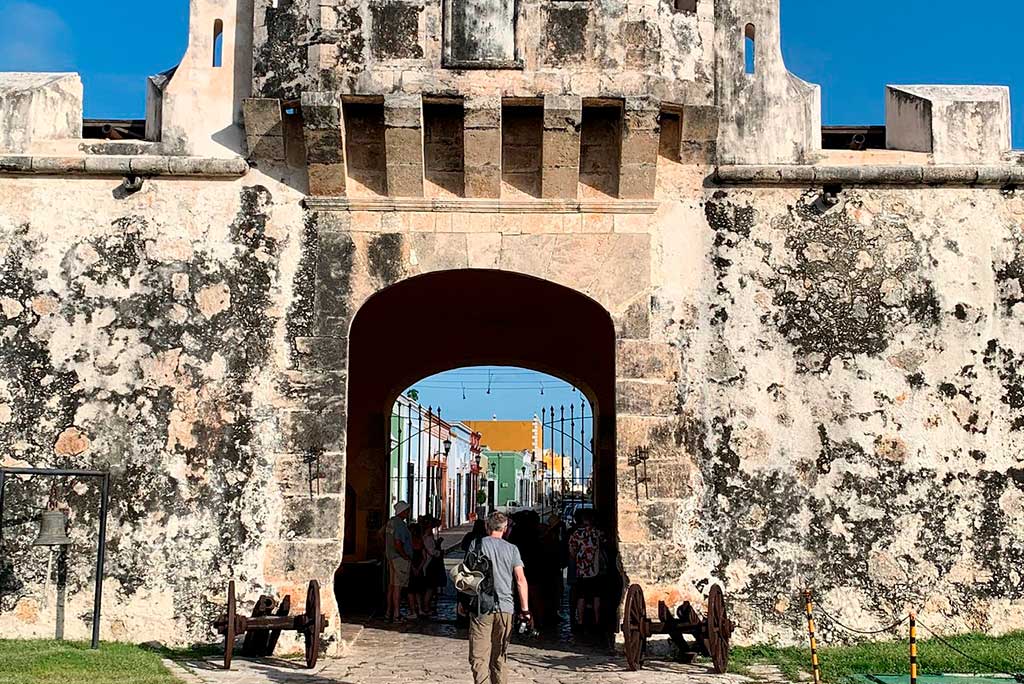
The historic center is enclosed by roughly 2.5 kilometers of original fortification wall, pierced by two main gates and studded with the remains of seven bastions. The most atmospheric entry is Puerta de Tierra on Calle 18, where you climb onto the seaward side of the wall for a clear view of the malecón and the Gulf.
At night the Puerta de Tierra hosts a light-and-sound show dramatizing pirate attacks with projected images on the wall. Schedules vary by season and are posted at the gate. The show is free but draws a crowd. Arrive early for a spot on the rampart or sit on the plaza benches.
Walk south along the malecón from Puerta de Tierra to reach Puerta de Mar (the Water Gate), the original port entry. This section of wall is lower and less restored than the Land Gate, giving it a quieter feel. The contrast between the two gates — one polished for visitors, the other catching the salt wind — is worth the 15-minute walk.
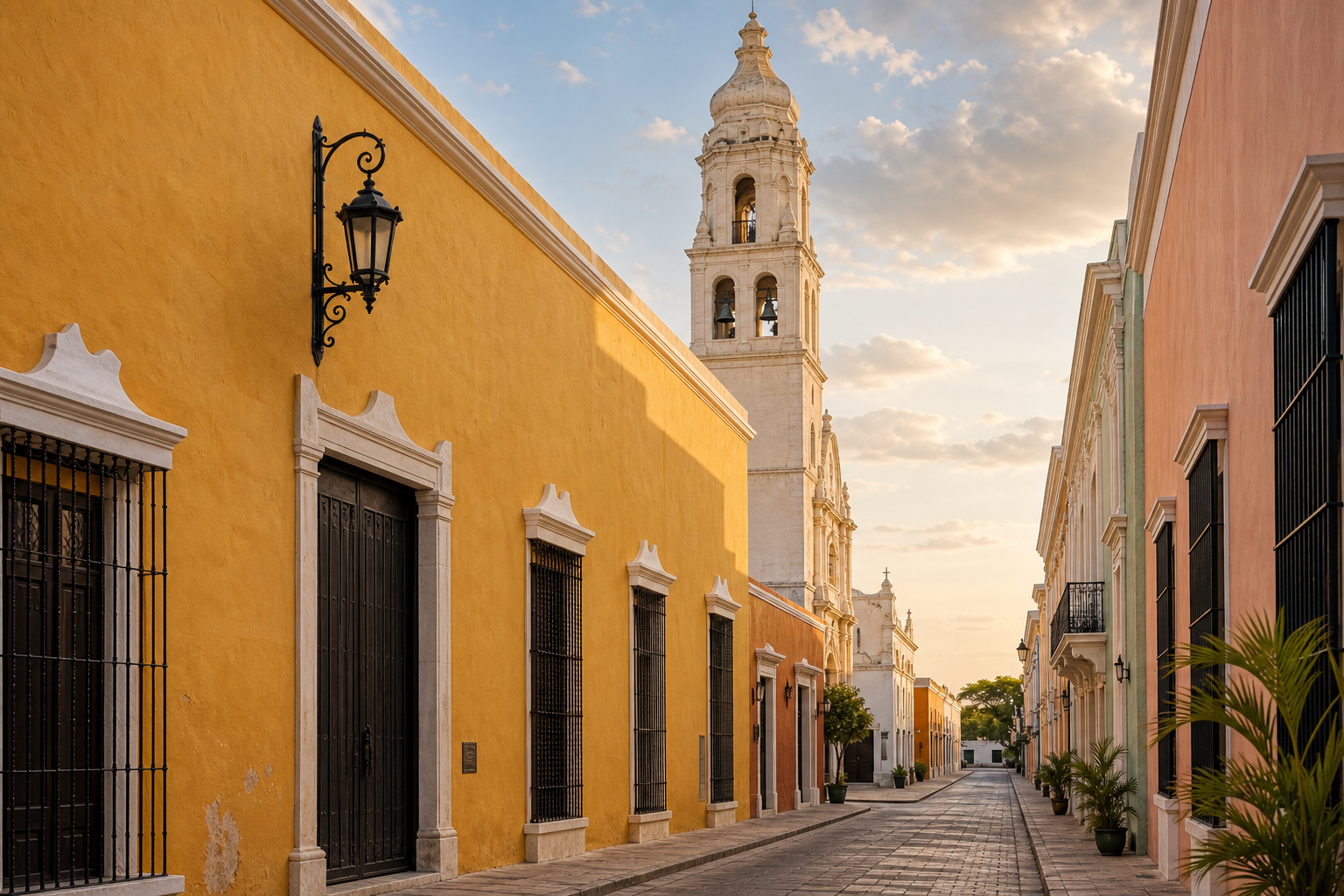
Inside the walls, the UNESCO-listed center is laid out in a tight grid of narrow streets painted in pastels — ochre, powder blue, coral pink — opening onto small plazas with fountains and shade trees. Pick a direction and let the side streets lead you.
 Campeche colonial street with pastel houses and city wall
Plaza de la Independencia and the Cathedral
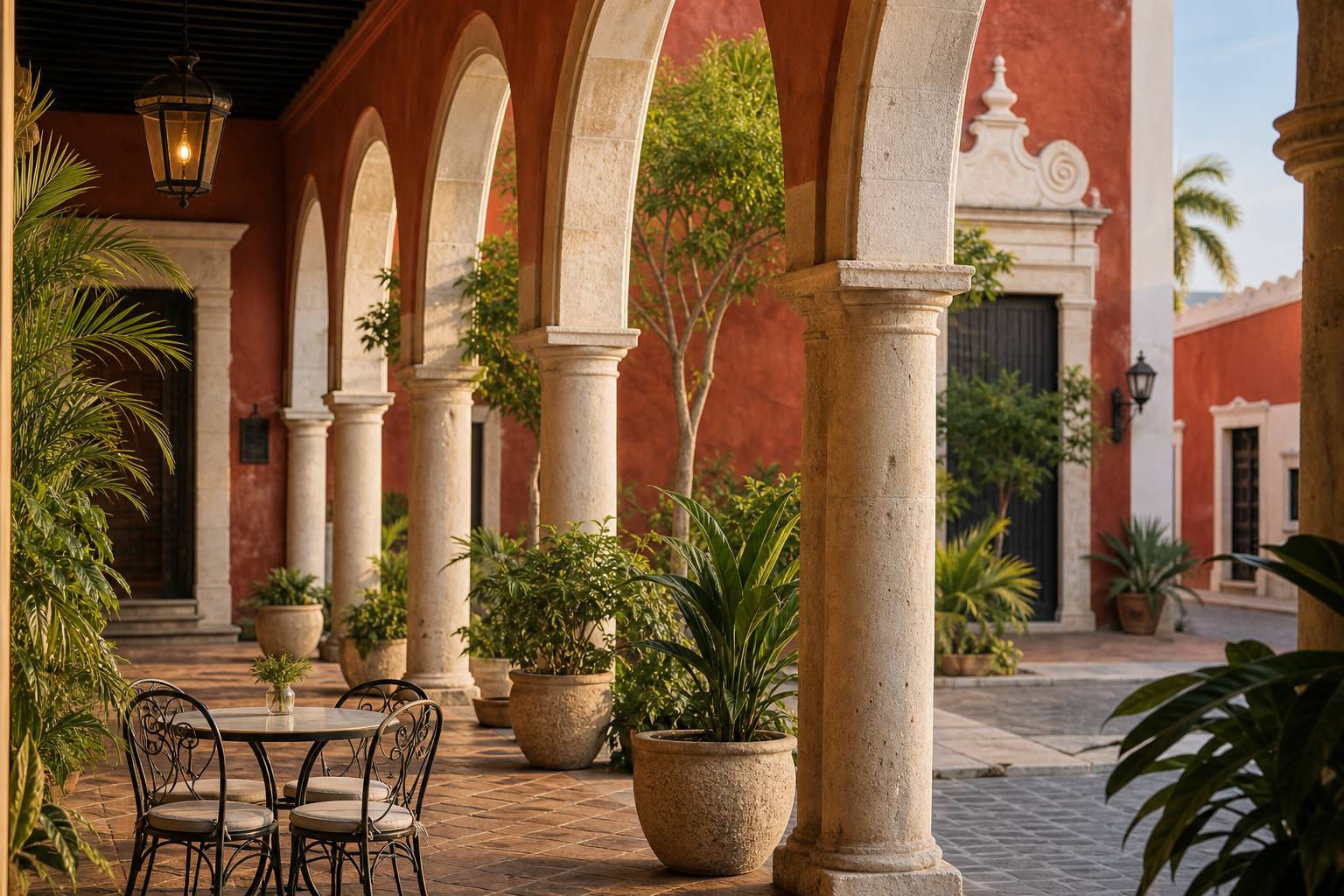
The main square is Plaza de la Independencia (also called Plaza Principal), at the heart of the walled city. It has a central gazebo, open-air café seating under the trees, and arcade-fronted commercial buildings around the perimeter. Locals sit here in the evening — it is not staged for tourists.
On the east side stands the Catedral de Nuestra Señora de la Inmaculada Concepción, a whitewashed baroque structure with twin bell towers. Enter freely during daytime hours. It is simpler than the grand cathedrals in Mexico City or Mérida but the proportions are good and the carved altarpieces reward a 15-minute visit.
Just north of the plaza, the Iglesia del Dulce Nombre de Jesús draws attention for its bright yellow facade, and the smaller Iglesia de San Roque sits another block east. You can loop past all three churches in under 30 minutes.
GuideBaluarte de la Soledad & Museo de Arquitectura Maya: Visitor GuideA practical guide to Baluarte de Nuestra Señora de la Soledad and the Museo de Arquitectura Maya in Campeche’s walled centre, including its fortifications, Maya collections, access, timing, and how to combine the visit with a walk through the historic city.Explore
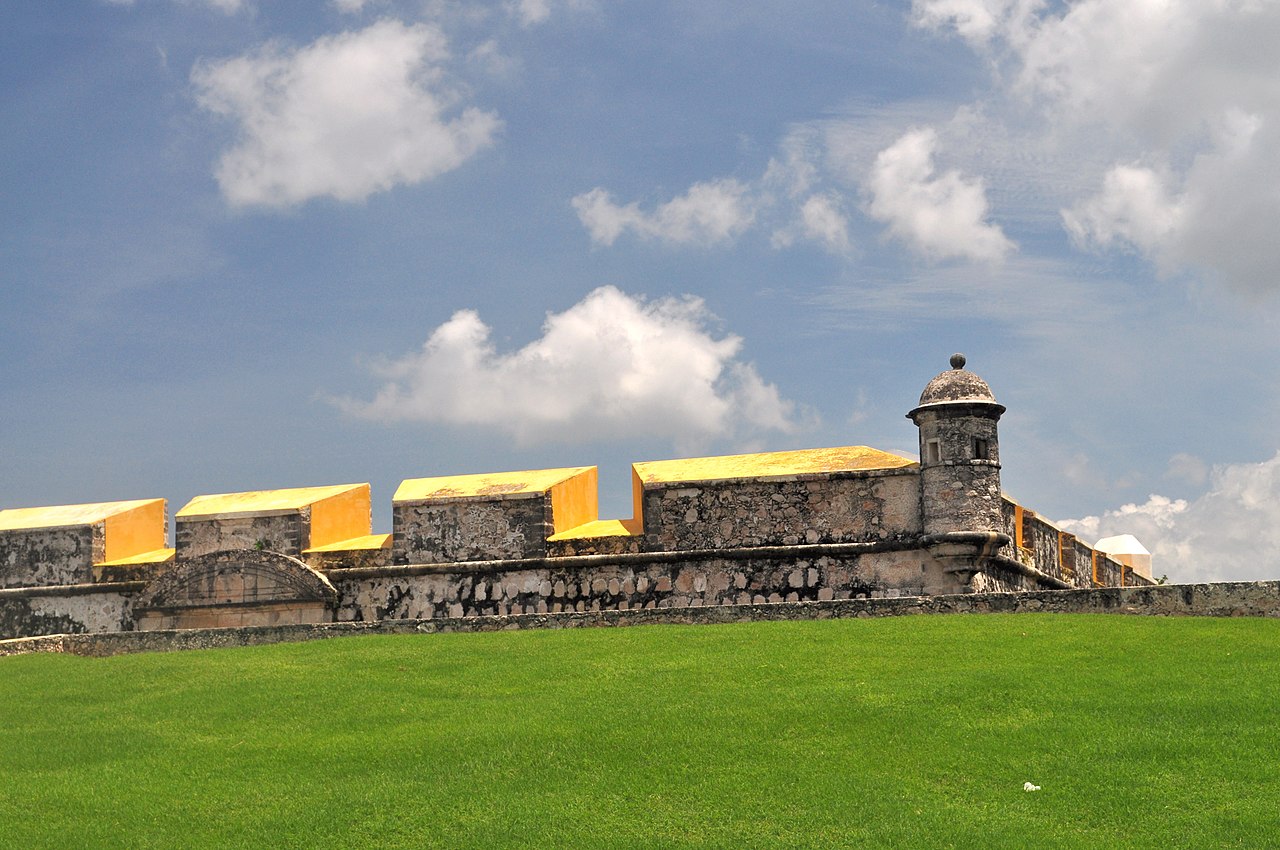
The Seven Bastions and Their Museums
What makes Campeche's fortifications unusual is that several bastions — the angular defensive projections along the wall — now house small museums and cultural spaces. You can enter most of them and walk through the thick-walled chambers where gunpowder and cannonballs were once stored.
Baluarte de San Carlos sits on the north edge of the historic center, near Puerta de Tierra. It houses the Museo de la Ciudad (City Museum), a compact collection covering Campeche's history from pre-Hispanic trade through the colonial boom and pirate era. The rooftop gives you an elevated view back over the rooftops toward the plaza. Entrance is roughly 50–60 MXN (verify locally).
Baluarte de la Soledad contains the Museo de Arquitectura Maya (Maya Architecture Museum). This is the museum that justifies a dedicated visit even if you are not into museums. It displays carved stone lintels, stucco friezes, and doorway panels recovered from Edzná, Calakmul, and the Río Bec sites. Labels are bilingual.
The remaining bastions — San Juan, San Francisco, San Pedro, Santa Rosa, and Santiago — are open to varying degrees. San Pedro has artisan stalls. Santiago houses the Jardín Botánico Xmuch-Haltún with regional plants. You can walk the wall top between some of them for a half-hour circuit with the best aerial perspective of the old city.
Practical note: Most bastion museums open between 9:00 AM and 6:00 PM and may close on Mondays. Carry cash — card payment is unreliable at the smaller sites (verify locally).
Mercado Principal: Food, Breakfast, and Local Commerce
The Mercado Principal Pedro Sainz de Baranda sits just north of the walled center along Calle Pedro Sáinz de Baranda, inside a covered hall that opens early and closes by mid-afternoon.
This is where Campechanos shop — not a tourist market, a working one. Morning is the best time. Food stalls serve panuchos (refried tortillas stuffed with black beans and topped with pulled chicken), tamales in banana leaf, sopa de lima, and fresh juices. Meals run 60–100 MXN at a stall. Stalls with the longest local lines are the ones to trust for freshness.
Beyond food, the market sells habanero hot sauces, dried shrimp, queso de bola (Edam cheese that became a Yucatecan staple through colonial trade), and achiote paste. Free entry. Bargaining is acceptable on non-food items.
Malecón at Sunset
The Malecón de Campeche is a paved waterfront promenade running north-south along the Gulf. The most active stretch covers roughly 3 kilometers north and south of the Puerta de Mar area.
Sunset here is the evening ritual. The Gulf coast at this latitude faces roughly west, giving unobstructed sunsets over the water. The promenade fills with joggers, families, cyclists, and couples on benches. Flat and wheelchair-friendly on the main paved section. Rental bicycles are available near the Puerta de Mar gate and near the big "CAMPECHE" letters at the northern landmark section.
At the Palapas y Parador Turístico section near the northern stretch, open-air palapa restaurants serve grilled fish, camarones al coco, and cold beer. These close around 7:00 PM — lunch or late afternoon, not dinner.
For an evening walk, start from the Puerta de Mar end about 45 minutes before sunset. The 20-minute walk north toward the letters gives you the sun hitting the water at an angle that colors the wall and colonial facades. Bring water — April and May heat on the Malecón is intense even after sunset.
 Atardecer on the Malecón de Campeche
Calle 59: Restaurants, Bars, and Danzón
Calle 59 runs east-west near the center of the walled city, connecting past the cathedral toward the Malecón. It is a pedestrianized street that works as Campeche's social spine from late afternoon into the early hours.
By day the street is quiet — a few café terraces, some shops, restored colonial facades. After sunset it transforms. Car traffic shuts off. Restaurants extend seating into the street. Bars and cantinas open. Foot traffic builds from 8 PM onward.
For dinner, Aduana Vasconcelos serves modern Campechano cuisine in a courtyard. Casa Vittoria does Italian-influenced pasta and seafood. Memech leans into Japanese-Mexican fusion. Options run from taco-style casual to white-tablecloth dinner. Budget 250–500 MXN per person for a full meal with a drink at a mid-range spot.
For drinks, Barko 59 is the pirate-themed bar — decorated like a galleon with marine life hanging from the ceiling. Ambigú 50 does karaoke and draft beer. Briiz 59 and Scattola 59 are cocktail bars with a more measured atmosphere. La Chopería and Patroni's are where the dancing happens on weekends.
On Thursday evenings around 7 PM and Friday evenings around 8 PM, the Pasaje Román Piña Chan — the covered passage at the Malecón end of Calle 59 — hosts danzón and salsa nights. Locals of all ages dance in the open-air passage. It is free, informal, and one of the most genuine cultural experiences in the city.
GuideCalle 59, Campeche: Restaurants, Bars & What to SeeExplore
Forts Outside the Walls
Two hilltop forts sit outside the walled perimeter, both built in the 18th century to defend the city from landward attack.
Fuerte de San Miguel sits on a hill south of the center, a 25-minute walk from the Plaza Principal or a short taxi ride (roughly 50 MXN). The fort houses jade masks, ceramic vessels, and carved jade pieces from Calakmul and other sites. The hilltop view over the city and the lagoon is the reward. Entrance is modest (verify locally). Open Tuesday–Sunday, 8:30 AM to 5:30 PM.
Fuerte de San José el Alto sits on the northern hill, a 35–40 minute walk or a 10-minute taxi ride. Less visited and more atmospheric, its Museo de Arqueología Subacuática covers shipwreck archaeology — cannons, anchors, and trade goods from colonial-era Gulf wrecks. The views are broader, taking in the full sweep of the malecón and lagoon.
If you only have time for one fort, choose San Miguel for the Maya collection or San José for the shipwreck museum and broader views.
Centro Cultural Casa No. 6
On Calle 57 between the plaza and Calle 59, Casa No. 6 is a restored colonial mansion operating as a cultural center and museum. Period furniture, tile floors, and the layout of a wealthy 18th-century Campechano family home give you a sense of how the merchant class lived during the dyewood and salt trade boom. It is small enough to see in 20 minutes. Free or nominal entry (verify locally).
Day Trips Worth Your Time
Campeche City works as a base for two day trips that rank among the best experiences in the state.
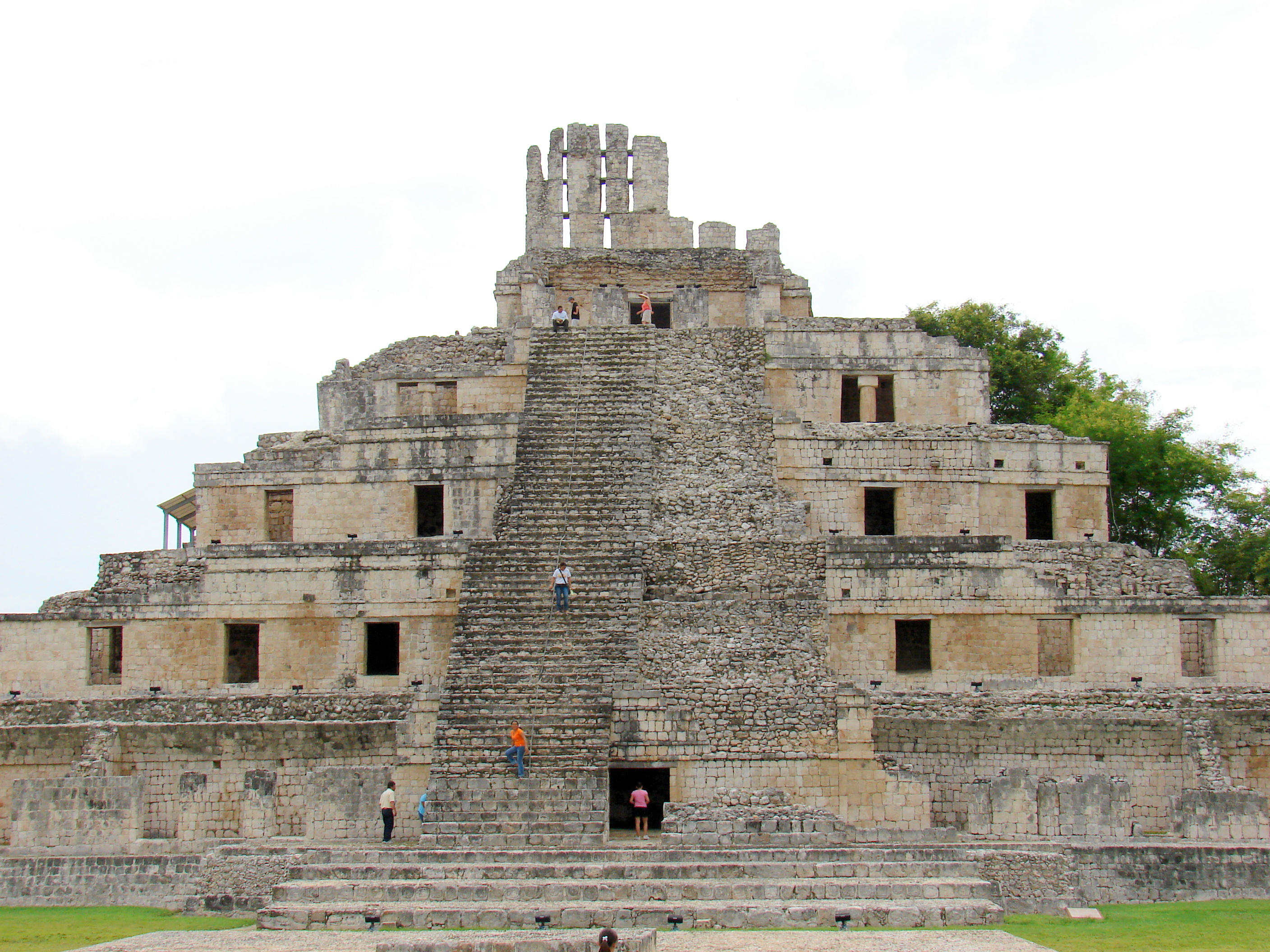
Edzná is the closest major Maya ruin, about 60 km southeast (one hour by car or taxi). The centerpiece is the Five-Story Building, a stepped pyramid rising 35 meters above the plaza. Edzná is less visited than Calakmul and compact — you can see the main structures in two hours. Buses run from the ADO terminal but frequency is limited. A taxi or tour is more reliable for a half-day trip. Entrance is around 80 MXN (verify locally). Go early — minimal shade and midday heat from March to May is punishing.
Laguna de Términos and Isla Aguada offer the coastal counterpoint. The lagoon is a protected biosphere with mangroves, dolphins, and birdlife. Isla Aguada is a fishing village about 60 km northwest where you can arrange dolphin boat tours in the morning. Doable as a long day from the city, but staying overnight gives you the early-morning dolphin activity when the water is calmest.
Practical Tips for Your Visit
Getting around the city: The historic center is walkable — roughly 1 kilometer across. You can cover the bastions, plaza, market, and Calle 59 entirely on foot. For the forts and the Malecón's northern stretches, taxis are cheap (40–80 MXN within the city). Uber operates in Campeche but coverage can be inconsistent; local taxis are reliable.
When to go: November through March offers the most comfortable weather — highs around 28–30°C and lower humidity. April and May are the hottest months (35–40°C). June through October is the rainy season, with September the wettest. Rain usually comes in short heavy bursts rather than all-day downpours.
Money: Cash is common at the market, smaller restaurants, and bastion museums. ATMs are plentiful inside the walled center. Cards work at most hotels and mid-range restaurants. Budget roughly 800–1,500 MXN per day for a comfortable mid-range visit including meals, museum entries, and a taxi or two.
Safety: Campeche City is one of the safer state capitals in Mexico. The historic center is well-lit and patrolled. Normal precautions apply — watch your belongings in the market, avoid walking alone in unlit areas late at night, and use official taxis or ride-hailing rather than unmarked cars.
How long to stay: Two full days covers the city itself — one day for the walls, bastions, plaza, and market; one day for the forts, Malecón, and Calle 59. Add a third day for Edzná without rushing. Four days lets you add the lagoon or a longer state loop.
Quick Reference
| Activity | Time | Cost | When |
|---|---|---|---|
| Walls walk (Puerta de Tierra to Puerta de Mar) | 1–1.5 hrs | Free | Early morning or sunset |
| Bastion museums (San Carlos, Soledad) | 1.5–2 hrs | ~50–60 MXN each | Mid-morning |
| Mercado Principal | 1 hr | Meals 60–100 MXN | Morning (before 2 PM) |
| Malecón sunset walk | 1–1.5 hrs | Free | 45 min before sunset |
| Calle 59 evening | 2–4 hrs | Drinks 60–120 MXN; dinner 250–500 MXN | After 8 PM |
| Fuerte de San Miguel | 1.5–2 hrs | ~60 MXN | Morning |
| Fuerte de San José el Alto | 1.5–2 hrs | ~60 MXN | Morning |
| Edzná day trip | 5–6 hrs total | ~80 MXN + transport | Early morning |