Campeche rewards travellers who give it time. The walled capital can fill a day on its own, but the state's real draws — a major Maya ruin 52 km from the city, a remote jungle-city biosphere six hours south — need room to breathe. This guide breaks down exactly what is covered in one through seven days so you can size a trip to your pace and interests rather than racing through.
Most first-time visitors anchor themselves in San Francisco de Campeche (simply "Campeche City" outside official documents) and use it as a base for day trips and one or two overnights. Public transport exists but is thin south of Edzná. If you want Calakmul and the Río Bec ruins without depending on colectivo schedules, pick up a car or hire a driver from the city.
Below, each day-count framework assumes you are already in Campeche City at the start. If you are arriving from Mérida, Cancún, or the Riviera Maya by bus or car, assume half a day of transit on Day 1 — count that day as a travel day, not a sightseeing day.
The One-Day Visit: The Walled City Walk
One full day is enough to cover the historic centre thoroughly. You will not see everything in Campeche State, but you will see the best single city on the Gulf coast of the Yucatán Peninsula.
Start at the Puerta de Tierra, the old sea gate near the malecón, and walk the restored wall portion toward the Baluarte de San Juan. Then enter the centre through one of the bastion gates and walk the interior: the Plaza de la Independencia, the Catedral de la Purísima Concepción (modest inside, active neighbourhood church), the Calle 59 restaurant strip, and the Francisco de Paula Toro Theatre on Calle 59 if a performance is listed.
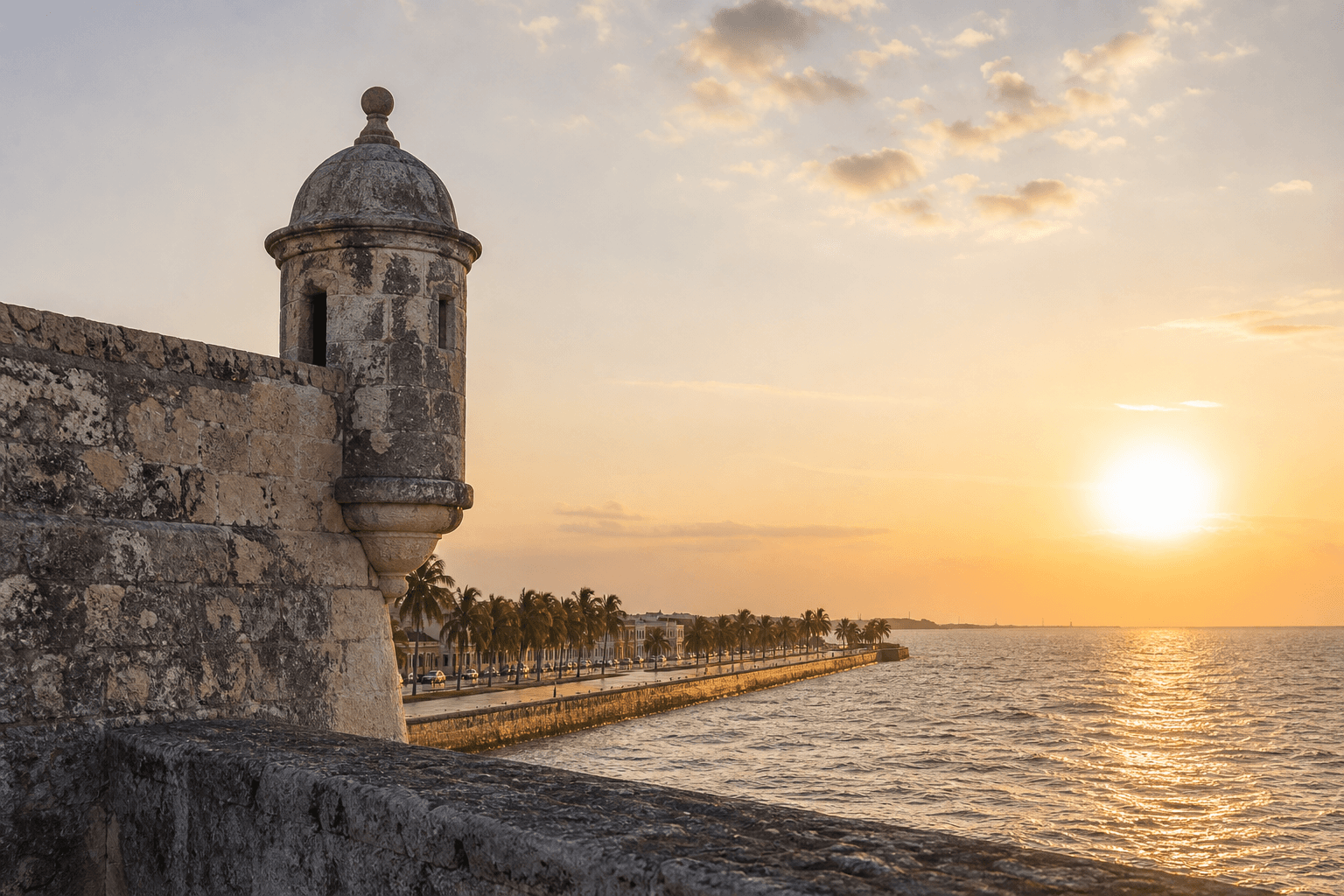
After lunch — try the Mercado Principal for pan de cazón or fresh ceviche stalls — spend the afternoon on the two forts. The Fuerte de San Miguel (higher, with a Maya jade collection and views from the ramparts) and the Fuerte de San José el Alto (larger courtyard, maritime exhibits, panoramic views toward the Gulf) each take 60–90 minutes. End the day on the Malecón de Campeche at sunset — 8 km of waterfront promenade with views across the Gulf and the city wall's western face lit up after dark.
One day is enough if you combine Campeche with Mérida or are crossing the peninsula. It falls short if you came for ruins.
GuideOne Day in Campeche: A Walking Route Through the Walled City, Bastions, and MalecónA complete self-guided walking itinerary for spending one day in San Francisco de Campeche. Follow a logical route through the walled centre, seven surviving bastions, two historic gates, Calle 59, and the malecón — with opening hours, costs, and practical tips.Explore
Two Days: Add Edzná
Two days is the most common first trip because it pairs the city with Campeche's signature Maya site. Edzná sits 52 km southeast of the capital, about 45 minutes by car or one hour on the bright-red-and-white shuttle bus ("Colectivos del Valle de Edzná") that runs from Calle Chihuahua near the market every 30 minutes during the day. Tickets are around 45 pesos one way when operated, paid on board.
 Atardecer on the Malecón de Campeche
Spend the morning of Day 2 at Edzná. Go early — the site opens at 8 AM and the lowland heat picks up by 11. Walk the Gran Acrópolis and climb the Edificio de los Cinco Pisos, the five-story main temple; from the top you survey a canopy of dry forest with no modern construction in any direction. The site's hydraulic system of channels and reservoirs is unusual for Maya lowlands and worth reading about at the small on-site museum before entering the plaza area. Allow 3–3.5 hours total. Bring your own water — the entrance shop is small and choice varies.
Return to Campeche by early afternoon. The remaining time on Day 2 can fill with a museum you missed on Day 1 (the Museo de Arquitectura Maya inside the Baluarte de la Soledad is the strongest single visit if you did not make it on Day 1), a cooking-class booking at one of the Calle 59 restaurants, or a second pass at the malecón in the late afternoon light.
Edzná's light-and-sound show runs several evenings a week (check locally for current schedule and cost; it is mostly in Spanish). If it coincides with your visit, use Day 2 as a late return — see the show after dark and take a taxi or pre-negotiated shuttle back to the city.
Three Days: Add a Gulf Coast Beach
Three days let you pair Campeche City and Edzná with a coastal overnight. You have two practical choices.
Option A: Sabancuy (closest, most relaxed) — 67 km northwest of Campeche City on Highway 180, about one hour by car or colectivo. Sabancuy is a small fishing-and-beach settlement on a shallow bay — no high-rise resorts, no big bars. Swimable water, inexpensive seafood stalls on the sand, a quiet waterfront walk in the evenings. Many visitors add this as a half-day relaxant rather than a full overnight; if you want two beach days, Playa Norte is a short colectivo north of Sabancuy with finer sand but fewer services.
Option B: Champotón (more character, food-focused) — 69 km south on Highway 180D, about one hour by car. The town straddles the Río Champotón where it meets the Gulf; the riverfront at Las Brisas is where locals eat fresh oysters and grilled fish at long communal tables. Beyond the food, the Malecón de Champotón was rebuilt after hurricane damage and offers a pleasant evening walk, and there are direct colectivos to the Petén-style ruins of Champotón Viejo (verify access locally).
A practical three-day structure: Day 1 — city centre; Day 2 — Edzná; Day 3 — morning depart for Sabancuy or Champotón, beach and seafood lunch, return by late afternoon or overnight and drive back the following morning.
Four Days: One of Two Deeper Additions
Four-day trips force a decision between two very different second-beyond-city highlights.
Track A — Calakmul biosphere and ruins. This is the signature deep-state itinerary for Maya-culture travellers. Calakmul's main pyramid (Structure II) rises above a canopy that the Reserva de la Biósfera de Calakmul — Mexico's largest tropical protected area — preserves intact. The ruins sit 174 km from the capital via Route 186 through Xpujil; driving time is four to four-and-a-half hours of near-empty two-lane road past the Xpujil junction and into the biosphere. You need two nights in the area to do it properly — one on arrival to turn around the drive, one after visiting the ruins — adding up to four nights away from Campeche City. Combined with your two city nights starting the trip, a four-day trip allows one night near Calakmul: drive down, visit the ruins the next morning, drive back that evening. It works but is long-paced. Five days is better for this route.
Track B — Edzná, coast, and a deeper city day. If you are not pulled to the jungle ruins, use Day 3 and Day 4 for a second coastal town (Isla Aguada or Champotón) and an unhurried second city day. Dedicate one full afternoon to the Mercado Principal food circuit and a walk along the Calle 59 restaurant strip, visit the Teatro Francisco de Paula Toro if a show is on, and take the time to walk the full 4-km circuit of the murallas (city walls) from the Baluarte de San Francisco to the Baluarte de San Juan — rarely done end-to-end, but revealing of how the wall is still part of the living city, not a segmented tourist track.
Five Days: The Full Circuit
Five days is the number most return visitors cite as the practical minimum for covering Campeche State at a sane pace. A five-day structure looks like this:
| Day | Focus | Nights |
|---|---|---|
| 1 | Arrive, historic centre (Plaza, Catedral, Calle 59) | Campeche City |
| 2 | Edzná (morning) + forts or museum (evening) | Campeche City |
| 3 | Drive to Sabancuy/Champotón, beach, evening seafood | Coastal town or Campeche |
| 4 | Drive Calakmul; visit ruins morning | Xpujil or km-120 lodge |
| 5 | Return drive; depart or final city evening | Campeche City |
This route covers the walled city, the Gulf coast, and the largest Maya site in the state — three of the four distinct Campeche experiences (the fourth being Río Bec / Laguna de Términos, which pushes into a sixth or seventh day).
Practical notes: Day 4's drive into the biosphere starts early — leave Campeche by 6 AM to reach Xpujil by 10, and the ruins entrance (km 120 from the capital, 60 km past Xpujil) by mid-morning when the wildlife is still active. Howler monkeys are common directly along the road near the site entrance; spider monkeys are chance sightings. Jaguar tracks appear on the access road after rain, though a live sighting is uncommon and always a matter of luck. Entry to the archaeological zone involves three checkpoints and fees (community gate at the biosphere entrance, Ejido gate at the ruin entrance, INAH ticket at the ticket booth); budget 200–250 pesos total per person.
Seven Days or More: Adding Río Bec and the Coast Proper
Seven days opens the southern third of the state.
The Río Bec cluster — Becán (moated city with a deep defensive ditch), Chicanná (the "House of the Serpent Mouth" with a well-preserved Itzamná facade), Balamkú (small but home to one of the most important Maya stucco friezes in Mexico), Hormiguero, Xpujil — lies along Highway 186 between Xpujil and the Belize corridor. These sites are smaller individually than Edzná or Calakmul but together represent a distinct Maya architectural style (decorative façades, false towers, Puuc-Río Bec hybrid). A full day visiting four or five of them is practical if you base in Xpujil for two nights.
Beyond ruins, Laguna de Términos and Isla Aguada sit between Campeche City and Escárcega. Isla Aguada is a small pueblo on a barrier island — long shallow beaches, dolphin-watching boat trips on the lagoon (bottlenose dolphins are resident locally), and a quiet evening boardwalk. A day trip from Campeche is possible (95 km, 90 minutes); an overnight in one of the small guesthouses slows the pace nicely.
Ciudad del Carmen is the state's second city, on Isla del Carmen connected by two long bridges. It is an oil-and-sea hub — functional rather than picturesque — but the ferry to playa Norte and the Laguna de Términos mangrove boat tours through the Área de Protección de Flora y Fauna Laguna de Términos are the state's best bird-watching access. Flamingo sightings are seasonal; the reserve is a year-round pelican, osprey, and occasional American crocodile stop.
A seven-day framework:
- Days 1–2: Campeche City (walls, forts, food, museum, malecón)
- Day 3: Edzná (morning), return, evening on the coast (Sabancuy)
- Day 4: Drive south to Xpujil, enter biosphere
- Day 5: Calakmul ruins (morning, coolest wildlife hours)
- Day 6: Río Bec cluster (Becán, Chicanná, Balamkü) from Xpujil base
- Day 7: Return to Ciudad del Carmen or Campeche City, lagoon birding or malecón sunset, depart
Quick Reference by Trip Length
What each day count realistically covers:
| Days | Primary coverage | Who it suits |
|---|---|---|
| 1 | Campeche City (walls, forts, malecón, food) | Peninsula crossover, weekend add-on |
| 2 | City + Edzná | First-time visitors, ruins-curious travellers |
| 3 | City + Edzná + Gulf coast (Sabancuy/Champotón) | Culture + beach balance |
| 4 | City + Edzná + coast OR Calakmul overnight | Decisive about one deep add-on |
| 5 | City + Edzná + coast + Calakmul | Most-return-visitors recommendation |
| 7+ | All five: city, Edzná, coast, Calakmul, Río Bec / lagoon | Full-state circuit |
Which Base to Use and When to Rent a Car
Campeche City is the logical base for trips of one to four days. For five days and beyond covering Calakmul, you have two options:
Keep the city base and drive out each day. Practical for Edzná and the coast (both within 90 minutes). Not practical for Calakmul — the round-trip solo drive is a nine-hour commitment, and an overnight in the biosphere is part of the appeal.
Shift south after Edzná. Check into a lodge near Xpujil (15 km south of town, along Highway 186, jungle-front lodging, unpaved access) for the Calakmul leg, then return north for the coast or straight home. Car hire in Campeche City runs 400–800 pesos per day depending on season and whether you book through the counter at the airport or in town; a compact vehicle is sufficient for these roads.
Fuel note: the road from Campeche City to Calakmul passes the town of Xpujil with a station; beyond Xpujil, the next guaranteed fill is 130 km south near the ruins access turn. In the rainy season (roughly June to October), carry extra fuel in a jerrycan if you are driving independently. Topes (speed bumps) are common entering every settlement on every major road — slow down through every village regardless of how open the road looks.
Cash is standard at Edzná, at the Xpujil turn, at biosphere eateries, and at Colectivo depots. ATMs exist in Xpujil but are not reliable for large withdrawals. Budget with the upper-end restaurant estimates here rather than assuming card acceptance: small-town meals and rural fuel are cash-heavy across southern Campeche. Planning around this detail saves frustration when signal disappears south of Escárcega and your card machine at the pump or the seafood shack simply will not cooperate.
When to Go by Length
Short trips (one to three days) fit any dry-season month: November to April delivers the most comfortable walking weather in Calpeche City and on the ruins. Longer trips (five days or more) ideally sit in the dry season too, but the big variable is the Calakmul stretch. From June to October, Route 186 south of Xpujil can develop standing-water sections and mud patches; a compact vehicle may manage but check locally at the Xpujil Pemex station before continuing if rain has fallen for two or more days. The ruins themselves feel different in the wet season — howler monkeys vocalise more frequently, vegetation is green rather than khaki, and the entrance road supports a genuinely lush visual experience trade off against the access risk.
For one to three-day itineraries, any clear-weather window works. For five or more, book November to April and you are covered.