

A waterfront between two waters
Ciudad del Carmen occupies almost the entire length of Isla del Carmen, a long, low barrier island that separates the Gulf of Mexico from Laguna de Términos, the largest estuarine lagoon system in Mexico. That geography gives the city two completely different waterfronts, and understanding the difference is the first step to planning any walk along the water.
The northern shore faces the open Gulf. That is where you find the city's beaches, led by Playa Norte, with sand, palapas, and families in the water. The southern and western shore faces the lagoon. That is where you find the malecón: a seawall promenade and waterfront road looking across calm, shallow water toward the mainland, the port installations, and the long line of the El Zacatal bridge closing the horizon to the southwest.
When people in Ciudad del Carmen say "el malecón," they usually mean this lagoon-side waterfront in the central district. It is the city's living room: the place where families stroll after the heat breaks, where joggers appear at first light, where fishing boats and supply vessels give the view a working-harbour rhythm, and where the evening light show over the water is, for many visitors, the single most memorable thing the island does.
This guide covers the malecón in practical detail: what it is, what you pass along it, the Stella Maris monument standing in the lagoon, the sunsets, the birdlife, the bridge, the separate Gulf-side promenade at Playa Norte, and how to fold a waterfront evening into a trip that also includes beaches, the historic centre, or a boat excursion on the lagoon.
Why the waterfront matters to this city
Ciudad del Carmen exists because of the water on both sides of the island. Spanish forces expelled the pirates who had occupied Isla de Términos and founded a military post here on 16 July 1717, the feast day of the Virgen del Carmen, which is how both the island and the city got their name. The waterfront has been the city's front door ever since: first for dyewood and chicle, then for shrimp, and since the 1970s for the offshore oil industry that made Carmen one of the most important energy towns in Mexico.
You can read that whole economy from the seawall. Shrimp boats and small fishing craft work the lagoon side. Platform supply vessels and crew boats tie up near the port facilities. The bridges at either end of the island carry the highway traffic that connects the Yucatán Peninsula to the rest of the country. Unlike a resort town, where the promenade is the product, here the promenade is a vantage point over an economy that would run exactly the same without a single visitor.
That is the character you should expect. The malecón is genuinely pleasant, genuinely local, and free. It is not a manicured tourist boardwalk with a ticket booth and a row of international restaurants. Some stretches are freshly landscaped and busy; others are plain pavement with traffic on one side. Treat it as a long, varied city waterfront that rewards an unhurried evening rather than a single attraction you tick off in ten minutes.
What and where the lagoon-side malecón is
The central malecón runs along the lagoon edge of the central district, following the waterfront around Calle 20 in the colonia Centro, a few blocks south of the main square. It combines a coastal road, a seawall, benches, walking paths, small parks, and public art, with the water of Laguna de Términos on one side and the low-rise commercial centre on the other.
Three practical things shape a walk here. First, the promenade is not a single uniform strip: quality, shade, and lighting vary block by block, and the most polished sections cluster around the central waterfront park and the monument area. Second, the water is close. The seawall puts you at eye level with the lagoon, and on the central stretch the harbour traffic — fishing boats coming and going, supply vessels at anchor — is close enough to watch properly. Third, heat governs everything. From roughly late morning to mid-afternoon the waterfront is exposed sun, and the humid sea air makes it feel hotter than the thermometer says. The malecón belongs to the early morning and the evening.
The walkable central stretch takes about twenty to thirty minutes one way at a relaxed pace, depending on where you start and how many stops you make. Distances look short on a map and feel longer at midday. Carry water, use the shaded benches, and plan your route so the walk ends near food: the streets immediately behind the waterfront hold most of the centre's marisquerías and everyday restaurants.
Stella Maris: the monument in the lagoon
The signature sight of the waterfront is the Stella Maris, a monumental bronze statue of the Virgen del Carmen standing on a stone pedestal out in the lagoon, a couple of hundred metres from the seawall. The figure — Our Lady holding the child Jesus, a halo of stars around her head — was sculpted by the Mexican artist Sergio Peraza and unveiled in mid-July 2014, during the city's annual festival week. The statue itself stands roughly twelve metres tall and weighs about as many tonnes; on its pedestal above the water, the whole assembly rises far higher.
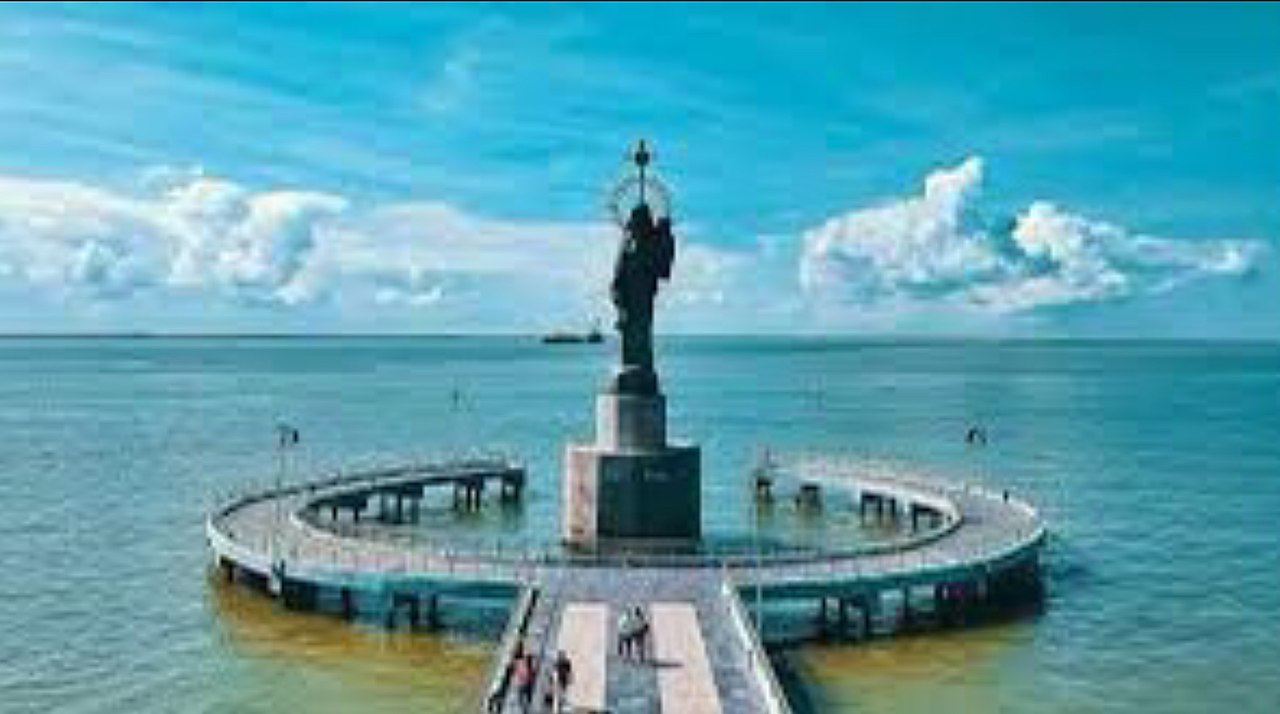 The Stella Maris monument, a tall statue of the Virgin of Carmen rising from a stone pedestal in Laguna de Términos, reached by a curved pier at Ciudad del Carmen
What makes the monument work as a visitor sight is its setting. The pedestal sits on an artificial base built out in the lagoon, and a curved pier with a circular viewing walkway reaches it from the shore, so you can walk out over the water and stand almost beneath the statue. From the seawall it reads as a silhouette against the sky; from the pier you see the scale of the bronze work up close, with the lagoon and the port traffic behind it. At night it is lit, and the illuminated figure on the water has become the city's de facto emblem — it appears on postcards, murals, and the covers of local guidebooks.
The dedication is not decorative. Carmen is a fishing and seafaring city, and Stella Maris — Star of the Sea — is the traditional protector of mariners. During the July festival of the Virgen del Carmen, the waterfront fills with processions and celebrations, and the statue becomes the focal point of the city's most important religious week. If your trip falls in mid-July, expect crowds, music, and a different, festive energy on the malecón in the evenings.
Walking the central malecón: what you pass
Start a waterfront walk from the central park on the promenade, Parque del Malecón, which is the most developed section of the whole shore. It gathers most of the malecón's furniture in one place: a small white lookout tower with an external staircase, an elevated walkway, playground equipment, palm trees, and a low seawall where people sit facing the water. On weekday evenings and all day Sunday it belongs to local families, and the sunset crowd here is as good a cross-section of the city as you will find anywhere on the island.
 Sunset over Parque del Malecón in Ciudad del Carmen, with families on the seawall, a lookout tower, and a playground
From the park, the promenade continues along the seawall past benches, lamp posts, and pieces of public art, with the harbour in front of you the whole way. Fishing crews mend nets and unload catches at the working docks. Brown pelicans patrol the water close to the wall. Across the lagoon the mainland is a low green line, and to the southwest the El Zacatal bridge stretches toward the horizon. Supply ships and crew boats tied up near the port installations give the central stretch its working-harbour soundtrack: engines, gulls, and the occasional horn.
Keep three things in mind as you walk. The pavement is generally flat and in fair condition, but edges, steps down to the water, and the occasional broken tile deserve attention, especially after dark or after rain. Shade is scarce — the palms and park structures help, but most of the walk is open sky, which is why the early morning and the hour before sunset are the comfortable windows. And the promenade is a real city space, not a stage set: you will share it with cyclists, skateboarders, courting couples, and vendors, and a little ordinary street awareness about phones and bags applies as it would on any busy waterfront.
Sunsets over the lagoon
If you take one piece of timing advice from this guide, make it this: be on the lagoon side of the island at sunset. The open Gulf faces north, but the lagoon lies to the south and southwest, which means the sun drops over water at the western end of the island. From the seawall you watch the light go orange and pink across Laguna de Términos, the supply ships turn to silhouettes, and the El Zacatal bridge becomes a dark line with the sky burning behind it.
 Sunset over Ciudad del Carmen, Campeche
The best viewing spots depend on what you want in the frame. The west end of the waterfront and the small shore at Playa Puntilla, in the old El Guanal neighbourhood, put you closest to the bridge for the classic sunset-with-bridge composition. Parque del Malecón gives you the social version, with the crowd, the playground, and the lookout tower in the foreground. Anywhere along the central seawall works; there is no single official mirador, and half the pleasure is picking your own bench.
After dark, the waterfront changes register. The malecón lighting comes on, the Stella Maris is illuminated out on the water, and the El Zacatal bridge runs its own decorative light scheme across the lagoon. On some evenings a short light-and-sound show plays on the bridge and along the waterfront, with the illumination synchronised between the two; schedules have changed over the years, so treat it as a bonus rather than a plan, and ask at your hotel what time it currently starts (verify locally). Even without the show, an after-dinner walk under the lights is the most reliable pleasure on the island.
Pelicans, dolphins, and the lagoon's wildlife
Laguna de Términos is not a decorative lagoon; it is one of the most productive estuarine systems in Mexico, a protected flora and fauna area of hundreds of thousands of hectares where the Gulf's waters mix with freshwater from the rivers of Tabasco and Campeche. You do not need a boat tour to notice that. Stand at the seawall for half an hour and the water will introduce itself.
Brown pelicans are the constant. They patrol the seawall, loiter around the fishing docks hoping for discards, and take up residence on any half-sunken piling or abandoned dock structure, which they share with cormorants, frigatebirds overhead, and herons working the shallows. The old wooden docks near the waterfront are the most photogenic place to watch them: weathered timber, birds in a row, and the bridge on the horizon.
 Brown pelicans resting on a collapsed wooden dock in Laguna de Términos, with the El Zacatal bridge on the horizon at Ciudad del Carmen
Dolphins are the lottery win. The lagoon holds a resident population of bottlenose dolphins, and on a lucky evening you may see them from the seawall or the bridge approach, rolling through the calm water at dusk. Locals treat a sighting as a small event, and visitors should too: there is no schedule and no guarantee. If you want to improve your odds, a boat excursion into the lagoon from the city or from Isla Aguada spends more time in dolphin water than a shoreline walk ever will. Either way, keep the etiquette — never feed or chase wildlife, and give fishing crews and their lines a wide berth.
El Zacatal Bridge from the waterfront
The line on the southwestern horizon is worth knowing about, because it is more than scenery. Puente El Zacatal carries Federal Highway 180 across the mouth of the lagoon between Isla del Carmen and the Atasta peninsula on the mainland. It runs about 3,861 metres — nearly four kilometres of concrete beam roadway on piles, two lanes wide with a toll plaza on the mainland side — and when it opened in 1994 it was the longest bridge in Mexico. It remains the longest in Campeche and one of the defining engineering works of the Gulf coast, the obligatory crossing for anyone driving between the Yucatán Peninsula and Tabasco or central Mexico.
You cannot stop on it — there are no lay-bys, and traffic includes heavy freight — so the bridge is something you either cross in ten minutes at highway speed or admire from shore. The malecón gives you the view for free. The best shore-side angles come from the western end of the waterfront and from Playa Puntilla, where the small lagoon beach looks straight down the bridge line, and where a plaza commemorating the city's founding displays an eagle-and-lion monument drawn from the city's coat of arms. At sunset, with the decorative lights coming on, the bridge photographs best from exactly these spots; the image of the sun dropping behind its arched navigation span is the classic Carmen postcard.
The bridge also explains the shape of a Carmen visit. Everything arriving by road — buses, rental cars, the supply trucks feeding the oil industry — funnels across El Zacatal at the island's southwest corner before spreading along the waterfront boulevard toward the centre. A second, newer crossing, Puente La Unidad, opened in 2019 at the eastern end of the island and carries the coast road toward Isla Aguada. Between them they turn the island into a natural overnight stop on any Gulf-coast drive, which is precisely how most first-time visitors end up watching the sunset from this seawall.
The Gulf-side promenade at Playa Norte
The word malecón also gets used for a second, separate waterfront: the coastal walkway along the Gulf shore at Playa Norte, northeast of the centre. This stretch — built along Paseo del Mar in the Justo Sierra neighbourhood and named after Nelson Barrera Romellón, the slugger from Ciudad del Carmen known as "El Almirante," one of the most feared home-run hitters in Mexican league history — extends several hundred metres along the beach road, with a dedicated bike lane, palm planting, palapa-roofed beach restaurants behind it, and a roundabout sculpture honouring the ballplayer himself.
 Palm-lined coastal boulevard along Playa Norte in Ciudad del Carmen, with the Gulf beach and thatched palapas beside the walkway
The mood here differs from the lagoon side. Instead of harbour views you get sand, surf noise, and beach life: families under palapas, vendors with fruit and snacks, kids running between the bike lane and the water's edge. It is the natural extension of a beach day rather than a destination in itself, and the two waterfronts together make a satisfying loop for anyone spending a full weekend on the island — promenade and monument at sunset on the lagoon side, beach walk and swim on the Gulf side. For detail on swimming conditions, facilities, and the beaches themselves, see the separate Playa Norte guide and our roundup of Ciudad del Carmen's beaches.
One honest caveat: the Gulf-front walkway is younger and less continuous than the maps imply, and some blocks between the centre and Playa Norte are plain roadside rather than promenade. Walk the polished sections near the beach strip, and use a taxi or your car to cover the gaps rather than assuming an unbroken seafront path the whole way around the island.
Running, cycling, and early mornings on the waterfront
If your trip includes exercise, the waterfront is the only sensible venue. Runners have the seawall path and the quieter early hours: before eight in the morning the central malecón is cool by local standards, mostly empty apart from joggers and dog walkers, and the light across the lagoon is at its cleanest. Cyclists get the dedicated lane on the Playa Norte coastal stretch, which is the flattest and most pleasant riding on the island; the rest of the waterfront shares space with pedestrians and the waterfront road's traffic, so ride with ordinary care.
Timing matters more than equipment here. By ten in the morning the sun is already punishing on open pavement, humidity makes hard effort feel harder than the distance suggests, and afternoon heat regularly pushes outdoor exercise into the stupid-risk category for visitors unused to the tropics. Carry more water than seems reasonable, start early or go after five, and treat the evening promenade crowd — which swells noticeably after work and again after dinner — as part of the experience rather than an obstacle. Skateboards, strollers, and bicycles all share the same pavement, and everyone manages.
Food and drink near the waterfront
A waterfront evening in Carmen should end at a seafood table, because this island earns its reputation from the lagoon and the Gulf. Shrimp — camarón — is the signature: breaded, in cocktails, in garlic, or simply grilled. Cazón appears as the region's classic pan de cazón, layered tortillas with shredded shark in a tomato-and-black-bean sauce. Oysters, octopus, mojarra, and corvina round out a menu that changes with the season and the catch. For background on the dishes themselves, see our Ciudad del Carmen restaurants guide.
The practical geography is simple. The streets immediately behind the central malecón hold most of the centre's marisquerías and everyday kitchens, within a few minutes' walk of the seawall; along Playa Norte, the palapa restaurants behind the coastal walkway serve the same menu with sand underfoot. The municipal market, a short ride inland from the malecón, is where the town buys its fish and makes a good morning stop for fruit, pan dulce, and coffee rather than a dinner destination. Street vendors appear on the promenade itself in the evenings — elotes, esquites, raspados, and fried snacks — enough to assemble a whole informal meal from the seawall if you prefer grazing over a sit-down table.
Two cautions keep the evening pleasant. First, service in small family kitchens can be unhurried by design: order when you sit down, don't expect the check until you ask for it, and treat dinner as part of the evening rather than an errand before it. Second, seafood quality tracks the day's catch and the kitchen, so follow the tables full of locals rather than the empty ones with menus in four languages, and ask your hotel's front desk which marisquería is currently cooking well — they field that question every week.
Is the malecón safe?
For ordinary purposes, yes — the waterfront is where the city relaxes in public, and the central stretch stays busy with families, joggers, and vendors from late afternoon through the evening. Normal street sense covers most of it: watch for bicycles and motorbikes sharing the promenade, keep bags zipped and phones pocketed in the densest crowd near the park, and mind the edges and steps down to the water after dark.
The honest exceptions come later at night. Once the crowds thin, some stretches of the seawall away from the lit central section become quiet, and quiet is not the same as inviting; there is no reason to walk them alone very late when a taxi costs little. The same logic applies to the beach side after dark. If you are out past the last diners, take the direct taxi to your hotel door, and let the bridge light show be something you watch from a busy spot rather than a lonely vantage point. For the wider context, see our practical safety guide to Campeche.
One more note specific to this waterfront: parts of the shore are working port. Docks, fenced installations, and vessels tied up near the port facilities are not sightseeing space even when they look photogenic, and security takes a dim view of photographers lingering around them. Stay on the public promenade, point your camera at the water and the skyline, and nobody will bother you.
How it compares with Campeche City's malecón
Travellers who know Campeche State usually arrive with the capital's waterfront in their head, so a comparison helps set expectations. Campeche city's malecón is longer, more monumental, and more deliberately scenic: kilometres of sculpted seawall, lit monuments, gardens, and a dedicated cycle lane running along the Gulf in front of the old walled centre. It reads as a work of urban design, and it rewards long, ambitious walks. Read our Campeche malecón guide for that version.
Carmen's waterfront is shorter, more compact, and less polished, but it offers things Campeche cannot: the monument standing out in the lagoon, a working harbour with ships and fishing boats in constant motion, sunsets over the estuary with a four-kilometre bridge on the horizon, and dolphins occasionally crossing the frame. Campeche gives you grandeur; Carmen gives you proximity to wild water. They suit different evenings, and on a state tour you will probably use both — the drive between them takes about half a day, which is one more reason Carmen works best as an overnight stop rather than a day trip.
If your itinerary only has room for one waterfront experience in the state, choose by trip shape. A cultural city break based in Campeche belongs on its own malecón. A Gulf-coast road trip — Champotón, Carmen, Isla Aguada, and onward toward Tabasco — gets its waterfront reward here, at the end of the causeway, with the sunset going down behind the bridge.
Combining the malecón with the rest of the island
The malecón fits naturally into a one-day Carmen plan, and it works best as the evening bookend rather than the whole programme. A sensible shape: beach morning on Playa Norte while the sun is still tolerable, a midday retreat into the centre for lunch and the historic core — the main square, the eighteenth-century parish church of Nuestra Señora del Carmen, and the small city museum in the old Victoriano Nieves hospital — then the waterfront from late afternoon onward, ending at a seafood table near the seawall. Nothing in that plan needs booking in advance except dinner reservations on a festival weekend.
A boat excursion is the one add-on worth arranging deliberately. Laguna de Términos is a protected biosphere, and a few hours on the water take you through mangrove channels, past bird colonies, and into the territory where dolphins actually live — far more reliably than from the seawall. Bookable tours from Carmen itself are limited; this remains a working town, so most visitors either charter boats directly at the docks or join excursions organised through hotels and operators based in Campeche city and Isla Aguada.
Compare current Ciudad del Carmen tours and boat trips on GetYourGuide · See Viator's Ciudad del Carmen listings
If nothing scheduled matches your dates, ask your front desk which dock families currently run lagoon trips; they field that question weekly, and a morning departure beats an afternoon one for wind, heat, and wildlife. For the fuller picture, our Laguna de Términos guide covers the reserve, the boat logistics, and the Isla Aguada side of the lagoon.
Two structural notes help the plan run smoothly. First, distances on the island are short but slow: traffic lights, topes, and bridge approach roads stretch every journey, so chain no more than two or three stops per half-day block. Second, July changes everything — the festival of the Virgen del Carmen around the sixteenth fills the waterfront with processions, concerts, and crowds, which is either the best week of your year to be here or the one to avoid, depending on how you feel about noise.
Where to stay near the waterfront
For a waterfront-focused stay, location means walking distance to the seawall, and the practical choice comes down to centre versus airport corridor. In the central district, Hotel Plaza Mirador is the dependable midrange name: not a boutique property, but steps from the malecón, with its own restaurant and the kind of position that lets you walk home after dinner instead of finding a taxi. Check Plaza Mirador on Booking.com or compare it on Trip.com.
The modern corridor between the ring road and the airport holds the island's strongest rooms — international-brand comfort aimed at oil-industry travellers, a short taxi ride from the waterfront. City Express by Marriott is the value play there, with reliable air-conditioning and early breakfasts; see it on Booking.com or Trip.com. The Courtyard by Marriott is the flagship option if the budget allows; compare rates on Booking.com or Trip.com.
The trade-off is real and worth deciding consciously. Centre-side puts you at the seawall for sunset without a car; corridor-side buys better rooms, pools, and quieter nights at the price of a taxi each way. For a one- or two-night visit built around the waterfront, the centre wins; for a longer working or road-trip stay, the corridor usually does. Browse the full range of Ciudad del Carmen stays on Booking.com and Trip.com, and read our dedicated hotels guide for the property-by-property comparison.
Getting there and getting around
Most visitors arrive by road across the El Zacatal bridge, which is also the first sight of the waterfront: the causeway delivers you onto the island's southwest corner, and the malecón boulevard runs northeast from there toward the centre — figure on ten minutes of driving between the toll plaza and the central seawall in normal traffic. Long-distance buses use the same route; ADO and other carriers connect Carmen with Campeche city, Villahermosa, and points across the southeast, and the ride from the state capital takes roughly four hours (schedules and journey times change — check current timetables). For route-level detail, see our Campeche–Ciudad del Carmen transport guide and the ADO bus-station guide. The terminal sits inland from the seawall, so take a taxi to your lodging rather than starting a hot walk with bags.
Ciudad del Carmen's airport serves the city with domestic connections, and it is the fastest entry if you are coming from Mexico City or Monterrey for a short stay; flights are limited and schedules shift with the oil calendar, so confirm routes before booking. The airport is a short taxi ride east of the centre along the ring road, and our airport arrival guide covers the transfer options. Within the island, the centre is walkable in sections and taxis are cheap and plentiful; agree on the destination before setting off, since street addresses here follow numbered calles that puzzle newcomers. For a waterfront evening, no car is needed at all.
When to go for the waterfront
The malecón works all year, but the seasons change what you get. November through February brings the mildest air and the cleanest evening light — the best stretch for long walks, running, and photography, with warm days and only occasional northerly wind events off the Gulf. March through May builds toward the hottest weeks of the year, when the comfortable window shrinks to early morning and sunset and midday belongs indoors. June through October is the rainy season: mornings usually stay walkable, afternoon storms arrive fast and leave fast, and the evenings after rain can be the most atmospheric of the year.
July is the wildcard. The festival week of the Virgen del Carmen, centred on the sixteenth, fills the waterfront with processions, music, fairground activity, and crowds that transform both the seawall and the Stella Maris monument. If you want the city at its most alive, aim for it; if you want quiet sunsets and empty benches, pick any other month. Semana Santa brings its own busy beach-and-waterfront energy. Whenever you come, keep the daily pattern in mind: the promenade belongs to the morning before nine and the evening from about six onward, and the middle of the day is for shade, lunch, and the museum.
Photographing the waterfront
The waterfront rewards patience more than equipment. The strongest light runs from about an hour before sunset into blue hour, when the sky over the lagoon turns pink behind the silhouette of the bridge and the lit Stella Maris comes up out of the water. Work the west end for bridge compositions, the central park for people-and-seawall scenes, and the pier at the monument for close frames of the statue against the water. Morning offers the reverse light — soft, clean, and empty of crowds — plus the best conditions for photographing pelicans and fishing boats at work.
A few practical notes save wasted effort. The harbour traffic moves all day, so a medium telephoto earns its place in the bag for ships, rigs under tow, and birds on the pilings. After dark, the illuminated bridge and monument shoot well handheld at high ISO, though a small tripod gives cleaner results from the seawall. Keep clear of fenced port installations and vessels under operation — security there takes a dim view of photographers, and the best frames do not need them. And mind the wet pavement near the steps when you move for a better angle; camera gear and saltwater do not mix.
Frequently asked questions
Is there an entrance fee for the malecón? No. The waterfront is public space, open at all hours, and free. You pay only for food, drinks, and taxis.
How long is the walk? The polished central stretch runs twenty to thirty minutes one way at a relaxed pace. With the west end, the monument pier, and the Playa Norte coastal walkway added, plan on several kilometres across an unhurried half-day — distances look short and feel longer in heat.
Can you swim off the malecón? No. The lagoon side is harbour and boat water, not swimming water. Swim at Playa Norte and the Gulf beaches, then come back to the seawall for the evening.
What is the best time of day? Sunset, without competition. Arrive by late afternoon, walk west as the light softens, and end near dinner. Early morning is the second-best window for cool air and clean light.
Will I see dolphins? Possibly, never certainly. They live in the lagoon and show themselves from the seawall occasionally at dusk; a boat trip improves the odds but guarantees nothing.
Does the bridge light show run every night? The bridge and the central malecón are lit nightly, and a short synchronised light-and-sound programme has run some evenings, but the schedule has changed over the years — treat it as a bonus and verify locally rather than planning an evening around it.
The bottom line
Plan one deliberate evening around this waterfront and it will carry the whole stop. Get to the seawall by late afternoon, walk from Parque del Malecón toward the west end while the heat breaks, watch the sun go down behind the El Zacatal bridge, wait for the Stella Maris to light up out in the lagoon, then eat shrimp within sight of the water where the tables are fullest of locals. That single sequence — free, walkable, and genuinely local — is the best thing Ciudad del Carmen does for a traveller, and it costs nothing but the time to be there.
