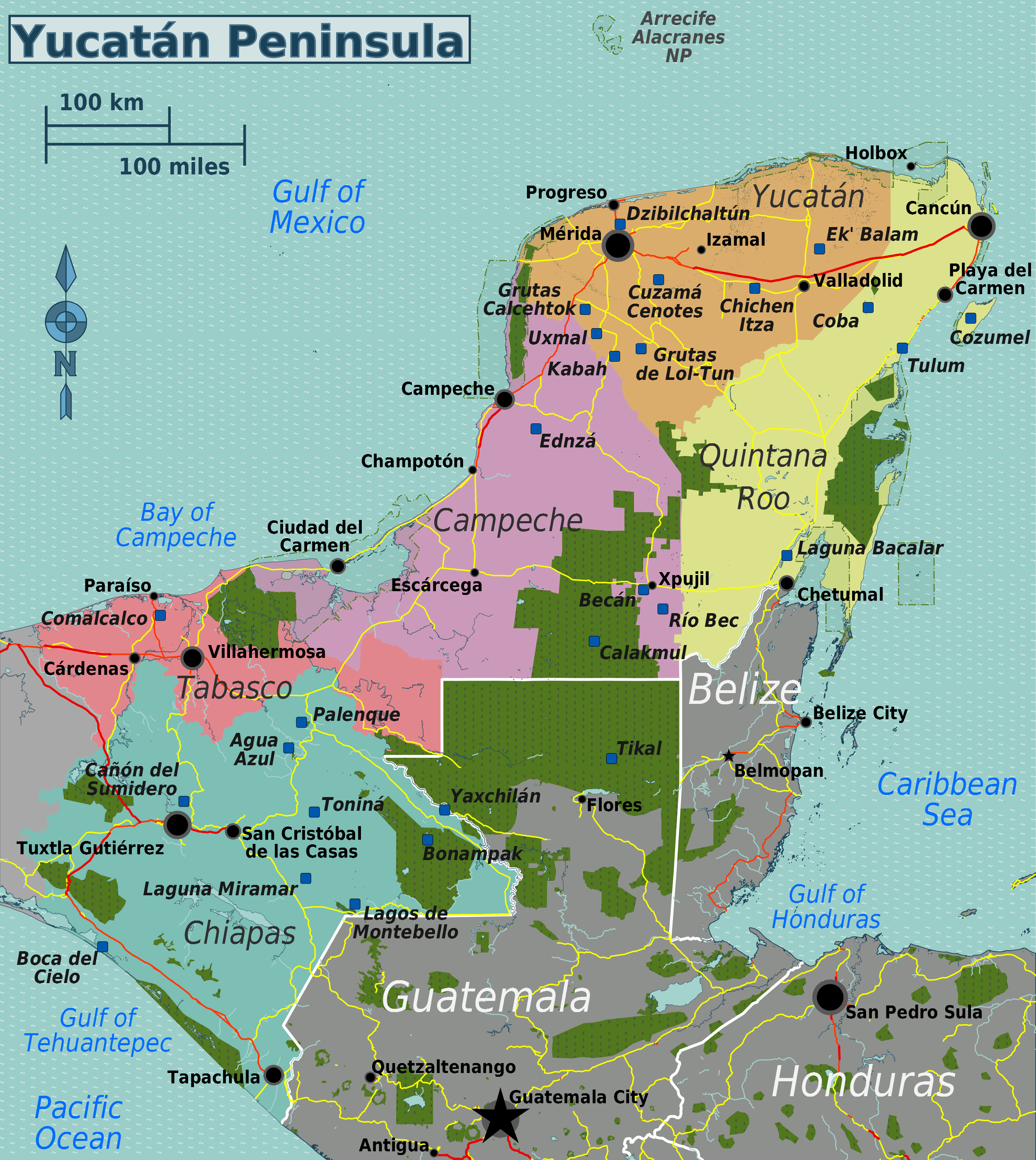
Tulum sits at the southern end of the Riviera Maya, all beach clubs and boutique hotels. Campeche lies 430 kilometres to the west, a walled colonial city on the Gulf coast with a different pace entirely. Getting between them is straightforward — you have three realistic options, and the right one depends on your time, budget, and tolerance for a long travel day.
This guide covers the three main ways to make the journey: the bus (with a transfer in Mérida), driving the highway, and the Tren Maya with a connection. All prices are in Mexican pesos unless noted.
 Tulum Castillo ruins on the Caribbean coast
Bus: Tulum → Mérida → Campeche
There is no direct ADO bus from Tulum to Campeche. The route requires a transfer in Mérida, the Yucatán capital. This is the most common budget option and works well if you plan your connection with a buffer.
Tulum to Mérida: ADO and ADO GL run multiple daily departures from the Tulum ADO terminal (located on the highway just north of downtown). The journey takes 3 hours 45 minutes to 4 hours 30 minutes, covering roughly 260 kilometres via Highway 180. Tickets cost 400–650 MXN one way. Buses run from early morning through evening, with departures approximately every 1–2 hours.
Mérida to Campeche: From Mérida's Terminal Paseo 60 or the ADO Centro station, ADO runs direct buses to Campeche every 30 minutes from early morning until late night. The trip takes 2 hours 15 minutes to 2 hours 40 minutes (170 km) and costs 240–380 MXN. Several other operators — ATS, OCC, TRT — also run this corridor at similar prices.
Total journey time: Plan 7–8 hours including a 45-minute to 1-hour transfer buffer in Mérida. The Mérida terminals have food courts, clean restrooms, and luggage storage, making the wait comfortable enough.
Total cost: 640–1,030 MXN one way (approximately 35–60 USD).
Practical tips:
- Book the Tulum–Mérida leg online through the ADO app or website, especially in high season (December–April) when morning buses fill up.
- When you arrive in Mérida, check the departure board immediately. If there is a Campeche bus leaving within 30 minutes, buy a ticket and go. If not, grab food at the terminal — the cochinita pibil at the Paseo 60 food court is reliable.
- The ADO Campeche terminal is on Avenida Patricio Trueba de Regil in the Tepeyac neighbourhood, about 10 minutes by taxi from the historic centre (40–60 MXN).
- ADO offers two classes on this route: standard ADO (first class, reclining seats, AC) and ADO GL (luxury, wider seats, fewer passengers, onboard service). The price difference is modest — 100–150 MXN — and worth it for the longer Tulum–Mérida leg.
- If you are travelling with a bicycle or oversized luggage, ADO charges a small supplement (50–100 MXN). Standard suitcases and backpacks go free in the under-floor compartment.

Need transport? Book a transfer on WhatsApp.
Driving: Tulum to Campeche
Driving is the fastest option and gives you the flexibility to stop at cenotes, haciendas, or the Edzná ruins along the way. The route is almost entirely on well-maintained federal highways.
The route: Take Highway 307 north from Tulum to Cancún, then merge onto Highway 180D (the Mérida–Cancún toll road) westbound. Continue past Mérida on Highway 180 toward Campeche. The total distance is approximately 429 kilometres.
Drive time: 5 hours 30 minutes to 6 hours without long stops. Add an hour if you plan a proper break in Mérida.
Tolls and fuel:
- The Highway 180D toll from the Cancún area to Mérida runs about 450–550 MXN for a standard car (two toll plazas). The Champotón–Campeche segment of 180D adds another 63 MXN.
- Fuel for the full trip (roughly 430 km) costs approximately 800–1,000 MXN depending on your vehicle and current prices.
- Total driving cost: 1,300–1,600 MXN one way (tolls + fuel), not including rental car fees.
Road conditions: Highway 180D is a modern four-lane toll road with regular service areas. Highway 180 (the free alternative) is a two-lane road that passes through every town — slower but usable if you want to avoid tolls. Speed bumps (topes) are common on the free road through villages. Stick to the toll road for speed and safety.
Rental car note: If you pick up a car in Tulum, confirm with the rental agency that you can drop it off in Campeche (or elsewhere) without a prohibitive one-way fee. Some local agencies charge 2,000–5,000 MXN for a different drop-off location. International agencies like Hertz and Europcar tend to be more flexible.
Rest stops: The Highway 180D has clean service areas near Valladolid and Mérida with restrooms, food, and fuel. There are fewer options on the final stretch between Champotón and Campeche — fill up in Mérida or Seybaplaya.
Safety and road conditions: Highway 180D is well lit at night and patrolled by federal police. The main risks are speed bumps (topes) at toll plaza approaches and the occasional wildlife crossing in the forested sections between Champotón and Campeche — deer and smaller animals are active at dawn and dusk. Drive defensively through the town of Hopelchén, where the highway narrows and local traffic mixes with through traffic. Avoid driving this route at night if you are unfamiliar with rural Mexican roads; the free Highway 180 has unlit sections and occasional unmarked speed bumps.
Tren Maya: Tulum → Escárcega → Campeche
The Tren Maya now connects Tulum to Campeche by rail, but it is not a quick trip. The southern section (Tulum to Escárcega via Bacalar and Chetumal) covers 256 kilometres of jungle and wetland, then you transfer at Escárcega for the onward leg to Campeche.
The route: Board at Tulum station (6 km from downtown, 100–150 MXN by taxi). The train runs south through Felipe Carrillo Puerto, Bacalar, and Chetumal, then turns northwest to Escárcega. At Escárcega station, transfer to a train heading north to Campeche City.
Stations on the route:
- Tulum → Felipe Carrillo Puerto → Bacalar → Chetumal → Escárcega → Campeche City
Duration: The Tulum–Escárcega leg takes approximately 4–5 hours. The Escárcega–Campeche leg takes about 2 hours 15 minutes. With the transfer wait at Escárcega (typically 30–90 minutes), the total journey is 7–8 hours.
Cost: Tourist class fares are approximately 400–500 MXN for Tulum–Escárcega and 200–300 MXN for Escárcega–Campeche, totalling 600–800 MXN one way. Premier class (wider seats, fewer passengers) costs more.
Frequency: Service on the southern section is limited — typically 2–4 trains per day in each direction. Check the official Tren Maya website (trenmaya.gob.mx) for current schedules before planning around this option. Weekend and holiday trains fill up; book 3–5 days ahead.
The transfer at Escárcega: Escárcega is a small oil town with little to offer travellers. The station has basic facilities (restrooms, a small café), but do not expect a comfortable wait. Bring water and snacks. If your connection is tight, confirm both legs are on the same ticket — otherwise you may need to exit and re-enter the station.
Time zone note: Tulum observes Eastern Time (UTC-5). Campeche observes Central Time (UTC-6). When you arrive, your phone may not auto-update — set your watch back one hour. This matters for bus and train schedules, which run on local time.
GuideTren Maya Campeche: Stations, Routes, Timetables, and Travel TipsA practical guide to riding the Tren Maya through Campeche State — stations, routes, timetables, ticket classes, prices, and how to connect to Calakmul, Edzná, and the Yucatán coast.Explore
Which Option Should You Choose?
Choose the bus if: You want the cheapest option and do not mind a travel day. The Tulum–Mérida–Campeche bus route is well established, safe, and comfortable. ADO buses have air conditioning, reclining seats, and luggage storage. Budget 7–8 hours and under 1,100 MXN.
Choose driving if: You want flexibility to stop along the way — Edzná is a natural halfway point, and the route passes several cenotes and haciendas. It is also the fastest option at 5.5 hours. You need a car for your Campeche stay (useful for visiting Calakmul or the coast). Budget 1,300–1,600 MXN in tolls and fuel plus rental costs.
Choose the Tren Maya if: You want to experience the train itself, or you are travelling without a car and prefer rail to bus. The scenery through the southern jungle is genuinely pleasant — tropical forest, small towns, and the Bacalar lagoon area. It is not the fastest or cheapest option, but it is the most interesting if you have time to spare.
Skip the train if: You are on a tight schedule. The limited frequency and transfer requirement make it less reliable than the bus for a same-day arrival.
Practical Tips for the Journey
- Start early. Whether bus, car, or train, a morning departure from Tulum gets you to Campeche by early afternoon. A midday departure means arriving after dark.
- Bring snacks and water. While the Mérida terminals and Highway 180D service areas have food, the bus itself and the train have limited options. Fresh fruit, nuts, and a refillable bottle go a long way.
- Cash is useful. Small bus stations, taxis, and rural rest stops may not carry card terminals. Keep 500–1,000 MXN in small notes for tolls, taxis, and quick meals.
- Luggage: ADO buses have under-floor luggage compartments — no extra charge for standard suitcases. The Tren Maya has overhead racks and a luggage area at the end of each car. If driving, keep valuables in the cabin, not the boot.
- Arriving in Campeche: The ADO terminal is 3–4 km from the historic centre. A taxi to the centro costs 50–70 MXN. The Tren Maya station (San Francisco de Campeche) is closer to the old city — about 2 km, a 10-minute taxi or a 25-minute walk.
Where to stay on arrival: If you arrive in the afternoon, the historic centre (inside the old walls) is the most atmospheric base — walkable, safe after dark, and close to the Malecón. Hotels range from 600 MXN for a clean budget room to 2,000+ MXN for a restored colonial property. The area around the ADO terminal is functional but uninteresting; head into the centro before dark.
Quick Reference
| Mode | Time | Cost (one way) | Best for |
|---|---|---|---|
| Bus (via Mérida) | 7–8 hours | 640–1,030 MXN | Budget travellers, no car |
| Driving | 5.5–6 hours | 1,300–1,600 MXN + rental | Flexibility, road trips, families |
| Tren Maya (via Escárcega) | 7–8 hours | 600–800 MXN | Scenic travel, rail experience |
The bus remains the workhorse of this route — cheap, frequent, and straightforward. But if you have a car and a full tank, the drive from Tulum to Campeche is one of the more underrated road trips on the peninsula: colonial cities, Mayan ruins, and a real shift in landscape from Caribbean coast to Gulf lowlands.
Need transport? Book a transfer on WhatsApp.

