Catedral de Nuestra Señora de la Purísima Concepción is the principal church inside the fortified historic centre of San Francisco de Campeche. Travellers usually call it Campeche Cathedral, and it is one of the easiest landmarks to find in the city: the two-towered façade faces the central Plaza de la Independencia, within the compact colonial grid.
The cathedral is not a vast complex that requires half a day. Its importance comes from the way it anchors the city around it. A visit can take a few quiet minutes inside, or it can become the centre of a longer walk that includes the plaza, city gates, bastions, museums, arcades, and Calle 59. The useful approach is to see the building as both a functioning Catholic church and a piece of Campeche’s urban history, rather than as a stand-alone photo stop.
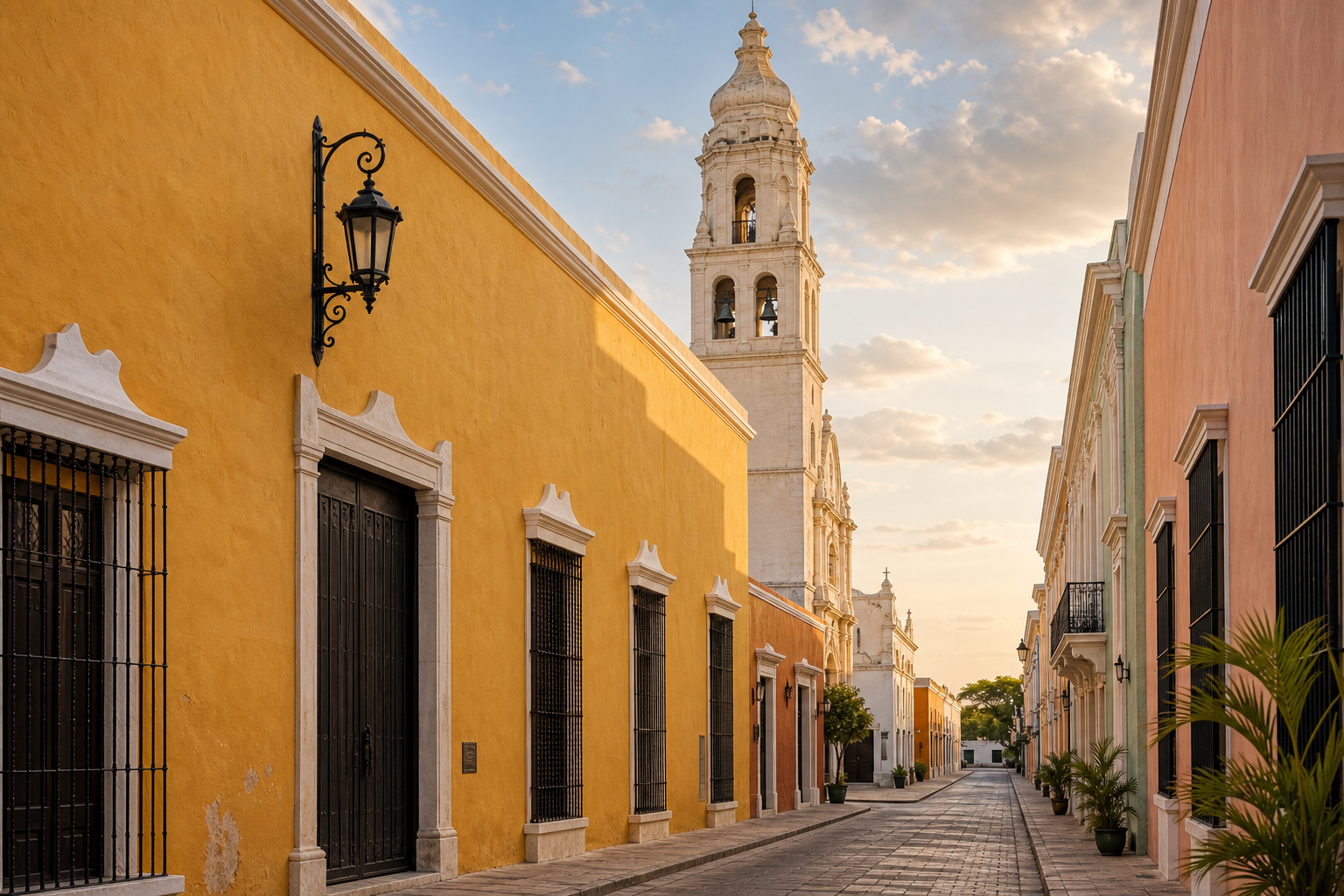
 The two-towered façade of Catedral de Nuestra Señora de la Purísima Concepción in San Francisco de Campeche
Where Campeche Cathedral is
The cathedral stands on the east side of the Plaza de la Independencia in the historic centre of San Francisco de Campeche, the capital of Campeche State. This is the city commonly shortened to “Campeche” in travel conversations. It is not the same place as the state’s southern archaeological region around Calakmul, nor is it in Ciudad del Carmen on the coast near Laguna de Términos.
The church is in the walled city, close to the streets and plazas that most visitors explore on foot. The surrounding historic centre is compact enough that you can reach the cathedral from a city-wall entrance, the Puerta de Mar area, or the central bus-connected parts of town without arranging a special excursion. If you are staying inside or near the historic centre, walking is usually the simplest option.
The plaza is the best orientation point. Stand in the square and look toward the cathedral’s façade before deciding whether to enter. This gives you a sense of its scale, its relationship to the public space, and the difference between the formal front of the building and the active streets behind it. Maps and navigation apps may use both the Spanish name and English translations; searching for Catedral de Campeche or Catedral de Nuestra Señora de la Purísima Concepción should bring up the same landmark.
There is no separate ticket simply to approach the plaza or photograph the exterior. The church is a place of worship, so access to the interior can change around Masses, religious observances, maintenance, weddings, funerals, or local events. Treat any online hours as provisional and verify locally when you arrive.
A short history of the cathedral
A church occupied this important central site from the early Spanish colonial period. Sources commonly connect the first chapel with the foundation of the Spanish settlement at San Francisco de Campeche in the sixteenth century. The building visible today belongs to a much later and more extended construction history. It was developed over the seventeenth and eighteenth centuries, with work associated with the period from roughly 1650 to 1760.
That long timeline matters because the cathedral should not be read as a building designed and completed in one moment. Colonial churches were shaped by available materials, local labour, changing finances, religious needs, and the growth of the settlement. Repairs and alterations also affected how the structure looked over time. The result is a church whose present form carries layers rather than a single clean architectural statement.
The church was elevated to cathedral status in 1895, when Pope Leo XIII established the Diocese of Campeche. Before that change, the building already held a central place in the city’s religious and civic life, but the new diocesan role gave it a different institutional importance. It became the seat of the bishop and the main Catholic church for the diocese.
The cathedral’s history is inseparable from Campeche’s role as a Gulf port. The settlement grew around maritime trade, colonial administration, and the movement of people and goods along the coast. Attacks by pirates and the construction of defensive walls and bastions changed the city’s physical shape. The cathedral was not a fort, but its position inside the fortified core placed it within the urban landscape created by those threats.
Campeche’s historic centre and its fortifications were inscribed on the UNESCO World Heritage List in 1999. That designation covers an urban ensemble rather than only one church. The cathedral is therefore best understood as one major element in a protected city of walls, gates, military works, public squares, domestic architecture, and religious buildings.
What to look at on the exterior
The first detail most visitors notice is the pair of tall bell towers. They give the cathedral a strong vertical presence above the low, colourful buildings of the central square. From several approaches, the towers act as a useful visual marker. Their shape also helps distinguish the cathedral from the smaller churches scattered through the historic centre.
The façade combines restrained stonework with the formal symmetry expected of a major church. Look at the main entrance, the openings above it, and the way the towers frame the central body. The building has Baroque and Neoclassical characteristics, although the practical visitor does not need to settle the style into a single label. The important point is that its appearance reflects the transition and overlap of architectural languages across a long construction and alteration history.
Stone takes on different character through the day. In the morning, the façade can look relatively flat and pale under direct light. Later, shadows define the doorway, mouldings, tower openings, and edges more clearly. If you are interested in photography, a second look in late afternoon can be more rewarding than trying to capture everything at noon.
The plaza gives you the most straightforward frontal view, but do not remain only in the centre of the square. Walk along the surrounding streets and look back at the cathedral between the arcades and façades. The building changes scale as the view narrows. From a side street, the towers appear to rise over the historic grid; from the plaza, the façade feels more civic and ceremonial.
 Campeche Cathedral facing the central Plaza de la Independencia
The square itself is part of the visit. It has been remodelled at different points in the city’s history and has served changing public, political, and social functions. A kiosk and planted areas shape the modern experience, while the cathedral supplies the older architectural focus. Take photographs from the edge of the plaza rather than blocking the central paths or approaching the church entrance as if it were only a monument.
Going inside: what to expect
The interior is quieter and more restrained than the exterior’s two towers might suggest. Enter slowly and allow your eyes to adjust if the light is bright outside. Depending on the time and current arrangements, you may see the central nave, side chapels, religious images, devotional objects, and the altar area. Display arrangements and access to particular parts of the church can change, so do not assume that every image shown online will be visible during every visit.
The building remains a working church. People may be praying, attending Mass, lighting candles, meeting a priest, or preparing for a ceremony. Visitors should keep voices low, silence phone notifications, and avoid walking around during a service. Photography may be possible in some circumstances, but ask or observe local instructions before using a camera, flash, tripod, or phone at close range.
Dress does not need to be formal, but beachwear is a poor fit for a religious interior. Cover shoulders and avoid very short clothing if you plan to enter. A light scarf or overshirt is useful in Campeche’s heat and also makes it easier to adapt respectfully. The same principle applies to children: explain that the cathedral is not a museum playground before you go inside.
The church’s religious meaning comes before its value as an architectural attraction. You do not need to share the faith tradition to appreciate the building, but you do need to behave as a guest in an active place of worship. Stand aside when parishioners are moving through the nave, do not touch devotional objects, and follow any request from staff or clergy.
Some visitors expect a large museum-style interpretive experience and leave disappointed because the cathedral offers little explanatory signage. That is normal for a functioning church. Read about the building before or after your visit, then use your time inside to observe proportions, light, materials, and the relationship between the devotional space and the public square outside.
The Santo Entierro and religious traditions
Campeche’s cathedral is associated with religious art and processional traditions, including an image known as El Santo Entierro, representing Christ in a coffin. It is connected with Holy Week observances and is carried through city streets on Good Friday according to local tradition. The exact route, timing, and public arrangements depend on the year’s religious calendar and diocesan programme.
This is not an attraction that should be treated as a guaranteed daily display or scheduled performance. If your trip coincides with Semana Santa and you hope to see a procession, check the current programme through local church or municipal channels. Expect crowds, street closures, and a more serious devotional atmosphere than a normal sightseeing visit.
Religious festivals can be among the best ways to understand how the cathedral functions within Campeche, but they also require extra consideration. Do not stand in front of a procession for a better photograph, enter restricted areas, or turn a solemn event into a casual photo backdrop. Follow the behaviour of local attendees and give the procession space.
Outside festival periods, the cathedral still communicates that living connection. The flowers, candles, quiet conversations, and occasional service matter as much as the stone façade. A short visit can be enough if you are passing through, while travellers interested in Catholic art and colonial history may wish to return at a different time of day.
How long to spend there
Allow around fifteen to thirty minutes for a respectful first visit if the interior is open and there is no service. That gives you time to look at the exterior, cross the plaza, enter briefly, and continue without rushing. Add more time if you want to study the façade, photograph the towers in changing light, or sit in the square.
The cathedral itself does not need to occupy an entire morning. Its best role is as the anchor for a historic-centre route. Pair it with the city gates and walls, a bastion museum, the central streets, and a meal or rest stop. This creates a fuller understanding of Campeche than visiting the church, taking one photograph, and immediately leaving the area.
A practical first visit might begin at the cathedral in the morning, continue through the nearby streets and fortifications, pause during the strongest heat, and return to the plaza in the evening. The same building looks different after sunset, when the square and façade may be illuminated. Confirm current lighting or event arrangements locally rather than planning around a show that may not be running.
A walking route around the cathedral
Start at the Plaza de la Independencia and spend a few minutes orienting yourself. Look at the cathedral, the surrounding arcades, the paving, and the flow of people. Photograph the building from the square, then move to one of the side streets to see how it sits within the colonial grid.
Next, walk toward the nearby historic streets and the Puerta de Mar area. The route is short in map terms but slow in practice because colourful façades, doorways, balconies, and street views invite stops.
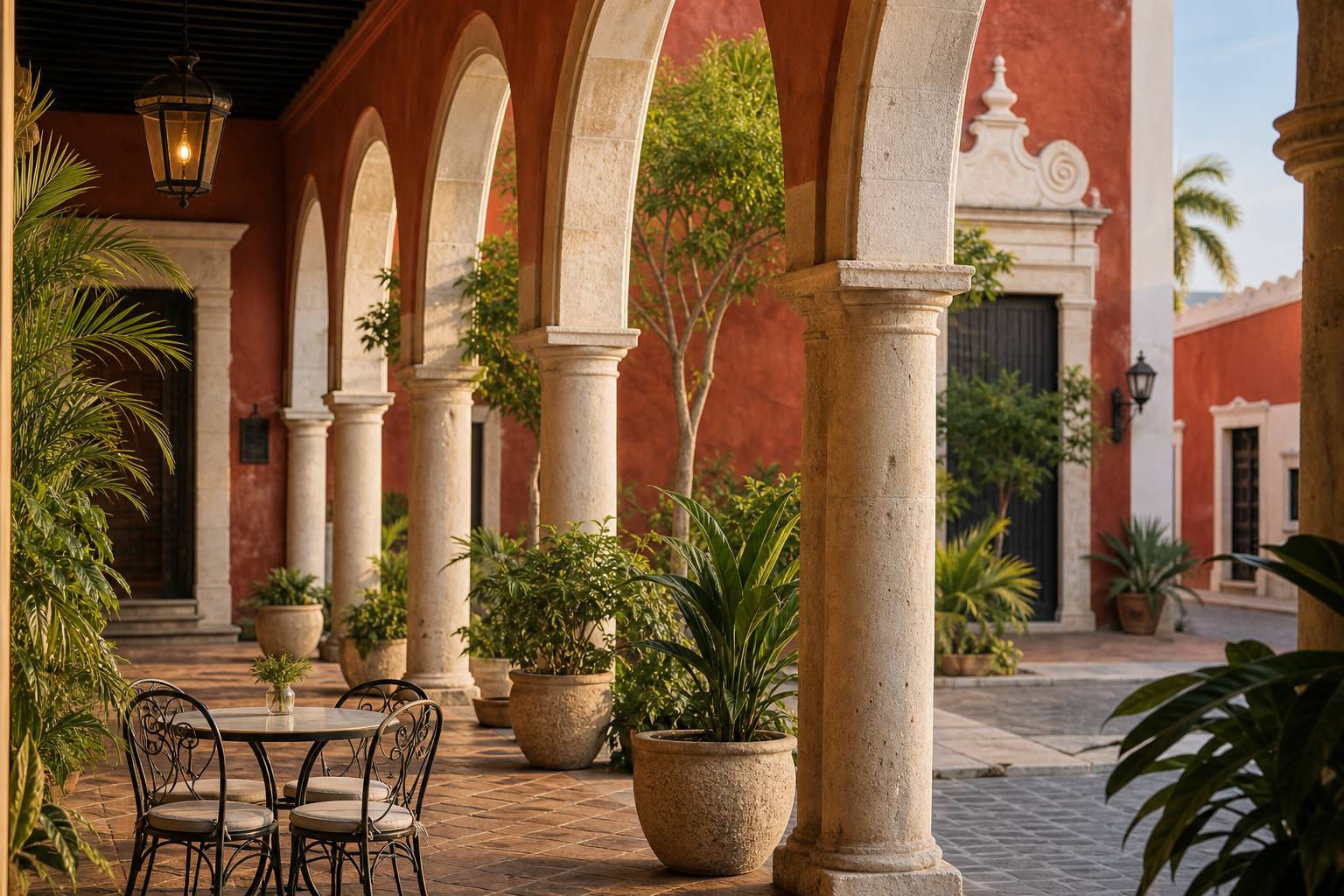
 Colonial houses and the old city wall near Campeche Cathedral
Keep the cathedral as a reference point until you are comfortable with the grid. Campeche’s centre is easy to explore, but heat and uneven surfaces make an unhurried pace more sensible than a strict timetable.
Continue toward a bastion or museum that is open on the day. The Baluarte de la Soledad is particularly relevant to a cathedral visit because it combines the military history of the fortified city with Maya architectural material and regional interpretation. It is a different kind of heritage experience: the cathedral represents religious and civic continuity, while the bastion shows how the city defended its port and controlled movement through its walls.
After the fortification, return through the central streets toward Calle 59 or another active part of the historic centre. This is a good point for lunch, a cool drink, or a break from direct sun. Do not assume that every restaurant or shop keeps identical hours throughout the year; check on the day and choose based on what is open rather than relying on a fixed list.
Finish with the plaza or the Malecón. The Malecón is Campeche city’s Gulf-front promenade, not an extension of the cathedral or the walled city. It is far enough from the central square to feel like a separate landscape, but the two work well together in one day. Explore the historic centre earlier, then go to the waterfront in late afternoon for open sky and sunset light.
Compare Campeche walking and cultural tours on GetYourGuide · See guided Campeche city options on Viator
Visiting with children
The cathedral can work well for families if the visit is kept short and connected to the outside environment. Children often respond more readily to the towers, the plaza, the city walls, and the idea of a fortified port than to a long explanation of architectural history. Give them a simple task: find the two towers, notice the thick stonework, compare the square with a modern waterfront, and listen quietly for a minute inside.
Heat is the main practical problem. The plaza can be exposed, and a child who was comfortable at the start of a walk may tire quickly after several streets. Visit early, or use the cathedral as a brief stop between shaded or indoor activities. Carry water and plan a pause rather than promising an ambitious circuit of every wall and museum.
Strollers may manage the main streets, but historic paving, kerbs, parked vehicles, and crowded passages can make manoeuvring slower. Keep children close around the plaza and road crossings. The cathedral entrance itself may have a step or a changing threshold; ask locally if you need a step-free route.
Inside, set expectations before crossing the doorway. A few quiet minutes is realistic. If a service is underway, skip the interior and return later. This is more respectful and usually produces a better family experience than trying to keep restless children silent during a ceremony.
Accessibility and mobility considerations
The cathedral’s central location makes it easy to reach, but the historic centre is not uniformly accessible. Flat routes are interrupted by kerbs, paving changes, narrow sidewalks, parked cars, and temporary works. A wheelchair user or traveller with limited mobility should inspect the immediate approach on arrival and allow extra time.
The square generally provides more room to manoeuvre than the narrowest surrounding streets. The entrance threshold and interior route may vary, especially during events or maintenance. If you need specific access arrangements, contact the cathedral or local tourism office before travelling, then confirm conditions in person because historic buildings can have limitations not visible in general listings.
For visually impaired visitors, the open square can be easier to navigate than the crowded street edges, but traffic and changes in paving still require care. Inside, ask before touching any feature or relying on a handrail. A companion or local guide can help identify the best route without interrupting worshippers.
The cathedral is not a fully interpreted museum. Travellers who need large-print information, captions, sign-language support, or detailed object labels should not assume those services are available. A guide booked for a historic-centre walk may be able to provide additional spoken context, but verify the language and accessibility details in advance.
Best times for photographs
Morning offers cleaner, cooler conditions and fewer people in many parts of the historic centre. The façade may be strongly lit, which is useful for a clear record photograph but less useful for showing relief and texture. Walk around the square to find an angle that avoids harsh glare.
Late afternoon is better for warm stone colour and longer shadows. The plaza becomes more social, so you may need patience to photograph the façade without people in the foreground. That is not necessarily a problem: the cathedral is a living city building, and people using the square provide scale.
Blue hour and evening can make the towers stand out against the sky. Bring a phone or camera that handles lower light without a flash. A tripod may be impractical or disallowed in the square and should never obstruct a religious service or pedestrian route. If the building is illuminated, confirm that the lights are operating on the evening you visit.
Avoid entering solely to take a photograph. If photography is restricted, put the camera away. The exterior provides ample opportunity, and a respectful visit is more important than an interior image.
Combining the cathedral with other Campeche sights
The cathedral is the natural starting point for the central historic district, but it should not replace the rest of the city. Campeche’s character comes from the relationship between church, plaza, domestic streets, defensive works, and the Gulf-facing edge.
The city walls and gates explain why the cathedral stands in such a dense and controlled urban setting. Bastions provide a military counterpoint to the church. The central plazas show how public life has changed. Calle 59 gives the evening route a different rhythm, with active façades and places to stop. The Malecón opens the view toward the Gulf and helps you understand the city’s coastal orientation.
If you have a full day, add a museum or fortification in the morning, the cathedral and plaza around midday or late afternoon, and the waterfront at sunset. If you have only a few hours, remain within the walled centre and resist the temptation to squeeze in a distant attraction. Campeche rewards close observation of a small area.
Edzná is a separate archaeological excursion outside the city and cannot be combined with the cathedral as a casual walk. It can fit into a broader Campeche itinerary, but allow for transport time, heat, and time at the site. Calakmul is much farther away and belongs to a southern Campeche jungle route, usually with an overnight base near Xpujil or another carefully planned arrangement. Keeping these distances clear prevents a common itinerary error: treating every Campeche landmark as if it were in the capital.
Staying near the cathedral
Staying in or close to the historic centre makes early walks, evening photography, and flexible returns easier. You can visit the cathedral before the hottest part of the day, rest at your accommodation, and return to the plaza later without arranging another long transfer. The trade-off is that historic buildings may have stairs, smaller rooms, limited parking, or sound from central streets. Read current property details carefully and decide whether location or modern facilities matter more for your trip.
The Malecón and newer parts of Campeche offer a different accommodation environment, often with more road access and larger modern properties. They can be useful if you are driving or want easier access to the waterfront, but they are less convenient for spontaneous walks around the cathedral. Taxis or local ride services can bridge the distance; confirm the return plan at night rather than assuming every central street will have immediate transport.
Check current rates for stays near Campeche’s historic centre on Booking.com · Compare Campeche hotels on Trip.com
Tours, guides, and independent visits
An independent visit is enough to appreciate the exterior, plaza, and basic interior if access is open. The cathedral is easy to place within a self-guided walk, and travellers who prefer a quiet pace may enjoy reading the history beforehand and exploring without a fixed group schedule.
A guide becomes more useful when you want the cathedral explained alongside the walls, gates, bastions, and colonial urban plan. The connections are not always obvious from a plaque. A good guide can distinguish documented history from local tradition, explain why the church occupies its central position, and adapt the route around heat or a service.
Check whether a tour includes interior entry or only an exterior stop. Some city tours pass the cathedral during a walking circuit without entering. That may be the correct choice if a service is taking place, but it is worth knowing before you book. Confirm language, duration, accessibility, meeting point, and cancellation conditions with the current operator.
Browse current Campeche cultural tours on GetYourGuide · Compare Campeche sightseeing experiences on Viator
 The Malecón waterfront of San Francisco de Campeche, a separate stop from the cathedral
Practical etiquette and safety
Keep bags and phones secure in the same ordinary way you would in any busy historic centre. The plaza is public and generally active, but crowds can form around events, ceremonies, performances, or transport activity. Do not leave a camera on a bench while moving to another viewpoint.
Cross streets at safe points and watch for vehicles around the square. Historic-centre traffic can be slower than on larger roads, but narrow streets and parked cars make visibility imperfect. At night, stay on active, lit streets and choose a route that matches your comfort level.
Church floors can be smooth, dusty, or uneven near thresholds. Shoes with a little grip are more practical than slick sandals, especially after rain. The climate is hot and humid for much of the year, so schedule a water break before entering rather than treating the cathedral as a guaranteed cool refuge.
Do not climb barriers, sit on altar steps, touch statues, or use flash close to artwork. If a wedding, funeral, or Mass begins, leave quietly or remain at the rear only if local practice permits visitors to stay. The building’s value is not reduced by missing an interior visit; there will be another time.
Common mistakes to avoid
The first mistake is confusing the cathedral with a separate attraction outside the city. It is inside San Francisco de Campeche’s fortified historic centre, facing the Plaza de la Independencia. You can combine it with other central sights, but not with Calakmul or Edzná without transport.
The second is relying on a fixed online opening schedule. A functioning church can close or limit access for reasons that have nothing to do with tourism. Treat hours as subject to change and keep the exterior, plaza, and surrounding walk as a worthwhile alternative.
The third is visiting at the hottest time and deciding that the city is unpleasant. The cathedral itself may be manageable, but the square and streets can be bright and exposed. Early morning, late afternoon, and a split-day plan are more comfortable.
The fourth is rushing through the plaza to collect a photograph. Look at the building from several angles and notice its relationship with the square. The cathedral makes more sense when you understand it as the religious anchor of a fortified port city, not just as a colourful colonial façade.
The fifth is assuming that every nearby business, museum, or evening event shares the cathedral’s access conditions. Each has its own schedule, ticketing, and maintenance calendar. Check them individually.
Is Campeche Cathedral worth visiting?
Yes, especially if you are already exploring the historic centre. The cathedral is easy to reach, visually distinctive, and historically important without demanding a large block of time. Its strongest qualities are its position on the central plaza, its two towers, its connection to the Diocese of Campeche, and its place within the wider UNESCO-listed fortified city.
It may not satisfy travellers looking for a large museum, a long guided interior tour, or a church filled with extensive visitor interpretation. In that case, combine it with the nearby fortifications, museums, and streets rather than treating it as the entire day’s activity. The building works best as one chapter in a Campeche walk.
Visit the plaza first, enter quietly if the doors are open and no service is underway, then continue through the walled city while the cathedral remains your reference point. Return near sunset if you want a second view. That simple rhythm gives the church time to register as part of Campeche’s living centre rather than a landmark crossed off a list.
GuideIs Campeche Worth Visiting? An Honest Guide to DecidingCampeche is one of Mexico's quietest colonial gems — a UNESCO walled city with real local life, nearby ruins, and Gulf coast access. Here is who it suits, who should skip it, and how to fit it into a Yucatán trip.Explore
Frequently asked questions
What is the official name of Campeche Cathedral?
Its Spanish name is Catedral de Nuestra Señora de la Purísima Concepción. It is also commonly described as Catedral de la Purísima Concepción or Catedral de Campeche.
Is Campeche Cathedral inside the walled city?
Yes. It stands in the fortified historic centre of San Francisco de Campeche, facing the Plaza de la Independencia.
Is there an entrance fee?
There is no separate fee to see the exterior or enter the public plaza. Interior access and any special events may follow current church arrangements. Verify locally rather than assuming a permanent visitor policy.
Can you visit during Mass?
You should not treat Mass as sightseeing time. If a service is underway, remain discreet at the rear only if local practice clearly permits visitors, or return later. Keep phones silent and do not photograph worshippers.
How long should a visit take?
Plan fifteen to thirty minutes for a short visit, then add time for the plaza and surrounding historic-centre walk. A broader route through the walls, bastions, streets, and Malecón can take several hours.
Is the cathedral near the Malecón?
Both are in San Francisco de Campeche, but they are different parts of the city. The cathedral is inside the historic centre; the Malecón is the Gulf-front promenade. They can be combined in one day, but allow for the walk or a short local transfer.
Is the cathedral suitable for children?
Yes, if you keep the interior visit brief and connect it with the plaza, walls, and streets. The heat and traffic around the historic centre require more attention than the church itself.
What should you wear?
Wear light clothing suitable for Campeche’s heat, but choose respectful attire for a place of worship. Cover shoulders and avoid beachwear if you plan to enter.
Can you take photographs inside?
Rules can vary. Ask or follow posted instructions, avoid flash unless explicitly permitted, and never photograph in a way that disturbs worship or ceremonies. The exterior and plaza provide the safest opportunities for photography.
Can Campeche Cathedral be visited on a day trip?
Yes. The cathedral is a practical stop for a day visit to San Francisco de Campeche because it is in the compact historic centre. A longer route from outside the capital needs separate transport planning; do not confuse the city cathedral with distant sites in southern Campeche.
Campeche Cathedral is most rewarding when visited at an ordinary pace: arrive through the central streets, read the façade from the plaza, step inside respectfully if conditions allow, and then keep walking. The towers identify the city’s religious centre, but the surrounding walls, public square, and Gulf-facing urban landscape explain why this particular church matters.