Puerta de Mar is the sea-facing gateway of San Francisco de Campeche’s walled city. It is a modest-sized monument, but it explains a large part of the city’s history. Stand on the bay side and you are looking at the threshold through which ships, cargo, sailors, officials, and news once entered the fortified settlement. Walk through it and the street leads into the colonial grid, toward Plaza de la Independencia, the cathedral, Calle 59, museums, and the other surviving pieces of Campeche’s defensive system.
The gate is best understood as part of a town rather than as an isolated arch. Its stonework belongs to the same defensive landscape as Baluarte de la Soledad, Baluarte de San Carlos, the curtain walls, Puerta de Tierra, and the forts outside the centre. It also sits close to the modern malecón, where the Gulf is now a place for evening walks rather than an approaching military threat. That contrast is one reason the stop works so well: a few steps connect maritime history, colonial streets, and ordinary Campeche life.
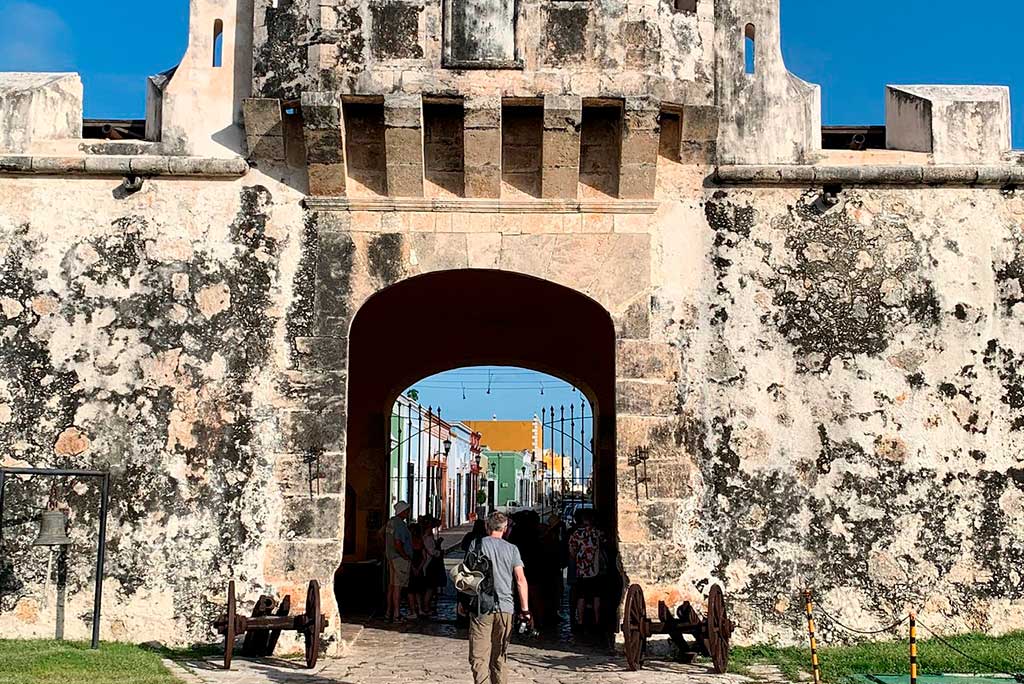 Puerta de Mar, the sea gate of Campeche’s historic fortified town
This guide explains what the gate is, how to read it, how to include it in a realistic walking route, what to combine with it, and what not to assume about opening times or access. It focuses on San Francisco de Campeche in Campeche State. Puerta de Mar is not a ruin in Calakmul, a beach in Ciudad del Carmen, or a gateway to the archaeological sites in the south of the state; it is a historic urban monument on the Gulf coast.
What Puerta de Mar is
Puerta de Mar was one of the principal access points through the walls of colonial Campeche. The Spanish settlement grew around a harbour on the Gulf of Mexico, and the gate connected the defended town with the maritime side of the city. In practical terms, it was a controlled opening in a larger barrier. The wall was not meant to make the port unreachable. It was meant to regulate movement and give defenders an advantage when the town was threatened.
The gate’s Spanish name is usually translated as Sea Gate. Locally, you may also see it described simply as Puerta de Mar, without an English translation. Use the Spanish name when asking for directions. Maps and tourism pages can vary in how they label the surrounding walls, but Puerta de Mar is a clear reference in the historic centre.
The visible structure should not be confused with a complete surviving section of the original harbour installations. The shoreline has changed, the city has expanded beyond the walls, and the gate has been altered and restored over time. What remains is valuable because it shows where the old town met the sea and because its position still makes the original urban logic legible.
The gate is not normally a large standalone museum with a long sequence of galleries. Your visit is primarily architectural and geographic. Look at the masonry, the relationship with the adjacent wall, the direction of the street, and the way the opening frames the city. If an upper wall walk or adjacent interior space is open during your visit, treat it as an additional experience rather than assuming it is always available.
A short history of the gate and the walls
Campeche’s location made it commercially useful and strategically exposed. The port connected the settlement with routes across the Gulf and the Caribbean. Timber, agricultural goods, passengers, military orders, and supplies moved through maritime networks. Those same routes could bring hostile ships. The history of Campeche’s walls is therefore tied to the value of the port as much as to the famous stories of pirates.
The city’s defensive works developed over more than one phase. Earlier protections were strengthened as attacks and military technology changed. Construction of the principal wall system took place during the late seventeenth and early eighteenth centuries, with bastions projecting from the wall to give defenders better angles along the faces and approaches. Gates were carefully placed openings within that system, not decorative entrances added after the fact.
Puerta de Mar belonged to the side of the city that faced the harbour. Its location made it the natural point for controlled movement between water and town. The route through the gate would have been busy in a working port. People crossed for trade and daily life, while guards had to monitor who and what entered the defended settlement.
The gate and wall system should be read against the broader history of colonial Campeche. The Spanish settlement occupied a region with a much older Maya history, and the port economy depended on the labour, land, and resources of the surrounding territory. A visit to Puerta de Mar is therefore not a complete history of Campeche. It is one layer: the colonial military and maritime layer. Pairing it with a museum, a church, or a later urban neighbourhood helps avoid treating the monument as if it explains everything by itself.
The Historic Fortified Town of Campeche was inscribed on the UNESCO World Heritage List in 1999. The designation concerns the urban ensemble: the street plan, colonial buildings, walls, bastions, gates, and the relationship between the town and its harbour setting. Puerta de Mar matters within that ensemble because it is a surviving threshold where those elements meet.
Restoration has also shaped the present appearance. A historic gate in a living city is repaired, maintained, and sometimes adapted for public access. Not every stone visible today should be assumed to be untouched from the first construction period. That does not reduce its importance. It means you are seeing a monument with a long afterlife, including periods of neglect, conservation, changing traffic patterns, and heritage management.
For reliable background, compare the visitor information from INAH’s description of Campeche’s historic fortified city with the UNESCO entry for the Historic Fortified Town of Campeche. These sources are more useful for the defensive system than a short caption on a social-media photograph.
How to read the monument when you arrive
Begin on the outside of the walled centre, on the side oriented toward the bay. Do not rush through the opening immediately. From this position, notice how the gate is set within the wall and how the street beyond narrows the view into the old town. The monument works as a piece of urban engineering: it makes the transition between open waterfront and defended settlement visible.
Then look at the opposite side. The same opening feels different when viewed from the city. Instead of presenting the harbour as a destination, it frames the way out of the historic centre. The change in perspective is simple but useful. A gate controls movement in both directions, and the city’s history involved people leaving for the water as well as arriving from it.
Examine the details at a human pace. Heavy masonry, the thickness of the wall, the proportions of the opening, and the way later paving meets older construction tell you more than a single dramatic photograph. Look for where the gate joins adjacent defensive elements. Notice how low colonial buildings around it contrast with the mass of the fortification.
The nearby bastions help complete the picture. Baluarte de la Soledad is a short walk away and houses the Museo de Arquitectura Maya. Baluarte de San Carlos is associated with another part of the city’s defensive circuit and provides a useful comparison. You do not need to visit every bastion in one stretch, but seeing at least one other fortification prevents Puerta de Mar from seeming like an independent monument.
The gate is also a lesson in scale. Campeche’s walls are substantial, but the historic centre is compact. A city that once needed military protection can now be crossed in a few minutes. That does not mean the walls were unimportant; it shows how closely the defensive structure was integrated into the everyday town.
Where Puerta de Mar is and how to get there
Puerta de Mar is in the Centro Histórico of San Francisco de Campeche, on the bay-facing side of the walled city. It is within the same walkable district as Plaza de la Independencia, Campeche Cathedral, Calle 59, Baluarte de la Soledad, and the route toward the malecón.
From the central plaza, walk toward the sea-facing side of the walled centre and follow the streets toward the gate. The exact turns are easy to confirm on a current map because the monument is a fixed landmark, but the historic grid can feel confusing in strong heat. If you are using a taxi, say “Puerta de Mar” and confirm that you mean the gate in the Centro Histórico of Campeche City, not a similarly named point outside the city.
From the ADO bus terminal, a taxi is the least tiring option if you have luggage or arrive during the hottest part of the day. Public transport and local taxis can bring you into the central area, after which the gate is reached on foot. Routes and stops can change, so ask locally rather than relying on an old timetable. Campeche’s historic centre is compact once you arrive, but the terminal is outside the walled district and walking the entire approach with bags is rarely worthwhile.
If you arrive by car, treat the gate as a walking destination rather than expecting to park directly beside it. Streets around the historic centre can be narrow, busy, or subject to local restrictions and event changes. Leave the car in a legal space and continue on foot. Do not block the gate, the wall, or residential entrances for a photograph.
Campeche’s heat is the main practical difficulty. The distance from the plaza may be short, but stone and paving hold heat, and there may be limited shade around exposed sections of the wall. Carry water, use sun protection, and plan a pause indoors after the gate if you are visiting between late morning and mid-afternoon.
For accommodation, the most convenient base is the historic centre or its immediate edge because you can see Puerta de Mar early, return to rest, and come back for the evening waterfront. You do not need a named hotel to choose well: compare the walking distance to the plaza, air conditioning, luggage access, noise, and current cancellation conditions. Check current Campeche City stays on Booking.com · Compare Campeche accommodation on Trip.com
Best time of day to visit
Early morning is the most comfortable time to inspect the gate. The light can be good on the stone, streets are generally calmer, and you have more energy for the rest of the historic centre. Morning also lets you combine the gate with the cathedral, Plaza de la Independencia, and a museum before the strongest heat.
Late afternoon is another good choice, especially if you want to continue toward the malecón at sunset. The light changes the colour of the masonry and the surrounding façades. However, sunset times, weather, and local activity vary, so do not assume that every upper wall area or interior access point remains open late.
Midday can work if the gate is one stop in a museum-heavy itinerary, but it is the least pleasant time for a long wall walk. Use the monument as a short architectural stop, then find shade or an air-conditioned indoor attraction. Campeche is easier when you plan around the climate instead of trying to prove that every attraction can be covered continuously.
Opening conditions deserve a careful distinction. The public street and exterior view of Puerta de Mar are different from any ticketed wall walk, exhibition, performance, or nearby fort interior. Schedules can change with conservation, public events, weather, or municipal decisions. Do not promise a particular light show, rooftop route, or daily operating time based on an old travel post. Check current local information close to your visit and ask at the tourist information point or the relevant monument entrance.
A practical Puerta de Mar walking route
A useful first route takes about half a day at an unhurried pace, with longer time if you enter museums or stop for a meal. Start at Plaza de la Independencia, where the cathedral and the surrounding façades give you orientation. From there, walk through the historic streets toward Puerta de Mar. Take photographs from both sides, read any current interpretation panels, and pause to understand the gate’s position in the wall.
Next, continue along the bay-facing edge and connect the gate with the malecón. This is where the city’s historic and modern maritime identities meet. The malecón is not part of the walled gate itself. It is a broad waterfront corridor outside the intimate colonial grid, with open views across the Gulf and a different rhythm of walking. The separation is important: Puerta de Mar is a defensive threshold; the malecón is a public shoreline promenade.
After the waterfront, return through the historic centre by a parallel street rather than retracing every step. Follow the direction of Calle 59 for orientation, but explore a quieter cross street when the traffic and restaurant frontage become busy. You will see how the centre changes from commercial visitor corridors to residential blocks.
Make Baluarte de la Soledad your main museum stop if you want to extend the history. The Museo de Arquitectura Maya presents objects and architectural elements from Maya sites in Campeche State inside a colonial defensive building. That pairing is especially helpful for understanding that the city’s colonial walls are one historical layer, not the beginning of the state’s story. Check current museum hours and entry conditions separately; do not assume they match the outdoor gate.
Finish near the central plaza or Calle 59 for food and a rest. Choose a current menu rather than relying on a list of businesses that may have changed. If you return to Puerta de Mar in the evening, you can see the gate under different light and then continue to the waterfront. This second pass should be about atmosphere and orientation, not a separate duplicate attraction section in your itinerary.
If you prefer a guide for the first walk, a verified option is Campeche: Historic City Center Guided Walking Tour on GetYourGuide. It is listed as a walking experience covering the historic centre and related sights; check the current language, meeting point, duration, and availability. Viator’s Campeche walking-tour inventory is a useful comparison page for current guided options. A guided walk is most worthwhile at the start of a stay, when the city’s defensive vocabulary can make every later street easier to interpret.
Puerta de Mar and the other city gates
Puerta de Mar is usually compared with Puerta de Tierra because the two gates mark opposite sides of the historic centre. That comparison is useful, but the monuments do not offer identical experiences.
Puerta de Mar faces the harbour and the Gulf. Its value comes from the maritime relationship: the movement between water and town, the view through the gate, and the connection with the malecón. It is the natural gate to combine with a waterfront walk and the bastions toward the sea-facing side.
Puerta de Tierra sits on the inland side of the walled city. Its defensive features, moat, and relationship with the landward approach make the military logic more immediately visible. It is a stronger stop if your main interest is how an entrance could be protected from an attack over land. Current access to any interior or wall section can change, so inspect the exterior even if a particular program is not running.
Walking between the two gates along or near Calle 59 gives you a simple way to understand the city’s shape. The route is not a replacement for exploring the side streets. Treat it as a spine that helps you return to the plaza, bastions, churches, and museums. If the heat is high, split the two gates across morning and evening rather than forcing a continuous walk.
Other bastions add detail to the circuit. Baluarte de la Soledad is particularly convenient from Puerta de Mar and contains the Museo de Arquitectura Maya. Baluarte de San Carlos and other surviving fortification elements help show that Campeche was protected by a network, not by two attractive gates alone. The existing Campeche historic-centre guide and Baluarte de la Soledad guide are useful companions when planning the full circuit.
 Puerta de Tierra on the inland side of Campeche’s walled city
What to photograph
The strongest photographs usually explain location rather than isolate decoration. From outside the gate, include enough of the wall or adjacent street to show that Puerta de Mar is part of a fortified town. From inside, frame the opening toward the colourful low-rise streets. A photograph of the gate without context could be almost anywhere; a photograph that includes the passage, wall, and city grid tells the story more clearly.
Morning light is useful for architectural detail. Late afternoon works for the transition between stone and sky, particularly if you continue toward the bay. Avoid standing in the roadway or blocking pedestrians. The gate is a public urban passage, not a private photo studio.
Look for contrasts: old masonry against painted façades, the controlled opening against the broad Gulf horizon, and the defensive mass against the ordinary activity of the centre. These contrasts are more distinctive than trying to reproduce a postcard angle.
A second image can focus on the adjacent wall or a view through the gate. Do not label a wall view as the malecón unless the promenade is actually visible. Campeche City’s malecón is the Gulf-facing waterfront outside the walled centre; it is not the same place as the inland defensive wall or a street inside the gate.
For a wider city context, the Campeche Cathedral guide can help you place the plaza and the religious architecture in the same walk. The cathedral is close enough to combine with Puerta de Mar, but it is a separate monument with its own access and worship etiquette.
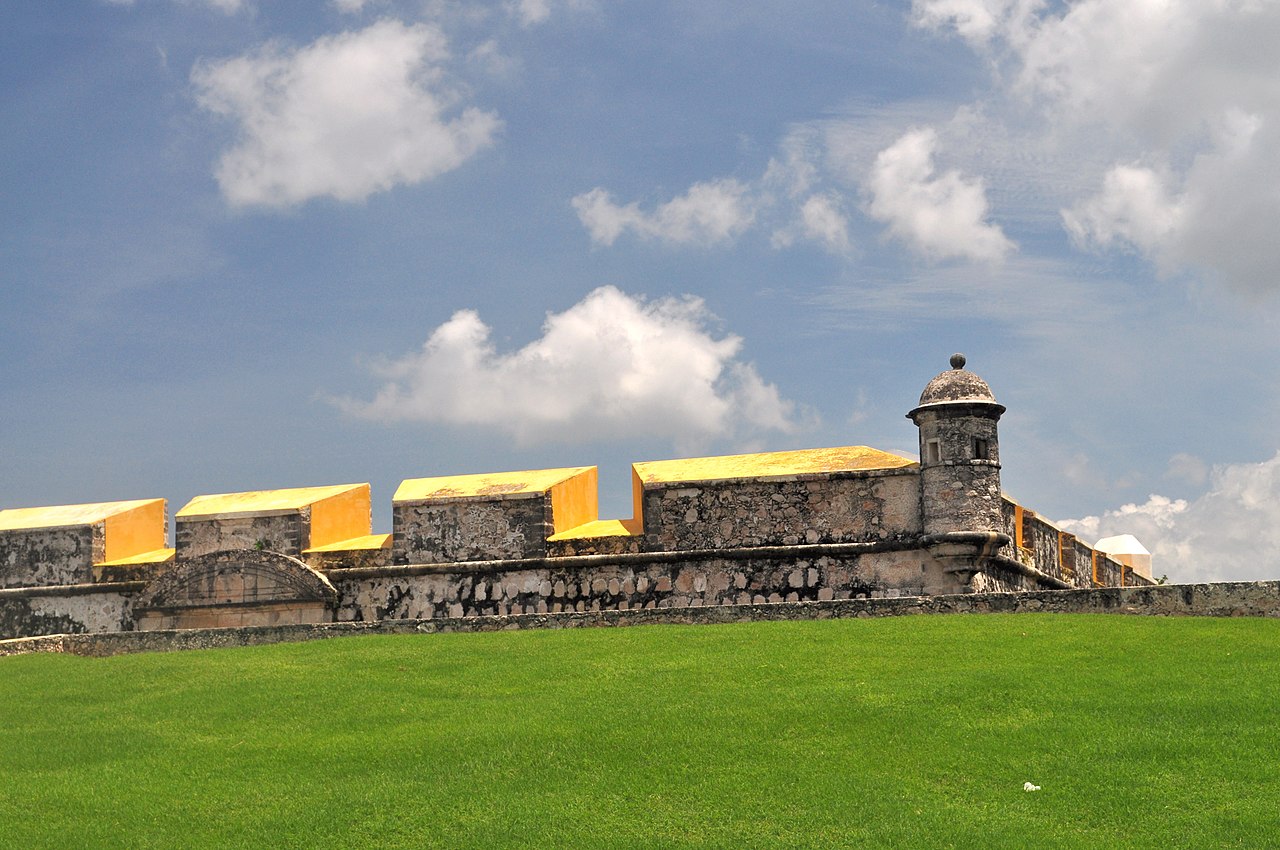
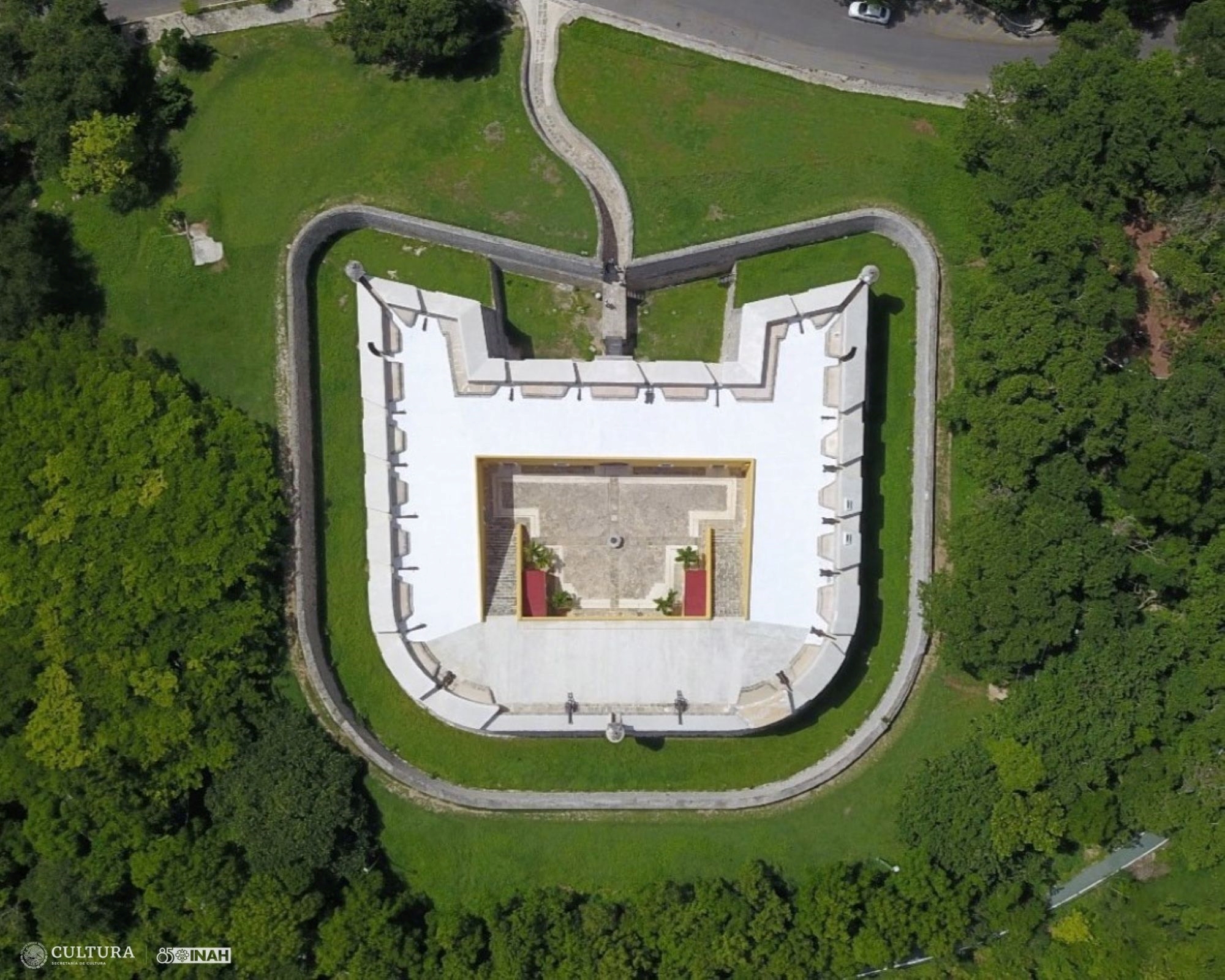 Fuerte de San Miguel on the hill above Campeche City
How long do you need?
For a quick orientation, allow roughly thirty minutes to see the exterior, pass through, photograph both approaches, and read the surrounding streets. That is enough if Puerta de Mar is one stop on a larger city walk.
For a more useful visit, allow one to two hours. This gives you time to compare the sea and city sides, walk along nearby fortifications, and connect the gate with the plaza or malecón. It does not include a long museum visit or a meal.
For a half-day historic-centre route, combine Puerta de Mar with Plaza de la Independencia, the cathedral, Calle 59, one bastion museum, and a section of the waterfront. Add breaks. The route may be geographically short, but heat, photographs, interpretation, and museum pacing all extend the day.
A full day is reasonable if you want the gate, both city gates, several bastions, a museum, the central streets, and the malecón without rushing. It is not necessary to visit every fortification in one day. A thoughtful selection gives you a clearer understanding than a checklist of monuments viewed from outside.
Accessibility, children, and mobility
The public approach to Puerta de Mar is at street level, but the surrounding historic streets may include uneven paving, thresholds, narrow sidewalks, and traffic. If you use a wheelchair, walker, or stroller, check the route in advance and ask locally about the easiest approach. A companion can help where pavement is irregular, but do not assume that every wall walk or upper level is step-free.
For children, the gate works well as a short visual history lesson. Ask them to identify what the wall protects, what lies on each side, and why a city would need a controlled opening. The nearby plaza provides a natural pause. Avoid turning the walk into a race between monuments; heat and traffic can make a slow route safer and more enjoyable.
Older visitors and anyone sensitive to heat should schedule the gate early or near sunset and use taxis for the longer transfers between the terminal, hotel, and centre. Carry water and take indoor breaks. The city is walkable, but walkable does not mean cool or universally smooth underfoot.
Food, rest, and practical manners
Puerta de Mar sits close to some of the busiest visitor streets in Campeche, but the best choice of where to eat depends on the current day and your needs. Look for a menu with clear prices, consider whether the room has shade or air conditioning, and allow time rather than trying to eat between two fixed attractions. Campeche’s local cooking includes seafood and regional dishes, but no single restaurant recommendation is necessary to enjoy the area responsibly.
Carry small cash for minor purchases or public facilities, while keeping cards available for businesses that accept them. Payment practices change by establishment. Do not photograph people closely without permission, particularly workers, vendors, and religious visitors around the cathedral or churches.
Dress for a hot coastal city and for a historic district where you may enter religious or cultural buildings. Light clothing, comfortable walking shoes, sun protection, and a layer for heavily air-conditioned rooms are practical. If you visit during rain, stone surfaces can become slippery and the waterfront can feel exposed; adjust the route rather than forcing the whole circuit.
Common mistakes to avoid
The first mistake is treating Puerta de Mar as a standalone fort. The gate makes sense only with the wall, bastions, harbour side, and street grid around it. Spend a few minutes looking away from the most photographed façade.
The second is confusing the gate with the malecón. The gate is a historic passage in the walled town. The malecón is the open waterfront promenade outside the wall. Visit both, but describe them accurately and allow for the different walking conditions.
The third is believing an old schedule without checking. Outdoor access, museum hours, wall walks, performances, and temporary closures can change. Verify current conditions close to your visit and keep the exterior route as a useful fallback.
The fourth is attempting the whole fortification circuit at midday. Campeche’s centre is compact, but the sun is strong. A shorter morning route followed by an indoor stop is better than a longer route that leaves everyone exhausted.
The fifth is reducing the history to pirates alone. Attacks are part of the story, but the gate also reflects trade, colonial administration, harbour labour, engineering, conservation, and the transformation of the city after its military purpose changed. Read the monument as infrastructure, not only as a dramatic backdrop.
Is Puerta de Mar worth visiting?
Yes, particularly if you are already exploring Campeche’s historic centre. It is a short, accessible-to-most introduction to the city’s relationship with the Gulf and one of the clearest places to see how a colonial gate connected the harbour with the defended town. It does not require a separate day, and it becomes substantially more meaningful when paired with Puerta de Tierra, Baluarte de la Soledad, the cathedral, or the malecón.
It may feel too brief if you expect a large museum, a long interior tour, or a preserved pirate ship. In that case, build the visit around the complete fortified town and add a museum or guided walk. The gate is a beginning and a point of orientation, not the whole history of Campeche.
The most rewarding plan is simple: arrive early or late in the day, see both sides of the gate, follow the wall toward one other bastion, walk through the historic grid to the plaza, and continue to the Gulf waterfront when the heat softens. That sequence lets Puerta de Mar remain what it is—a real urban threshold—while giving you the wider Campeche context that makes the monument worth remembering.
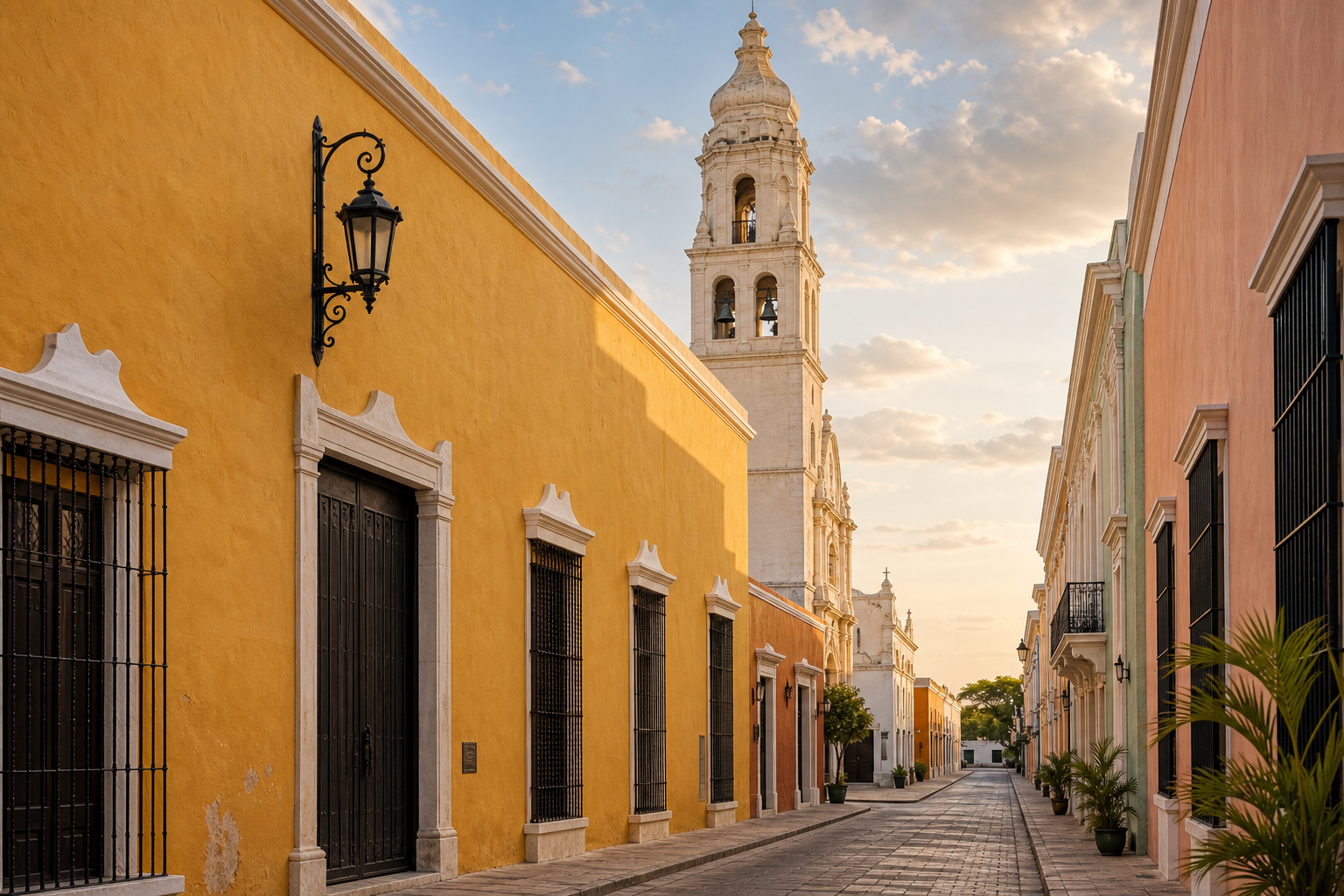
 A colourful historic-centre street near Puerta de Mar in Campeche
If you are booking a wider city experience, compare the current GetYourGuide Campeche walking options with Viator’s Campeche sightseeing inventory. For an overnight visit, check current Booking.com rates for Campeche City and Trip.com hotel availability, then choose the base that makes an early historic-centre walk realistic. Puerta de Mar is easiest to appreciate when it is part of a calm day in the walled city, not a rushed photograph between long-distance transfers.
Frequently asked questions
Is Puerta de Mar free to see?
The exterior and public street passage can be viewed as part of the historic centre. Any ticketed interior, wall access, museum, or special event is a separate question. Check current local information rather than assuming that every part of the fortification has the same access policy.
Is Puerta de Mar open at night?
The surrounding public streets may remain active after dark, but monument access and any upper wall route can have different conditions. Visit in daylight for architectural detail, and check locally if you plan an evening pass.
Can you walk from Puerta de Mar to Puerta de Tierra?
Yes. The two gates are within the compact historic centre and can be connected on foot, often using the direction of Calle 59 for orientation. Take water and split the walk if the heat is strong.
Is Puerta de Mar near Campeche Cathedral?
Yes. The cathedral and Plaza de la Independencia are within the same historic-centre walking route. They are separate monuments, so check worship etiquette and any current access restrictions at the cathedral.
Should you visit Puerta de Mar before Calakmul?
If your trip includes both, Puerta de Mar is a useful city introduction to Campeche’s colonial and maritime history, while Calakmul requires a separate journey into the southern jungle. Do not plan them as the same day. The distances and landscapes are completely different.
Is there a guided tour of Puerta de Mar?
Some city walking tours include Puerta de Mar among the historic-centre sights. Listings change, so compare the current GetYourGuide and Viator pages linked above and confirm the route before booking. If no suitable product is available on your dates, an independent visit is straightforward with a current map and the surrounding fortifications as context.
What should you see after Puerta de Mar?
The best nearby choices are the central plaza and cathedral, the streets around Calle 59, Baluarte de la Soledad and its Maya architecture museum, Puerta de Tierra, or the Campeche malecón. Choose one or two based on the weather rather than trying to collect every stop.
Is Puerta de Mar in Campeche City or Calakmul?
Puerta de Mar is in San Francisco de Campeche, the state capital on the Gulf coast. Calakmul is far to the south inside the jungle region and requires a separate transport plan. The two destinations belong to the same state but offer entirely different travel experiences.
How should you plan the visit in hot weather?
Go early or near sunset, carry water, wear comfortable shoes, and use indoor museums or a hotel break during the hottest hours. A short gate visit combined with a shaded plaza and one museum is usually more enjoyable than a continuous midday fortification walk.
Puerta de Mar rewards attention more than time. Look through the opening, then look back at the wall and the street behind you. In those two views, Campeche’s maritime setting, defensive history, and living historic centre come together.